A richly illustrated sourcebook of Indian spirituality in question-and-answer form, exploring how to know the Divine, honor all creation and see God everywhere, in everyone. Read by Professor Harish Vyas
A richly illustrated sourcebook of Indian spirituality in question-and-answer form, exploring how to know the Divine, honor all creation and see God everywhere, in everyone.
Author By Satguru Sivaya Subramuniyaswami Note: This audio includes 18 of his original recordings and the rest are a professional AI clone of his voice.
Every spiritually-inclined human being will be enriched by the path revealed in this extraordinary book. India’s tolerant and diverse vision of the Divine is all here: meditative, devotional, philosophical, scriptural and yogic, answering the vital questions:
What are life’s ultimate goals? How can I achieve them? How do Hindus view family, sex, sin, worship, death and nonviolence? What are the foremost schools of Hindu thought, and what do they teach? How do all the great religions look at God, salvation, heaven and hell? How did Hinduism evolve through history? What do we teach to children?
Dancing with Siva is Book One in the Master Course Trilogy of Sivaya Subramuniyaswami, a traditional satguru who guided the global Hindu renaissance for half a century, named by Delhi’s World Religious Parliament as a gifted Jagadacharya, or world teacher.
As announced earlier, we have professionally cloned Gurudeva’s voice based on hours of Merging with Siva lessons he recorded in the late 1990s. We have completed generating the remaining lessons of Merging with Siva in his cloned voice, and we have completed about 5/6 of the 365 lessons in Living with Siva.
Right now the audio files are appearing in the daily Master Course lessons on our website and in the daily email version if you are signed up for that. We are also going to present each book as a audiobook on our website. In this context, we want to generate additional parts of the book. For Merging with Siva, this means generating the Introduction, the resource section called Cognizantability, and the Conclusion. We just recently generated the Introduction, which lasts an impressive one hour and twenty minutes. Here it is–
The Introduction contains some thoughts not found anywhere in the 365 lessons, such as this section called “Nine Ways of Merging with Siva”–
Nine Ways of Merging with Śiva
Merger—that is what this book, the third book in the trilogy of Dancing with Śiva, Living with Śiva and Merging with Śiva, is all about. Some of the big questions about something as wonderful as becoming one with the universe or with God are: Is merger something to accomplish in this lifetime, or shall we put it off to another round? Is merger something that can be achieved even in future lives, or should we consider that it might never happen, or that it just might happen unexpectedly? Is merger with Śiva complete annihilation, an undesirable nothingness that we should delay as long as possible? Shall we cease all striving for realization and wait for mahāpralaya, the end of the universe, the Great Dissolution commanded by Lord Śiva, when every soul, young or old, merges in the All of the All—no exceptions, no one left behind, the ultimate perk of the Divine Cosmic Drama, the guarantee of final merger of every soul? Fortunately, the next Big Bang may happen after Śiva gets lonely dancing by Himself and starts His creation all over again.
Merger on the great inner path described in this book is already happening in your life and in the life of every soul on the planet, in the natural course of evolution. In Sanskrit, we express “Merging with Śiva” as Śivasāyujya, “Intimate union with the Divine.” Nine progressive ways of merging with Śiva are possible today, in fact impossible to avoid. Shall we now explore these nine ways, the wonderful ways of merging with Śiva as we walk the San Mārga, the straight path of dharma?
A jīva, or soul, merges with his potential mother who gives a physical body to which his astral body is attached. This is the first merger. Then, when his first guru, the parents, train him to quell the instinctive mind and become a producing member of the family and the social and global communities, the second merger occurs. Why should these two developments be related to merging with the Supreme? It is because Śiva is the life of our lives, as the venerable saints teach. Śiva is the life of the life of all sentient and insentient beings, the sea of prāṇa, ever emanating, mysteriously, from the All of the Allness of His mystery Being, by which all life exists and all happenings happen. Therefore to merge energies with all other humans without making differences is to find Śivaness in all and within all.
Having merged with the biological and social worlds, it then is for the young jīva, embodied soul, to be introduced by the parents to the family guru for spiritual training. Obedience and devotion to the guru is again another merger into Śivaness, for the satguru is Sadāśiva, or Śiva in form, having realized Śiva in Formlessness. It is from the satguru’s constant, silent emanation that the śishya thrives, as do flowering trees, bushes and vines thrive and grow from the sun’s silent rays and the occasional showers of rain. No words need be spoken, for both śishya and guru know the same—the śishya having had his training in scripture, divine inspiration of song, meaning and dance from his first guru, the parents.
Having walked the San Mārga through the charyā and kriyā mārgas, and having disciplined mind and emotions, the śishya is ready for the fourth merger into Śivaness. This is accomplished through art, calligraphy, drawing divine forms, writing out scripture in one’s own hand and depicting through drama, by learning and playing music, by having all bodily currents move into the rhythm of the sounds of nature, for nature is nāda in the external. It has its own choreography, and this merger is with Naṭarāja, Lord of the Dance. It is also the merger with knowledge of all kinds, of language and mathematics, of the many sciences and arts.
The fifth merger is deeper: endeavoring to penetrate the intuitive world, communing with nature, encountering the many dreams, visions and other mystical experiences that await the seeker of Truth. It is merger with the selfless life, of seeing oneself in others, and others in oneself, of losing the barriers that divide one from another, and the internal world from the external world. It is living a harmonious life with a heart filled with love, trust and understanding for all, desiring to give rather than wanting only to receive. The light that lights each thought picture when traced to its source is the sixth merger—the yoga of detaching awareness from that which it is aware of and being the light that lights the thoughts, rather than claiming identity as being the thoughts, then tracing this light of the mind out of the mind into the beyond of the beyond. Yea, this is the sixth way we merge into the Divine. The Lord of the Dance emanates His own lighting effects, does His own choreography, creates His own music and enjoys, as the audience, His own performance.
The seventh merger is into the nāda-nāḍī śakti, that unrelenting sound heard as an inexplainable “eee,” of a thousand vīṇās being played simultaneously by Vīṇādhāra, another form of Lord Śiva, the maker of sound, the composer of the symphony. The nāda is traced to its source, deep within the within, the city of a thousand lights and sounds, for sound is light and light is sound in this sphere of Satchidānanda, all-pervasive oneness with all form, the Self flowing through the mind, untouched by it, yet sustaining it in a mightily mysterious way.
The eighth merger with Śiva is Paraśiva. Becoming and being timeless, formless, spaceless is the total transformation of the soul body, the mental body, the astral body, the prāṇic body and the physical body. It is the breaking of seals which subsequently makes changes never to be repaired. A new, an entirely new, process begins. It is the ultimate healing of all karmas, the ultimate knowing of dharma.
And now, lastly, once the soul evolves out of the physical, prāṇic, emotional, mental and causal sheaths—annamaya, prāṇamaya, manomaya, vijñānamaya and ānandamaya kośas—and they are needed no more, it evolves into viśvagrāsa, the ninth and final merger with Śiva, as an infant effortlessly becomes a child, a child a youth and a youth an adult. Yes, the soul, jīva, encased in five bodies, is indeed merged into the emanator, preserver and absorber of the inner and outer universes as simply as a drop of water merges into the ocean, never to be found again. This is the timeless path the holy Vedas of the Sanātana Dharma proclaim. As a seed becomes a bud, and a bud becomes a flower, these nine steps of spiritual unfoldment are inevitable for all humankind. A parallel analysis known as dasakariyam, “ten attainments,” is found in ancient Tamil texts.
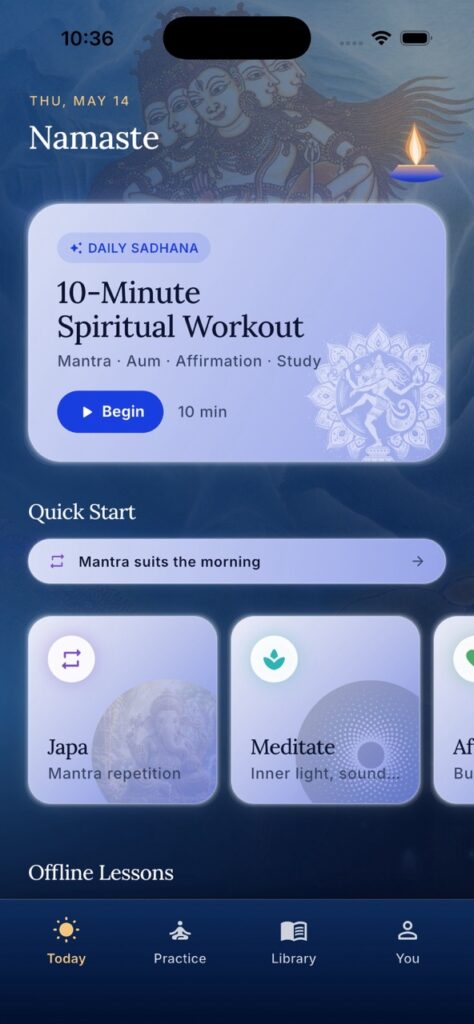
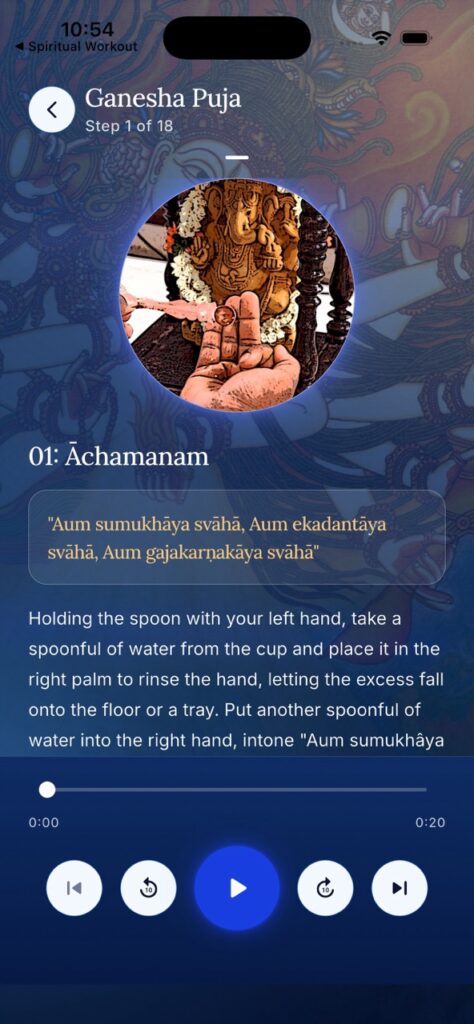
Today we have just rolled out a complete rebuild of the Spiritual Workout App for iOS! Android users will be receiving their update next week.
So if you have an Apple device, you should be able to use it today. If you have the previous version already, it might auto-update, or you can go to your app store and search for it to download it or update it manually.
What’s New
A complete rebuild — refreshed look, smoother feel, and several new ways to deepen your daily practice.
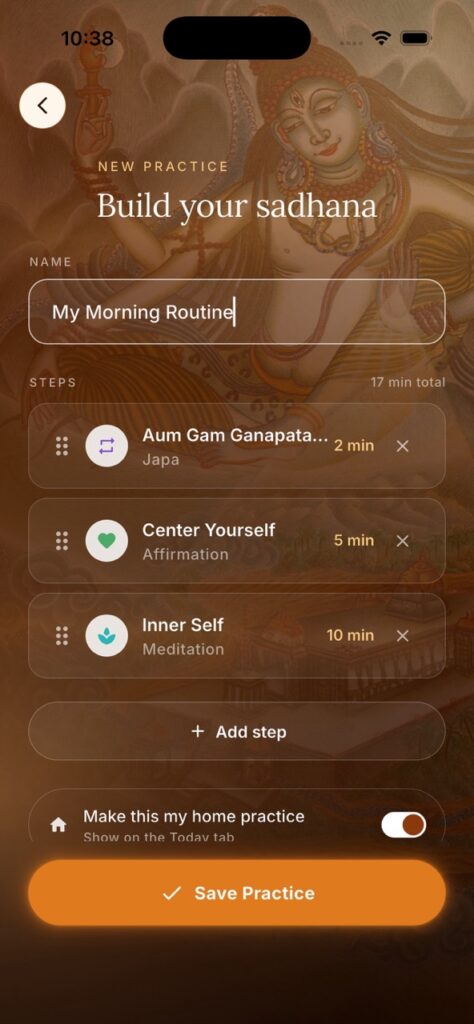
Custom Routines — design your own daily sequence, with the practices and durations of your choosing
Custom Affirmations — write your own alongside the built-in ones
Journal — capture insights and reflections after each practice
A daily reflection from Gurudeva on the home screen
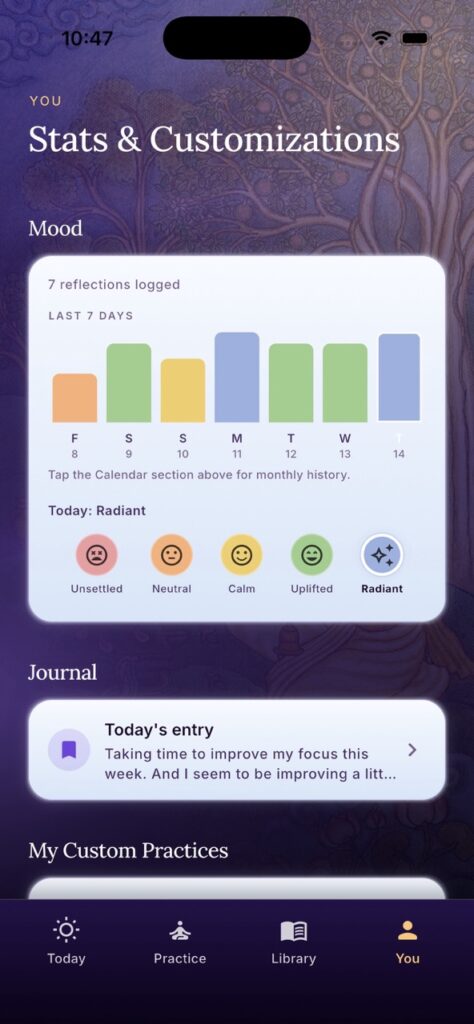
Practice insights, a 14-day mood chart, and a quiet heatmap of your year
Multiple color themes to suit your mood and surroundings
Gentle daily reminders, and an optional Face ID lock for privacy
Fully offline. No ads. No tracking. A refuge to return to each day.
More info from our App Store Description:
While today nearly everyone appreciates the need for daily exercise to stay fit and healthy, many don’t realize the need to maintain a balanced spiritual life through daily practices. The Spiritual Workout is designed for Hindus — and for those who consider themselves Spiritual But Not Religious — who would like to maintain a daily spiritual practice but may not always have much time to give to spiritual well-being.
The app offers a range of practices drawn from the Saiva Hindu tradition:
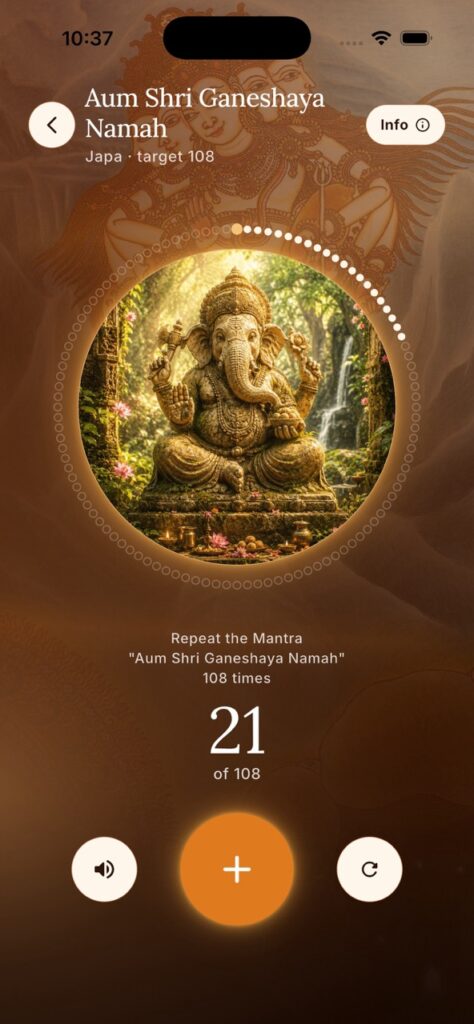
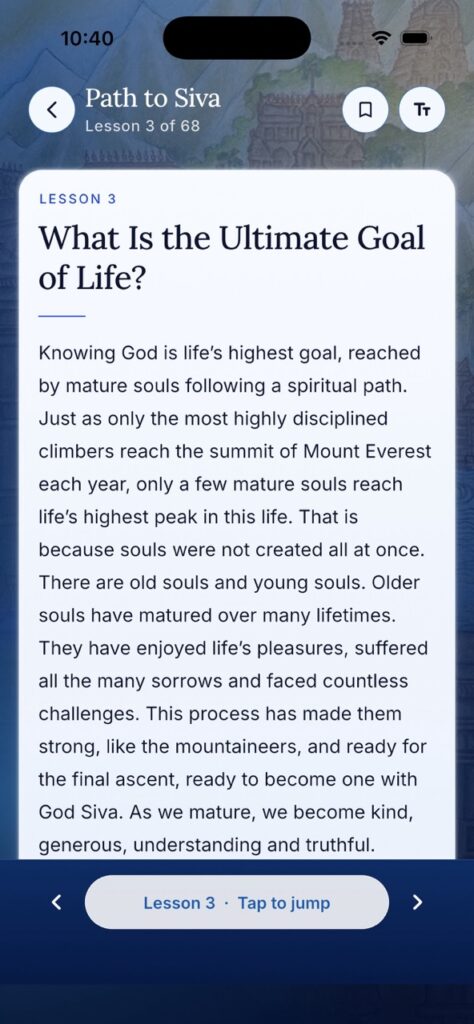
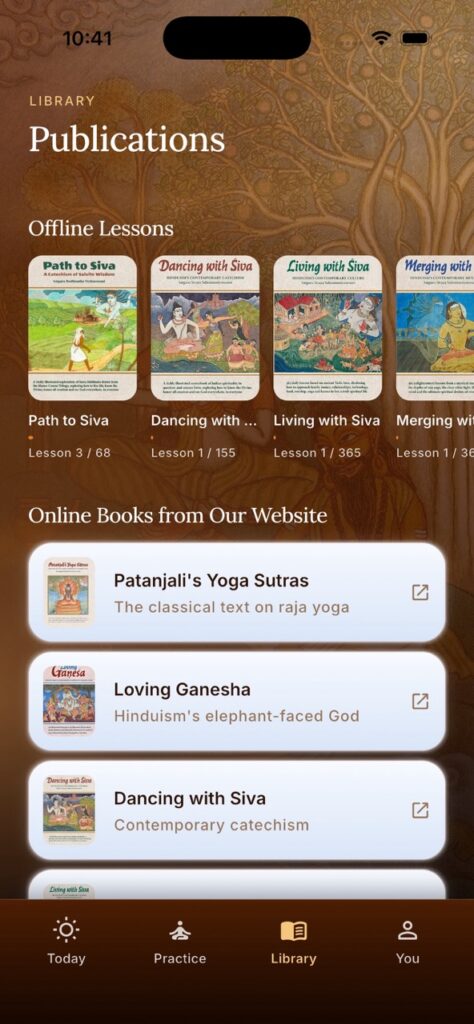
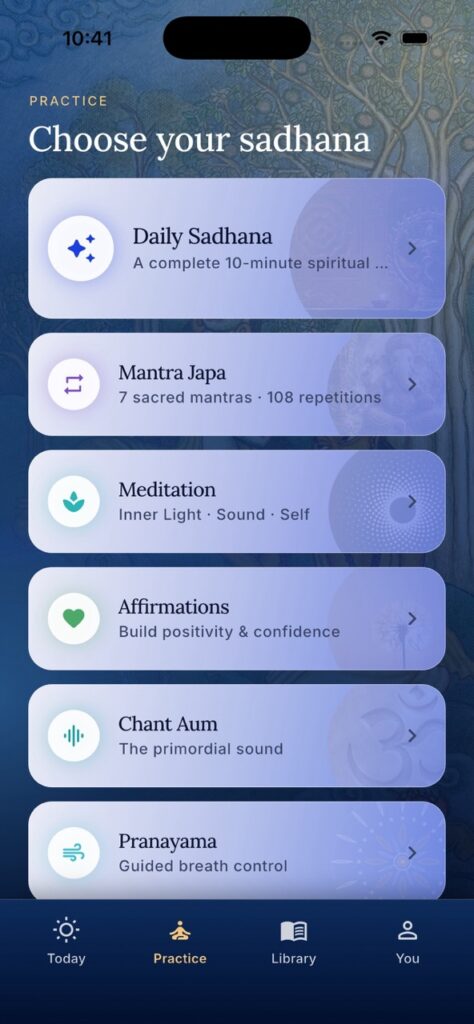
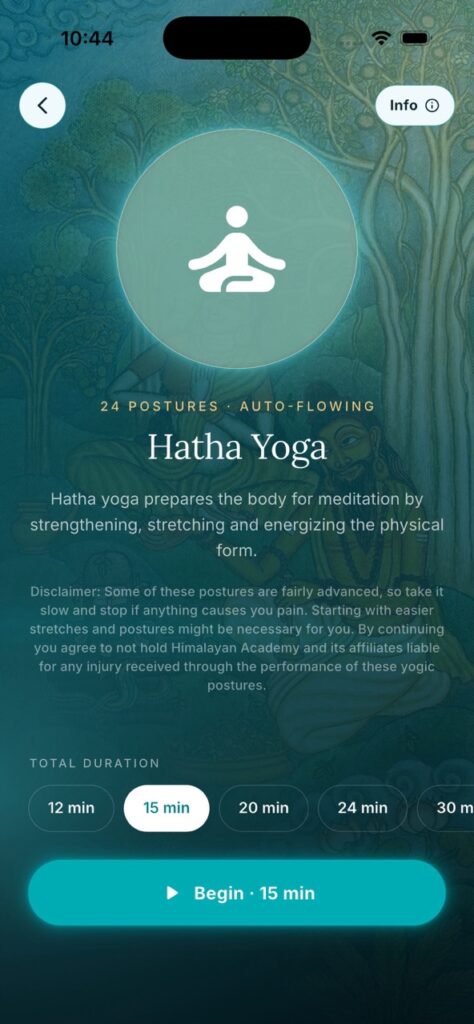
— Japa: mantra repetition — Meditation: guided sessions of several lengths, with optional voice guidance — Affirmations: built-in affirmations to gently reprogram the subconscious mind, plus the ability to add your own — Aum Chanting: the most fundamental of all mantras — Pranayama: a simple but powerful breathing practice — Hatha Yoga: gentle posture sequences — Ganesha Puja: a complete home worship with step-by-step audio guidance — Chanting: Learn several complex Sanskrit mantras — Study: four important Himalayan Academy publications — Path to Siva, Dancing with Siva, Living with Siva, and Merging with Siva — available offline, with bookmarking and adjustable text size
For those new to spiritual practice — or for busier days — the 10 Minute Sadhana combines several practices into one short daily routine. You can also build your own custom sequences, combining any practices in any order, with the durations you choose.
Spiritual Workout works offline, contains no ads, and tracks nothing about you off your device. It is offered as a refuge — a place to return to each day, not a streak to maintain.
The morning begins with a 5:30am Siva Homa in Kadavul Temple
Many written prayers to the Devas and Mahadevas were submitted. Satguru adds them to the flame.
Afterwards, everyone sits to listen to a talk from Satguru
Today Satguru focused on a passage from Gurudeva about Nirvakalpa Samadhi
The previous season’s flag is ready to be replaced
Everyone parades along the cliffs edge towards the flagpole
Iraivan Temple always looks nice in the morning light
Everything does, actually.
Satguru detaches the old flag
The new orange flag of the Nartana Ritau is raised
Aum Namah Śivaya
Happy New Year of Parabhava!
This samvatsara (year) is commonly associated with a theme of dissolution and transformation. Para (परा): “away,” “beyond,” “off,” “reversed” — a prefix indicating reversal, opposition, or loss; bhava (भव): “being,” “becoming,” “existence,” “state” (from the root bhū, “to be”). Taken together it references a “reversal of the current state of being” often stated as a “downfall which leads to its opposite.” Sounds like a good time for spiritual growth!
Today our monks began the day with our seasonal homa and a parade out to our flagpole. They raised the new dvaja for this spring season and for the new year as the Sun enters Mesha (Aries).
Here follows the passage from Saiva Dharma Shatras about how we should approach this new season:
Nartana Ritau, the season of Dancing with Siva, begins on Hindu New Year. This is the period of creation, the warm season, from mid-April through mid-August. The key word of this season is planning. The colors are orange, yellow-gold and all shades of green–orange for renunciation, yellow-gold for action, and green for regeneration. High above, the main Hindu flag flies the color orange, heralding the Nartana Ritau throughout this season, symbolizing sadhana and self-control. The other colors adorn smaller flags. This is the season of giving special attention to those in the grihastha ashrama. It is a time of awakening, renewal, review. The emphasis is on seeing ahead, planning for future years. It is a time of planning retreats and other activities for youths and adults for the entire year. During this time of looking forward, the Church’s six-year plan is updated by the Guru Mahasannidhanam and stewards and another year added. The Saiva Dharma Shastras are studied; and any needed additions in supplementary manuals, representing new growth, are made.
The practical focus is completion of unfinished projects. Secular holidays to observe among the families include Mothers Day in May, Fathers Day in June and Grandparents Day in August. In the monastery intensive cleaning of buildings and grounds takes place. New clothing is issued and old garments mended.
This season of harvest and new growth is also the time to review and reestablish picking and planting routines for the gardens. It is a time for ordering seeds and plants for the year, of planting trees, fragrant vines and the annual crop. Review is made for scheduling the care of all realms of the Aadheenam. Kadavul temple and the Guru Temple are cleaned and renewed during this season, and the adjacent grounds receive special, abundant attention.
The daily sadhana is the Sivachaitanya Panchatantra: experiencing nada, jyoti, prana, shakti and darshana. In Sanskrit, it is a time of learning new shlokas and mantras. Shrine rooms are renewed and redecorated for the year, and the clothing of all is renewed in the Hindu style of the current fashion. It is a time of doing things for others, religious outreach. In the missions, Nartana Ritau is the time of bringing in new students and Church members. It is a time of hatha yoga and philosophical teaching.
The main festival of Nartana Ritau is Guru Purnima. The mathavasis hold special conclave on Vaikasi Vishakham, the full moon day of May.
Recently, Madan Ganesh from Bengaluru created a small web app that specialized in playing Master Course audio lessons. Note that it currently draws on the formerly non-Gurudeva-narrated version of Dancing with Siva audio lessons, but that will be updated in the near future. You can access it here or click the image below.