
The Power of Nature
November 16, 2017Henry David Thoreau spent two years of his life alone in nature. He left society, built his own shack from lumber and grew his own food. His reflections have been archived in his short book, Walden, and can be accessed by anyone thanks to the internet.
The profundity of his realizations aren't solely that he himself had them but also because of who he was. Thoreau's education level--being a Harvard graduate with a masters--was far beyond what most people imagine a woodsman to be. His renunciation for a short time, sheer handyman ability and spontaneous farming mission is nothing short of mysteriously divine. An avid follower of the Vedas, Thoreau credited Eastern wisdom of the Hindu to be supreme.
Since our word of the week is Abstemious, Thoreau comes to mind as a man who cultivated a massive amount of moderation in his life. He says of his time alone in the woods,
"I went to the woods because I wished to live deliberately, to front only the essential facts of life, and see if I could not learn what it had to teach, and not, when I came to die, discover that I had not lived. I did not wish to live what was not life, living is so dear; nor did I wish to practice resignation, unless it was quite necessary. I wanted to live deep and suck out all the marrow of life, to live so sturdily and Spartan-like as to put to rout all that was not life, to cut a broad swath and shave close, to drive life into a corner, and reduce it to its lowest terms, and, if it proved to be mean, why then to get the whole and genuine meanness of it, and publish its meanness to the world; or if it were sublime, to know it by experience, and be able to give a true account of it in my next excursion. For most men, it appears to me, are in a strange uncertainty about it, whether it is of the devil or of God, and have somewhat hastily concluded that it is the chief end of man here to "glorify God and enjoy him forever."
The awe and fascination that nature can deliver is something we all need to observe and experience at some point in our incarnation. Nature can be thought of as the honey produced by the honeycomb of creation. If we are to fully understand why we should even be moderate, then we must explore the deeper caverns that life has to offer.
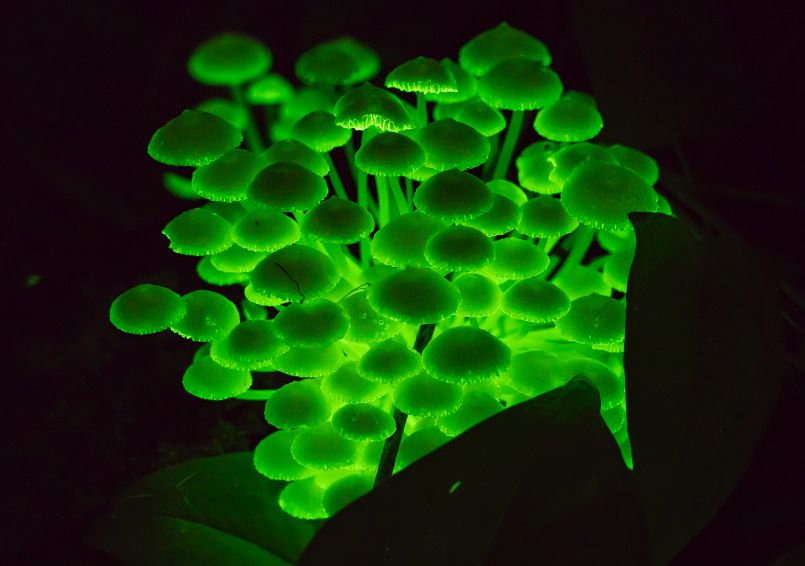
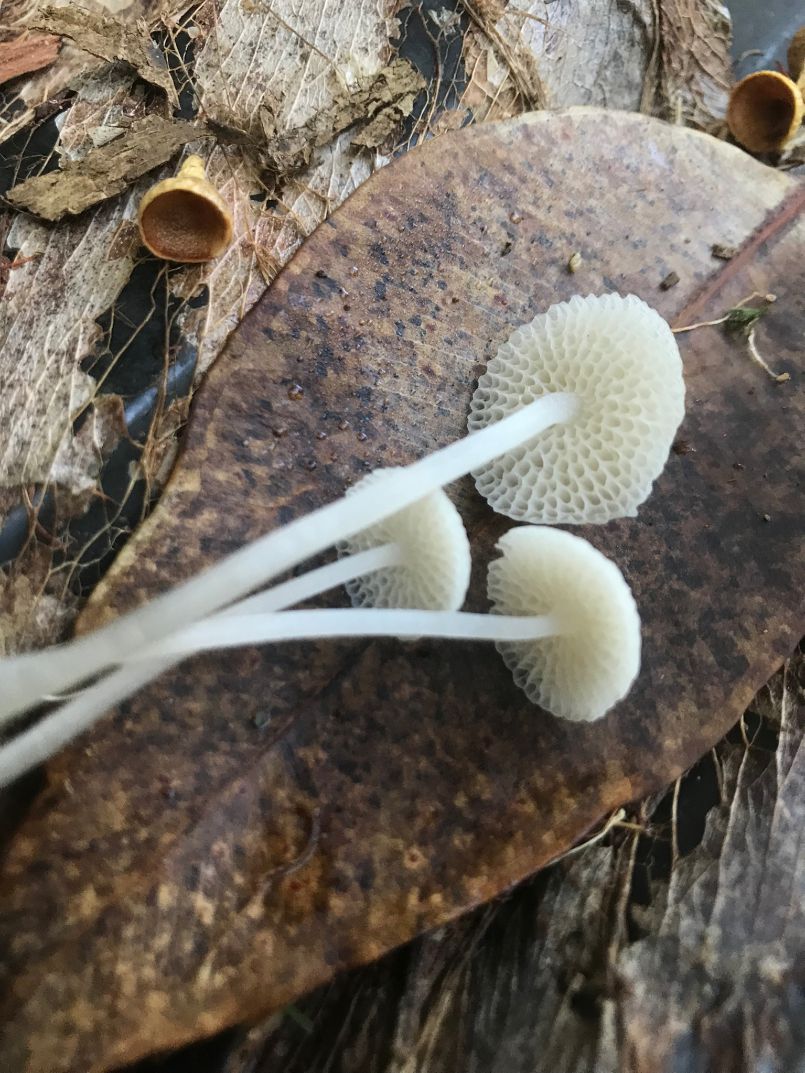
I suppose these mushrooms that glow in the dark have spurred some sort of awe in myself. Such a fragile creature of life has come from something that has died. In this way we see a full circle and can step away from the myopic day to day of everyday life. As the monastics enter our short retreat from the world, we suggest you also retreat and use the weekend to get away from it all and, as Thoreau would say, "Not till we are lost, in other words, not till we have lost the world, do we begin to find ourselves, and realize where we are and the infinite extent of our relations."
\" There was something cosmical about it; a standing advertisement, till forbidden, of the everlasting vigor and fertility of the world. The morning, which is the most memorable season of the day, is the awakening hour. Then there is least somnolence in us; and for an hour, at least, some part of us awakes which slumbers all the rest of the day and night.\" Henry David Thoreau
\" Perhaps the facts most astounding and most real are never communicated by man to man. The true harvest of my daily life is somewhat as intangible and indescribable as the tints of morning or evening. It is a little star-dust caught, a segment of the rainbow which I have clutched.\"
\"That man who does not believe that each day contains an earlier, more sacred, and auroral hour than he has yet profaned, has despaired of life, and is pursuing a descending and darkening way.\"
\" If the day and the night are such that you greet them with joy, and life emits a fragrance like flowers and sweet-scented herbs, is more elastic, more starry, more immortal,--that is your success. All nature is your congratulation, and you have cause momentarily to bless yourself.\"
\"I believe that every man who has ever been earnest to preserve his higher or poetic faculties in the best condition has been particularly inclined to abstain from animal food, and from much food of any kind.\"
}
];
transitionSpeed:150});