“To the Hindu the ground is sacred. The rivers are sacred. The sky is sacred. The sun is sacred. His wife is a Goddess. Her husband is a God. Their children are devas. Their home is a shrine.” – Gurudeva
“We should be uplifting to our fellow man, not critical or injurious. We should be loving and kind, not hateful or mean.” – Gurudeva
“The true Self is only realized when you gain a subconscious control over your mind by ceasing to react to your experiences so that you can concentrate your mind fully, experience first meditation and contemplation, then samadhi, or Self Realization.” -Gurudeva
“The stronger you are in your nature, the more you can bring through your real nature; the more you can enjoy the bliss of your true being. It is well worth working for. It is well worth craving for.” – Gurudeva
Today marks the end of our current lunar phase. The next two days will be retreat days for the monks. it also marks the end of our Sadhu Paksha observances. Several days from now we will enter our new season, the Moksha Ritau.
“It is the interplay between our experience and how we respond to it that makes karma devastating or helpfully invigorating.” – Gurudeva
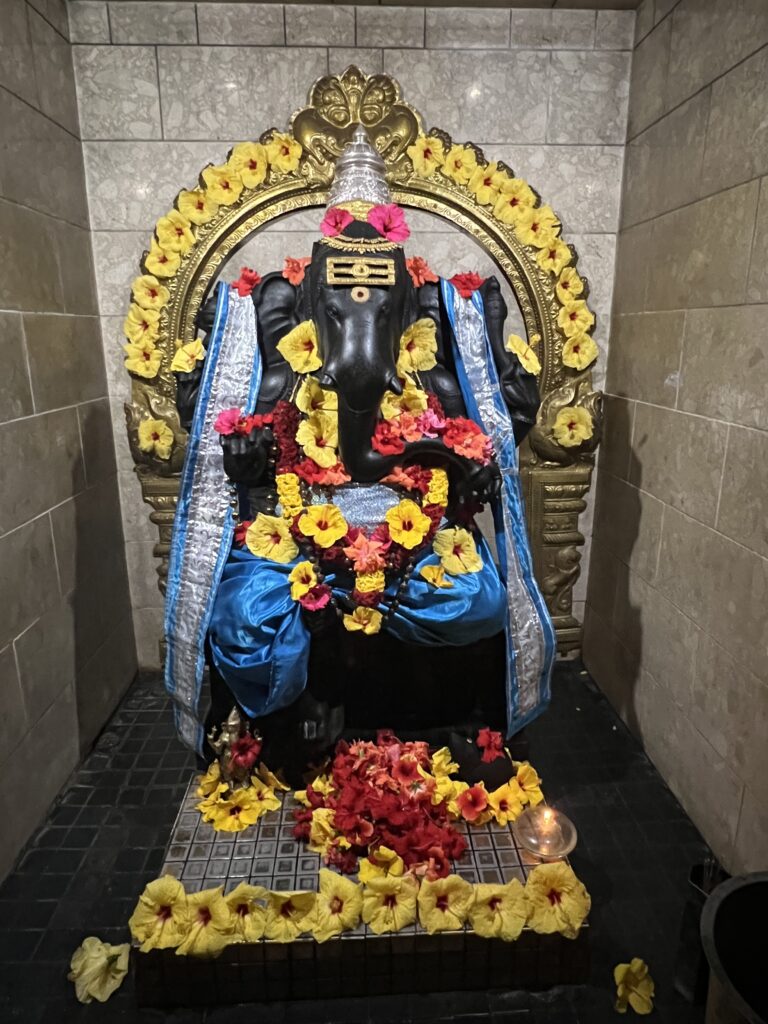
Today we would like to share you a lesson from Loving Ganesha written by Sivaya Subramuniyaswami.
Gaṇeśa, the Great Gatekeeper
Yes, it is the Great Gaṇeśa who is the gateway for seekers into the world’s most ancient faith. He is the inner authority, the guardian, the one who grants access to the spiritual mysteries of the Sanātana Dharma. All Hindus worship Him, regardless of their sectarian or philosophical positions. He truly binds them together in His love. This great God is both the beginning of the Hindu religion and the meeting ground for all its devotees. And that is only proper, inasmuch as Gaṇeśa is the personification of the material universe. The universe in all of its varied and various magnificent manifestations is nothing but the body of this cheerfully portly God.
Gaṇeśa sits on the psychic lotus of the mūlādhāra chakra, the ganglia of nerves at the base of the spine within everyone. This chakra governs time, matter and memory. As the spiritual aspirant is lifted up from fear and confusion into conscious awareness of right thought, right speech and right action, the mūlādhāra chakra becomes activated. It is then that the seeker, with heart filled with love, encounters the holy feet of Lord Gaṇeśa. As the spiritual seeker worships the loving elephant-faced God, clearness of mind comes more and more as he automatically and very slowly enters the Hindu path to enlightenment. Once the connection is firmly established between the devotee and Gaṇeśa, all of the currents of the devotee’s mind and body become harmonized. After that strong connection is made, should he falter on the spiritual path, he has gained divine protection.
But the seeker loses one thing. He loses his free, instinctive willfulness. It is lost forever. Yet it is not a great loss. Man’s own personal willfulness, his animalistic free will, is a feeble and insignificant force when compared to Lord Gaṇeśa’s divine will. When beholden to God Gaṇeśa and inwardly awakened enough to be attuned to His will, it is then quite natural that the instinctive will bows down. Personal likes and dislikes vanish. Limited faculties of reason and analysis are overpowered and subdued by a greater will, a cosmic will, the will of dharma. When sufficient humility has been awakened, it is easy to surrender personal, instinctive willfulness to the greater subsuperconscious will of dharma. It happens most naturally, but very slowly, because Lord Gaṇeśa, of all the many Gods, proceeds with methodic deliberation. He is the careful, loving guide on the inner path of all seekers.
Among all the wonderful Hindu Deities, Lord Gaṇeśa is the closest to the material plane of consciousness, most easily contacted and most able to assist us in our day-to-day life and concerns. In His hands Gaṇeśa wields a noose and a goad. With the noose He can hold you close or hold obstacles close. Gaṇeśa can capture and confine both blessings and obstacles. With the goad, Gaṇeśa can strike and repel obstacles. This Lord is called the Remover of Obstacles; but He also places obstacles in our way, for sometimes His devotees are proceeding in the wrong direction, and His obstacles block their progress and guide them slowly back onto the straight path of dharma. When instinctive willfulness causes the seeker to decide to step out of the boundaries of dharma, the Lord of Obstacles is there to block the way. His emblem is the swastika, symbolizing His circuitous course in guiding the seeker through life’s perplexing experiences.
It is through the worship of Lord Gaṇeśa that we come to know the venerable Lord Murugan, and lastly Supreme God Śiva, their Creator, our Father-Mother God, Lord of all creation, preservation and dissolution.
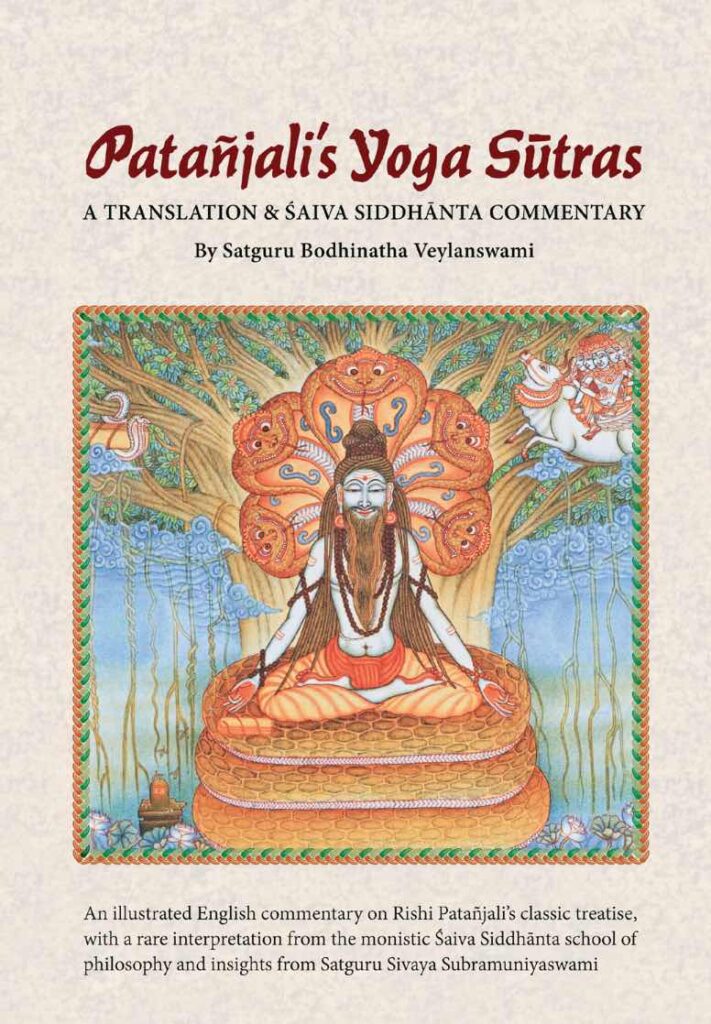
A sweet book review came to us from the Big Island and it is worth sharing with all CyberCadets. It speaks of one devotee’s discovery of what Satguru Bodhinatha Veylanswami has achieved with his newest book, Patanjali’s Yoga Sutras. We include below the review and we exerpt one of the slokas and Satguru’s bhashya as an example of the textual structure. You can download the PDF of the entire illustrated book here: www.himalayanacademy.com/books/patanjalis-yoga-sutras/
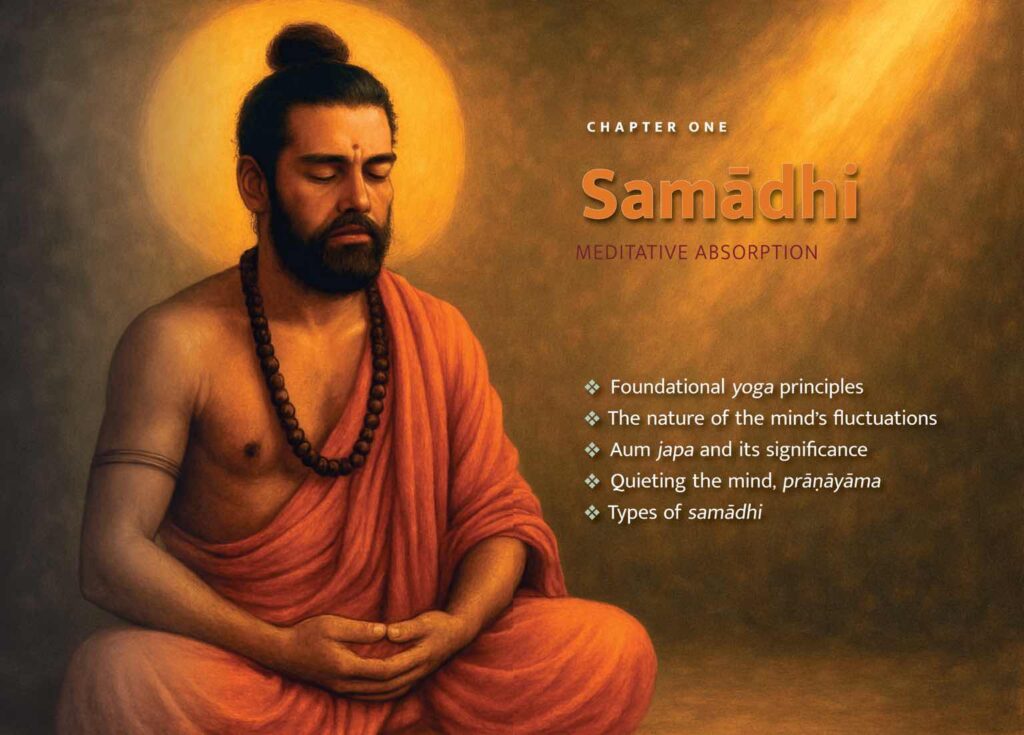
Chapter One spread
Cover art by Suresh Muthukulam, Kerala
A Devotee’s Review
Aum Namah Sivaya, Satguru, in prapatti and mingbasida! My soul soars with joy for the blessing of your gift of this book during Mahasamadhi celebration in October. I’m about a third of the way through in my first of many readings to come and I have incorporated this gem into my daily sadhana and shumnuhms. As in the Saiva Agamas, here Lord Siva imparts directly to us His Supreme Truth and Eternal Wisdom through living sages and satgurus. In this book, H.H. Satguru Bodhinatha Veylanswami bestows this vijnana (supreme wisdom) through his karika (means to liberation), and he draws upon the lotus words of his Paramaguru Sivaya Subranmuniyaswami and the knowledge of all the rishis and sages of Saiva Siddhanta who continue to exist in the second and third worlds watching over us and guiding us.
Through this book the Revealing Grace of Lord Siva becomes accessible to those who seek to purify and mature their souls. This Siva Bhaktar/Thondar has found that reading one, two or three sutras a day, intoning the Sanskrit, and then meditating and contemplating upon the inner deeper meaning of Patanjali’s revealed golden sutras enhanced by the commentaries is how I have chosen to absorb into my heart this quintessence of Saiva Siddhanta’s Monistic Theism.
Satguru Bodhinatha has brought forward into modern English a clear and comprehensible interpretation of ancient knowledge and provided a definitive transliteration of the original Sanskrit. The artwork is phenomenal and inspiring. This is a book to be highly cherished for a thousand and more years to come.
Kriyā yoga consists of austerity, self-study and devotion to Īśvara.
Commentary
In modern Hindu teachings, kriyā yoga generally refers to a spiritual path that includes techniques of meditation, particularly those that focus on breathing techniques, prāṇāyāma. Here, however, the term simply means the “yoga of action.” Kriyā could also be rendered in English as “the yoga of religious action.” It is threefold.
Tapas, austerity, may bring to mind images of yogīs wintering in Himalayan caves or bathing in the freezing waters of the Gaṅgā. Though tapas does include such intense practices, it also includes moderate disciplines that can be done by all. A simple form of tapas is sacrifice. Sacrifice is the act of giving up a cherished possession, be it money, time or a treasured item.
Svadhyāya involves both the study of sacred texts and introspection. It implies a process of learning about one’s own true nature through study of important spiritual texts, reflection and meditation. Chosen texts may vary depending on the cultural and religious context, and might include works like the Vedas, Upaniṣads, Bhagavad Gītā, Yoga Sūtras, and other scriptures that lead to greater understanding of oneself and the universe. Commentators sometimes include as an element of self-study, svādhyāya, japa, recitation of the sacred syllable AUM and other mantras.
Īśvarapraṇidhāna is total surrender to God. Though yoga as taught today tends to altogether leave out the concept of the personal God, Īśvara, the Yoga Sūtras give a central place of importance to worship and devotion to Īśvara.
From Satguru Sivaya Subramuniyaswami
External worship, bhakti yoga, is taught first on the spiritual path, because it produces a softened, mellow heart. It is to waste the guru’s time to give training in meditation and contemplation before the heart has been softened through bhakti yoga. The patient guru will wait until this has happened within the devotee. Otherwise, any accomplishment attained through intense raja yoga practices will not be sustained. And the problems that arise within the devotee’s subconscious mind—should he be taught raja yoga before the proper preparation has been mastered—will go back on the guru. (Merging with Śiva, Lesson 141: “Softening of the Heart”)
A few days ago we celebrated the new annual Krittika Dipam lamp lighting and bonfire. It began with the normal monthly Krittika homa in the morning. The regular afternoon 4pm puja then took on magical hues as various extra deepas were lit within and just outside the mukha mandapam. Rows of electric lights were hung around the temple to provide soft illumination as late afternoon gave way to early dusk and then nighttime. After the puja, we paraded around the mukha mandapam and maha mandapam, lead by Satguru carrying a large deepam which was then used to light our simple bonfire out front made of dry palm fronds. It burned up very quickly, perhaps in a minute or less. Ash was then passed around to place on our third eye, followed by final aratis and prasadam inside the temple.
An AI overview describes Krittika Deepam thusly:
“Krittika Deepam (or Karthigai Deepam) celebrates the divine light of Lord Shiva, symbolizing the triumph of spiritual knowledge over ignorance, marked by lighting clay lamps to dispel darkness, invoke prosperity, and honor Lord Murugan (Kartikeya) and the Krittika (Pleiades) stars that nurtured him. It signifies enlightenment, divine union (Shiva-Parvati), and removing ego, culminating in a massive bonfire (Mahadeepam) at Tiruvannamalai, representing Shiva’s infinite flame.
We mill various board widths to suit different future uses and to maximize the wood’s quality. This stack is nearly complete. Once the last layers are added, it will be covered with a sheet of metal roofing weighted with four concrete blocks to shield the lumber from sun and rain. In about a year the wood will be ready to use.
Cutting a camphor beam originally milled in 2013. Once all horizontal kerfs are complete, the entire stack is rotated 90 degrees and recut at 1 1/4 inches to produce ten-foot-long sticks.
About a hundred finished camphor sticks are stacked in a jig designed for quickly cutting them to 30-inch lengths with the battery-powered chainsaw.
Aditya unloads the freshly cut stickers from the jig
Storing the stickers in our rustic sticker shed. Later we will organize the stacks neatly and paint the sticker ends red for weather protection. This aged wood is dry and ideal for preventing fungus transfer to new lumber.
Acharya completes a long rip down the side of one of the large rainbow eucalyptus logs, just under our mill’s 25-inch capacity. Each of the biggest logs required two such faces: one for the mill bed and one to stand upright against the mill’s left side.
Acharya marks his cuts with a wax pencil and straightedge. He sights carefully down the chainsaw bar to keep the rip straight.
Acharya using the Echo 7310CS chainsaw for the rip cuts.
Time to load a log onto the mill.
Years ago we laid eight inches of gravel and stone in front of the mill to create a durable work surface for the skid steer and milling operations.
Aditya takes a turn at running the mill. The saw head moves by hand as the horizontal bandsaw slices through the log at the set height. Sawdust ejects to the operator’s left, strategically downwind.
Acharya cutting a prime 2-inch plank. Finished boards are already accumulating on the utility vehicle nearby.
After sharpening saw blades, preparing foundations, sorting supplies, cutting stickers and trimming logs, this is the rewarding moment: seeing beautiful lumber emerge board by board.
Prime rainbow eucalyptus lumber for a future woodworking project.
Starting a fresh log. It has been trimmed to width and cleaned of loose bark and soil before milling.
Aditya places finished boards onto the designated lumber stands. Behind him is a previous completed pile. Stickers are placed 16 inches apart to ensure proper airflow through each layer.
This is the yeild from three shorter logs, 23” in diameter.
Two of three long new stacks with an old stack of camphor slabs in the background.
From September 25 to October 21, Aditya Vinadhara joined our task force and teamed up with Acharya Kumarnathaswami for a lumber adventure worthy of its own mini documentary. Seven massive rainbow eucalyptus logs—gifted by a kind neighbor across the highway—became the project of the month. The photos capture it all, from cutting hundreds of stickers for perfect airflow to trimming the giant logs, milling beautiful planks and finally stacking everything into tidy piles to sun-kissed perfection in Hawaii’s balmy climate.
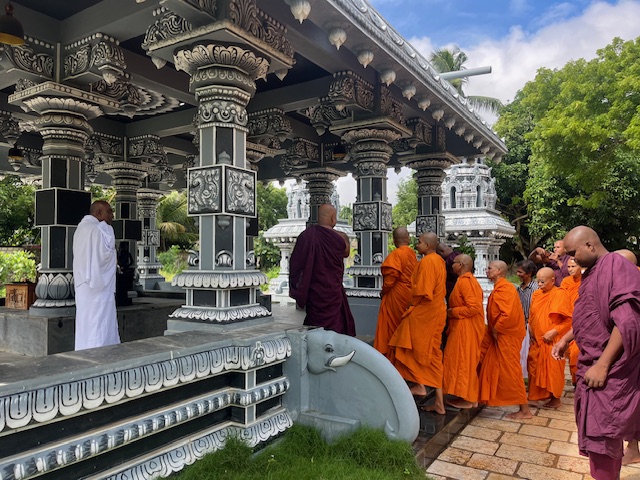
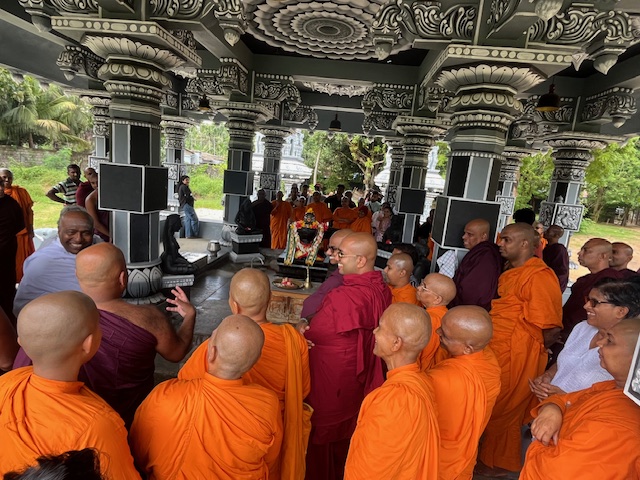
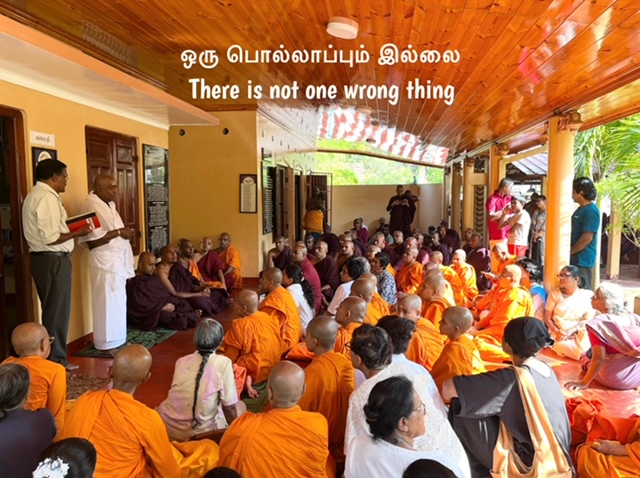
A happy exchange between Hindus and the majority Buddhists of the country.
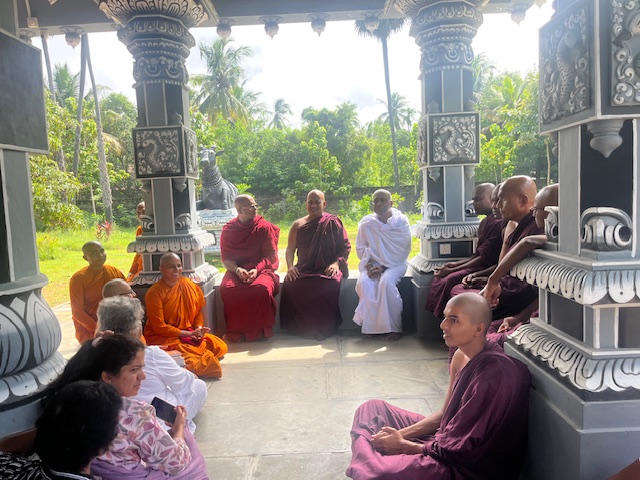
All sit for a quiet inner moment.
Earlier they visited Yogaswami’s hut
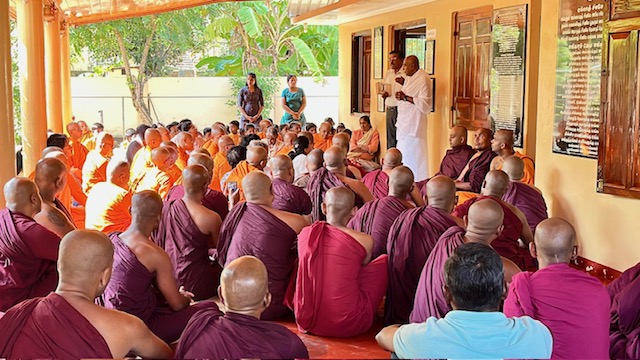
The monks’ colors, saffron and burgundy, denote their different sects.
We have been sharing Saint Tayumanavar’s wonderful teaching of samarasam—the unitive amity between religions. The idea of such shared respect is no less relevant to our 21st century experience than to his time, some 300 years ago.
A real-life example took place a few days back at the Sri Subramuniya Temple in Sri Lanka. Here is the report from Rishi Thondunathan (who this morning is hunkered down in Colombo due to a massive cyclone passing over the island).
“Greetings! On Friday, a group of 120 Buddhist monks and devotees from Kandy visited the Yogaswami Samadhi Temple and our Sri Subramuniya Temple in Alaveddy. They shared that they had read about Yogaswami’s life and teachings in various books, and were deeply moved by his simplicity and the profound wisdom reflected in his words and way of life. This inspiration led them to visit the sacred places where the sage lived. They had already downloaded the English Natchintanai from the Himalayan Academy publication website, and they have translated the song “Engal Gurunathan” into Sinhala. They attended the pūja and then eagerly listened to the story of Yogaswami’s life.”