Today at Kauai Aadheenam

Fish Tank special addition

Jai Ganesha!

A few months ago, the Siddhidata Kulam installed a fish tank in their new office. They are now planning to add a new feature by installing a casing around the tank to enhance its appearance. Sadhaka Shankaranatha is currently working on selecting the right wood for this project. This initial step involves cutting the wood, removing any rotten portions and beginning to craft it according to the size of the fish tank. Aum.

Fish Tank special addition Read More »

Iraivan Northwest Corner Buildup

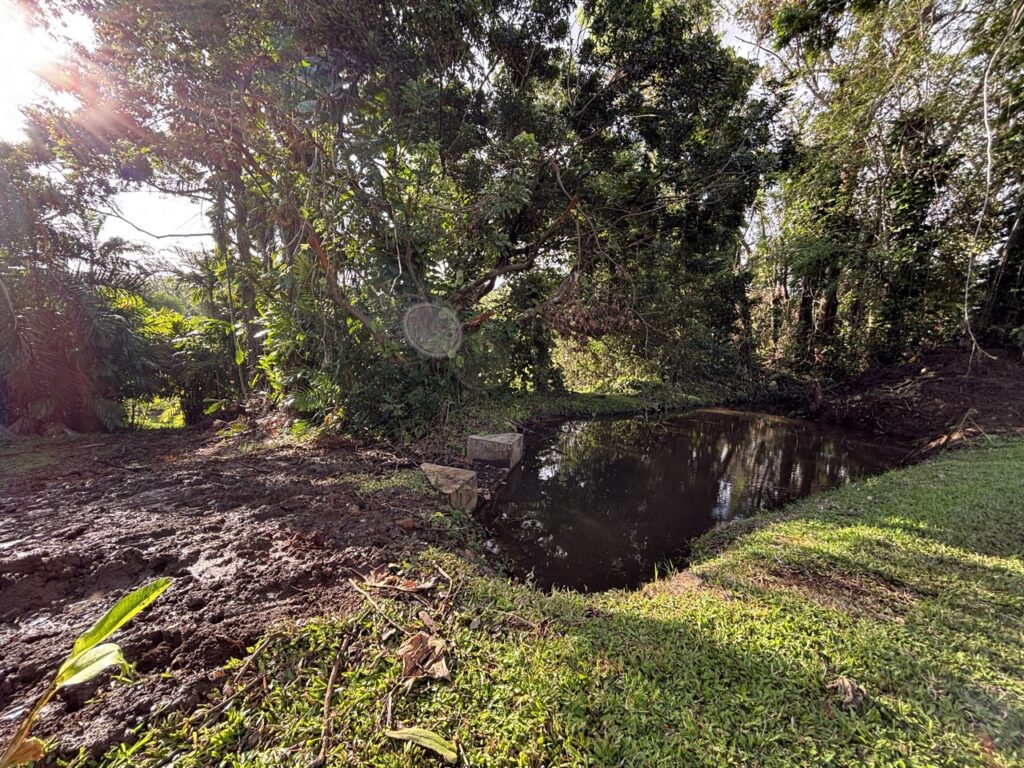
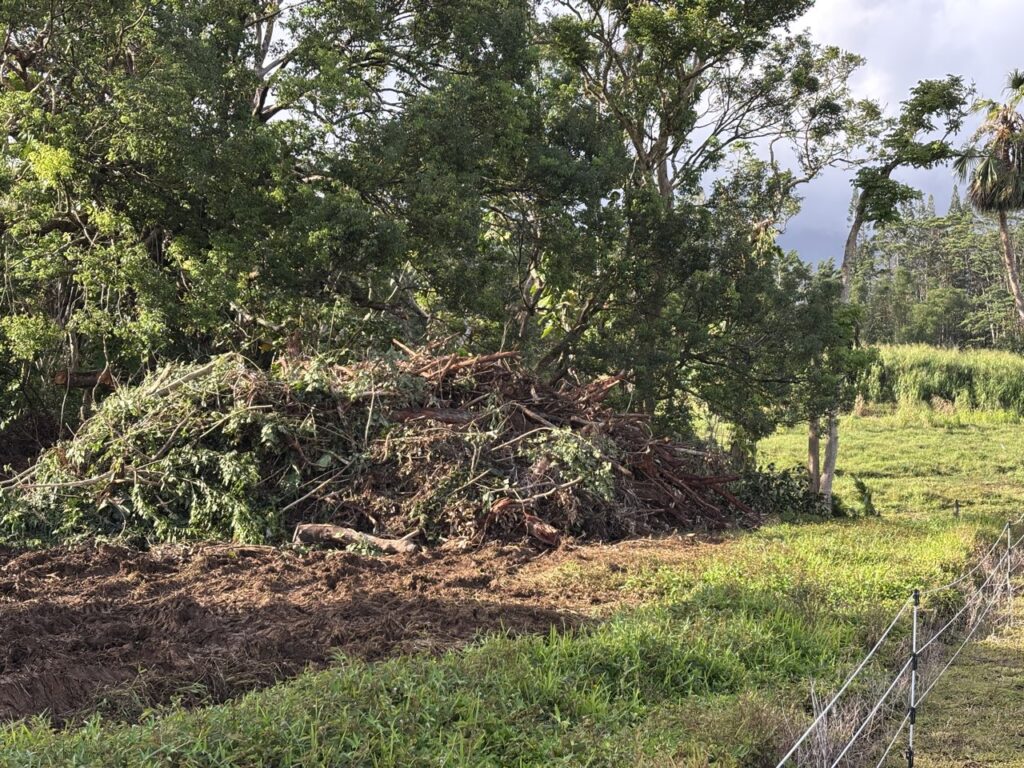
The ground-level perimeter of Iraivan is planted with two types of grass, separated in the middle by paver stones that form a pradakshina path. One can perform the circumambulation walking on the stones or on the light green short grass next to them. For a while now, the northwest corner of this grassy area and paver stones has been sunken, accumulating mud and standing water. We are now in process of rectifying this. Paver stones in the corner were removed and dirt brought in to raise the area. A pipe was placed under the new dirt to help channel water around the corner and away. When our employee returns to work, he’ll finish re-installing the paver stones.

Iraivan Northwest Corner Buildup Read More »

Did You Know?: Our Available Book Epubs

It has recently come to our attention that some people might not be aware of our free EPUBs that we have on this site in our books page. Most of our books can be easily downloaded to your device. Simply click the book cover of the book you’d like, then find the EPUP link above the description and click it to download.

For those unaware, we also have most issues of Hinduism Today Magazine available in EPUB as well.

Aum Namah Shivaya

Did You Know?: Our Available Book Epubs Read More »

New Hibiscus Tree

Jai Ganesha!

We have recently planted new hibiscus trees around our property. Due to a lack of sufficient rainfall, the plants are not receiving enough natural water. Because of this, Sannyasin Saravanathaswami has been watering the trees regularly to ensure they remain healthy. These hibiscus flowers are mainly used to decorate Kadavul Temple’s Nataraja and the Crystal Lingam at Iraivan Temple. Aum

New Hibiscus Tree Read More »

12 Shum Meditations

New Edition Published by Amazon

As our CyberCadets know, we are working with Amazon to publish our books. The latest to move into this new system is Gurudeva’s “12 Shum Meditations,” which are collectively called mamsani. The book is 100 pages long and has changed from a wire binding to perfect binding. It is now available on Amazon. The book contains The Advaitin, a remarkable writing from Gurudeva on the pure nondual philosophy. He presented it on June 10, 1968, and we share it here for those wanting to take a deep dive to balance this January day.

The Advaitin

All of the planned, thought-through philosophies derive their concepts through breakthroughs into expanded consciousness. These breakthroughs, well-recorded through relating them to prior concepts, form the philosophies we know today. The supreme breakthrough of the advaitin into nirvikalpa samadhi sustains the philosophy known as advaita without the necessity of recording experiential insights in the rational mind.

And we go on from there with a new point of unthought-out reference supplementing the rational mind with current insights which it has no time to record. This is because experience can only be recorded as it happens and referred to after. Whereas, constant experiencing can only be lived, recorded constantly in its happening but never referred to. This is the aftermath of being That which was fully realized. When a chela attains nirvikalpa samadhi, the mind reacts in a certain way. A rebirth of the psyche occurs. The constant experience begins of that which was experienced. The laws of the related difference of concepts change, and mind looks like being at the other end of the tunnel of consciousness looking out. Whereas before the happening, the mind was at the opposite end of the tunnel of consciousness looking in.

The flow of actinic energy through the constant changing force field of mental forces activates these odic force fields during an experience of nirvikalpa samadhi. This activation must be controlled through previous sadhanas, disallowing an influx of force that would deter succeeding experiences of nirvikalpa samadhi—perceptive insights into the overall nature of the mind, mind and Self as expounded through advaita yoga. This in turn brings out of the mind many comforting feelings as the advaita point of reference is gained.

All thinking people formulate their conclusions from one singular point of reference. Generally it is dvaita, dualistic in context. The pure advaita point of reference concedes positive conclusions backed by occasional intuitive flashes. Hence, advaita yoga is, in fact, healthy for the mind of man.

Beginning with the foreground of the average life span, we see lapses of consciousness in the generative functions of the mind. This is caused, no doubt, by all of the time spent in allowing dvaita thinking to penetrate the feeling nature. However, when schooled in advaitism, the same mind structure just referred to can change its format and condense its issues, and, without hesitation, relate all thinking, as well as feeling, to its base concept of the Self beyond mind, yet felt through mind even before a partial, actual realization occurs.

To cause advaita yoga philosophy to be a lifeline in one’s life, he must only be capable of thinking through the processes of subjective reasoning. Later some questions will be raised to stimulate this process of reason one must enter into, and exact methodology for bringing forth the advaita concepts in the mind into felt reality.

Not all persons, of course, are able to conceive of or accept the advaitin point of view. The mind is too superstitionally cluttered with dvaitic threats upon their own personal peace and future to dare look further. The process of disbelief is, therefore, almost automatic, and rejection final. Hence the two, advaita and dvaita, will always exist in the human kingdom. Man raising in consciousness from darkness into light has only to perceive his ancestors as they, too, sought through the lower, ebbing layers of the mind to bring forth from within themselves factual knowledge based not only on inductive thinking but the actual birth of experience. The format, therefore, is that to make a philosophy live vibrantly in mind and spur him on into its experiential states, its opposite must occur, causing the competitive whirl of the senses as they seek consciously conscious states.

As the advaita philosophy is looked at under the cold eyes of reason, it stands no chance of being realized in the personal life scope of the student. He must struggle first with his nature and clear an advaita pathway through many phases of his mind. First relating all experience through the summing-up process of reason, then clearly and unyieldingly define all his actions and way of life to the advaita path to enlightenment. This is difficult, and few really make the necessary strides beyond belief in advaita thinking. But even those who formulate a new point of reference through subjective reason live a grander and fuller life far from the superstitious dvaitic entanglements of the lower mind.

Talk to yourself and convince yourself of the logistics of the paramount factor that mind in all its various phases is form, even as protruded in light. Form is vibration; and yet beyond any possible vibration of consciousness is the Self beyond form, hence more intense than consciousness of time and space. Once sitting quietly in a meditative state, thus talking this over with yourself, trying to prove out the theory as well as disprove it, habit patterns of the subconscious begin to change radically, as preconceived, perhaps even unthought-out concepts held in faith begin to break, altering this mind structure. Yes, a new-found freedom, a lightness of body and mind, a true sense of religion occurs as the advaita principles begin to penetrate the mind structure and displace erroneous impressions.

“Thou art That,” the sages tell us and often never go on to explain the That, the Self. This Self within the very cellular structure of man can actually only be talked about but must become a constant nirvikalpa experience to be really realized.

Gurudeva’s Commentary

One can easily see the difficulties so far in expressing in either the languages of East or West these deeper truths. The Western languages simply have no inclusive conceptual words to encompass the internal happening of the superconscious. The best they can do is to tell of the existence of those states. The Eastern languages have long since lost the meaning of certain of their key words due to the varying interpretations of scholars approaching them from an advaitist point of view or a dvaita point of reference. Hence advaita yoga on an international scope in this age is hampered through the communication media.

This was realized halfway through the writing of The Advaitin on the shores of sublime Lago Maggiore while going through intense and profound inner states of superconscious in the struggle to convey some of its linear depth on paper. In a few hours, from deep within the uda current of the sushumna, came forth a new language—unfolded from the sounds of the anahata, visuddha and ajna chakras in action. This profound language will serve us to convey the inner teaching from the source of the sounds in which they exist. For it encompassed all the baser elements transmuted into conceptual fourth- and fifth-dimensional pictures. The three- and four-syllable words convey the happenings of the inner man. The one- and two-syllable words take care of the aspirant’s communication in his relation to external things, in monastic life, around the home in the kovilla or ashram, so that the flow of inner and outer conceptual viewing is not broken and life can flow on constructively.

The language of the Advaitin in the new age, called Shum, is of the four higher chakras, whereas his native tongue can take care of his association with thought patterns of the first three chakras.

The inmost center of consciousness—located only after the actinic forces dissolve concepts of form and even consciousness being conscious of itself—is found to be within the center of an energy-spinning force field. This center—intense in its existence, consciousness only on the perimeter of the inside hub of this energy field—vitalizes all externalized form.

Losing consciousness into the center of this energy field catalyzes one beyond form, time, space. The spinning hub of actinic energy recreating, preserving and dissipating form quickly establishes consciousness again. However, this is then a new consciousness, the continuity of consciousness having been broken in the nirvikalpa samadhi experience. Essentially, the first total conscious break in the evolution of man is the first nirvikalpa samadhi experience. Hence, a new evolution begins anew after each such experience. The evolutional patterns overlap and settle down like rings of light, one layer upon another, causing intrinsic changes in the entire nature and experiential pattern of the experiencer.

Almost as soon as dvaita thinkers come in contact with advaitist concepts, they accept the format of thinking and belief, wondering how ever could they have felt otherwise.

The advaita point of view has not been too prominent in the West, nor even in the Far East, for few scriptures are clear enough in their translations or editing, even in original text, to maintain the pure advaita point of reference. The Bhagavad Gita exemplifies this very clearly, having clearly defined its premise in two paragraphs, contradicting it in a sentence or two following. Of course, the advaita mystic can read and enjoy any scripture, only enhancing his realization; whereas the dvaitist becomes subconsciously confused when these inconsistencies occur. Great efforts on our part are now being made to edit some of these ancient scriptures in the true advaitist purity that I feel was originally intended by the enlightened rishis.

12 Shum Meditations Read More »

Esoterics of Worship, Part Four

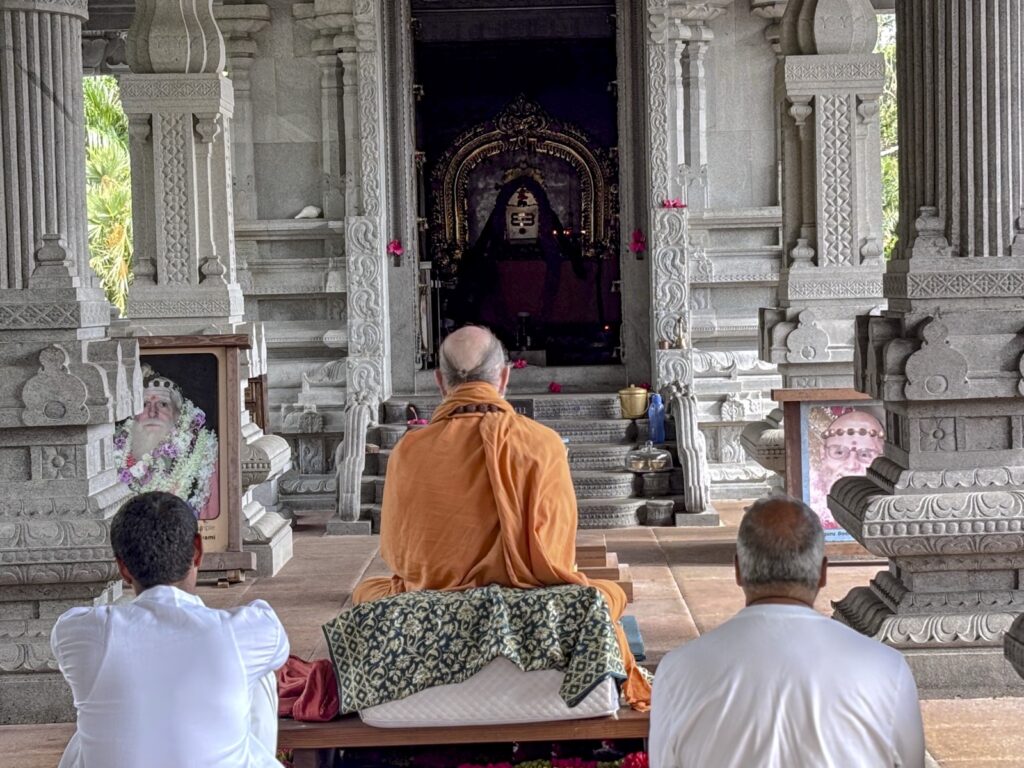
Satguru Bodhinatha Veylanswami gives his weekly upadesha in Kadavul Temple at Kauai’s Hindu Monastery in Hawaii. It is part of a series of talks elaborating on the inspired teachings of Satguru Śivaya Subramuniyaswami as found in his book Merging With Śiva.

When you worship the God in the temple through pūjā and ceremony, you are bringing that Divinity out of the microcosm and into this macrocosm. You supply the energy through your worship and your devotion, through your thought forms, and even your physical aura. The pujārī purifies and magnetizes the stone image for this to take place. The Gods and the devas are also magnetizing the stone image with their energy, and finally the moment is ready and they can come out of the microcosm into this macrocosm and bless the people. You observe that they stayed only for an instant, but to them it was a longer time. The time sense in the inner worlds is different.

Esoterics of Worship, Part Four Read More »

Scroll to Top