Satguru Bodhinatha Veylanswami gives his weekly upadesha in Kadavul Temple at Kauai’s Hindu Monastery in Hawaii. It is part of a series of talks elaborating on the inspired teachings of Satguru Śivaya Subramuniyaswami as found in his book Merging With Śiva.
“The Hindu does not have to die to have a final judgment or to enter into heaven, for heaven is a state of mind and being fully existent in every human being this very moment. There are people walking on this Earth today who are living in heaven, and there are those who are living in hellish states as well. All that the Hindu has to do is go to the temple. As soon as he goes to the temple, to a pūjā, he is contacting the divine forces. During the pūjā, he is totally judged by the Deity. All of his karma is brought current and he goes away feeling good. Or he might go away feeling guilty. That is good, too, because then he performs penance, prāyaśchitta, and resolves unseemly karma quickly.“
Additionally, today also marks 99 years since our late Gurudeva’s birth day in 1927. Here are some words he uttered in 2001 regarding diplomacy and discriminating speech.
Our deepest gratitude to every donor of our 2025 Digital Dharma Drive. With your incredible support, we reached our $80,000 goal by December 31st!
This spirited generosity ensures we can continue to inspire, create and share a vast ocean of digital wisdom. As we enter 2026, we are redoubling our efforts to bring Hinduism to the forefront of the information age. Your contributions directly fuel our websites, mobile and web apps, deep-dive learning courses, and vibrant resources for children.
With your help, our small team of media-minded monastics is empowered to do even more, whether it’s partnering with expert translators, engaging talented coders, commissioning sacred art, or utilizing cutting-edge technology to make our work more impactful. Thank you for walking this digital path with us.
Some comments left by this year’s donors:
Jai Ganesha! We’d like to show our support and appreciation for all the content. It’s been a little over a year since Gurudeva’s teachings have entered into our life and what a blessing it has been. Aum Namah Sivaya!
Thanks for all the wonderful work you do. We are grateful.
The Himalayan Academy resources has been my study resources for the past decade. The quality and quantity of information provided surpasses any other Hindu website.
Please keep up the outstanding work. It is now more important than ever that works like these should be preserved.
I use Himalayan Academy’s publications extensively. I give them as take away item for visitors to our Hindu Temple of Florida. Nearly 1000 visitors benefit from taking our free guided tours and taking home one or more of Himalayan Academy publications. The publications include, 14 Questions…, Visiting A Hindu Temple, My Ganesha, 15 Hindu Festivals, and Hindu Scriptures. Thank you, Academy, for doing a wonderful job in publishing these booklets.
Thank you for all the digital info you provide to the world. Very grateful.
My entire life has rotated around Gurudeva’ writings from the mimeograph Master Courses of the 1960’s to our AI cloned voice version of the currant day the thousands of pages blooming from His pen, how blessed are we!
Thanks to our dear Monks: “Take your daily dose of Anbe Sivamayam, Satyame Parasivam and from all anxiety be free.“
A few months ago, we began the Path to Siva series on Instagram, and today we have officially brought it to a close. This series was created to share the timeless teachings of Path to Siva in a simple, accessible, and easy-to-understand way for everyone. Click the link above to experience the final chapter, and scroll through our Instagram feed to revisit the previous chapters. We would love to hear your reflections—feel free to share how this journey through the posts and slides resonated with you.
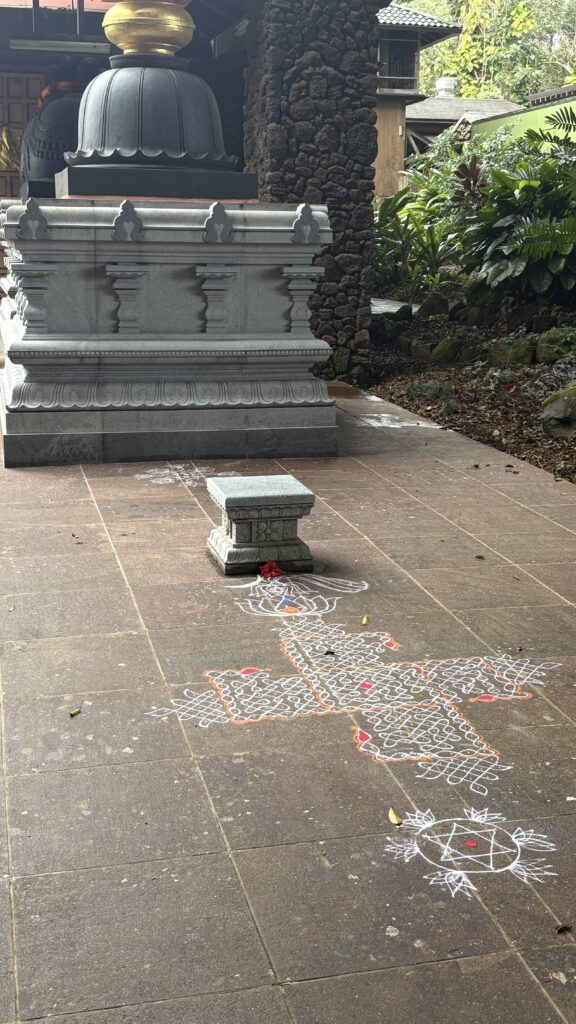
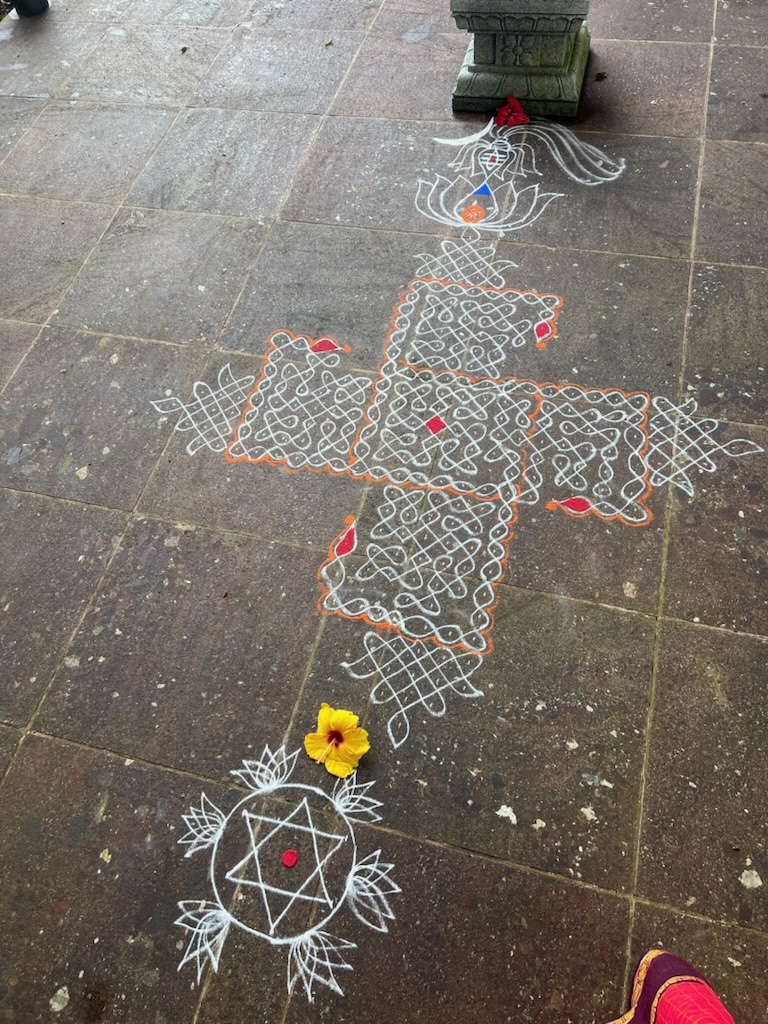
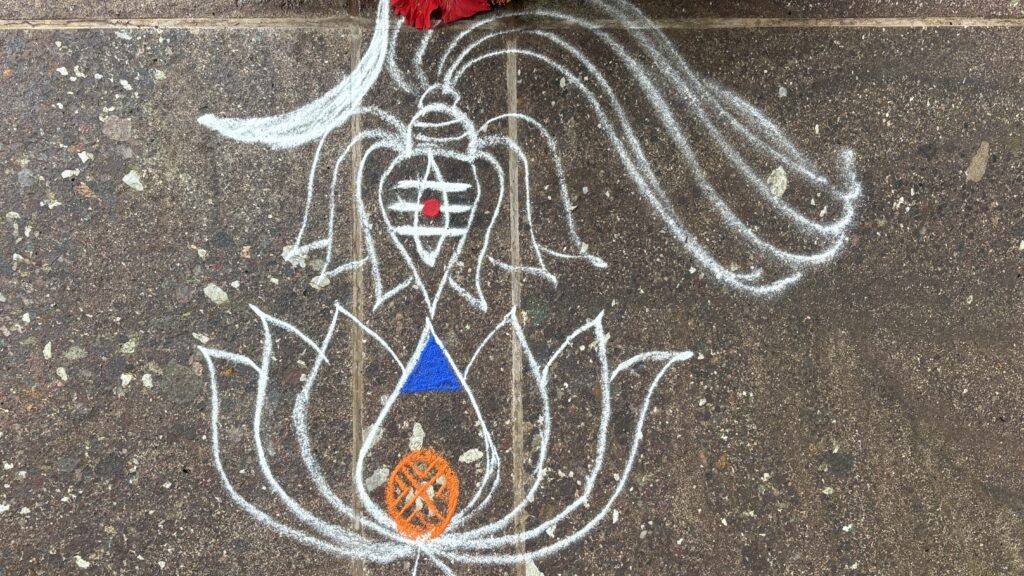
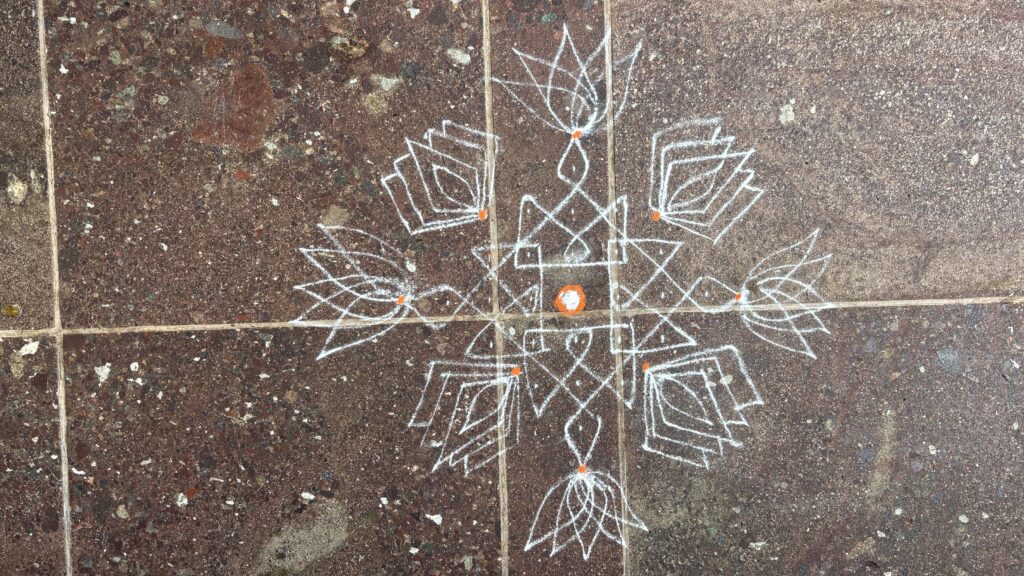
She took about three hours to make four different designs, each with a different meaning
Divya explained she used more rice flower this time, hoping the birds would have a nice lunch
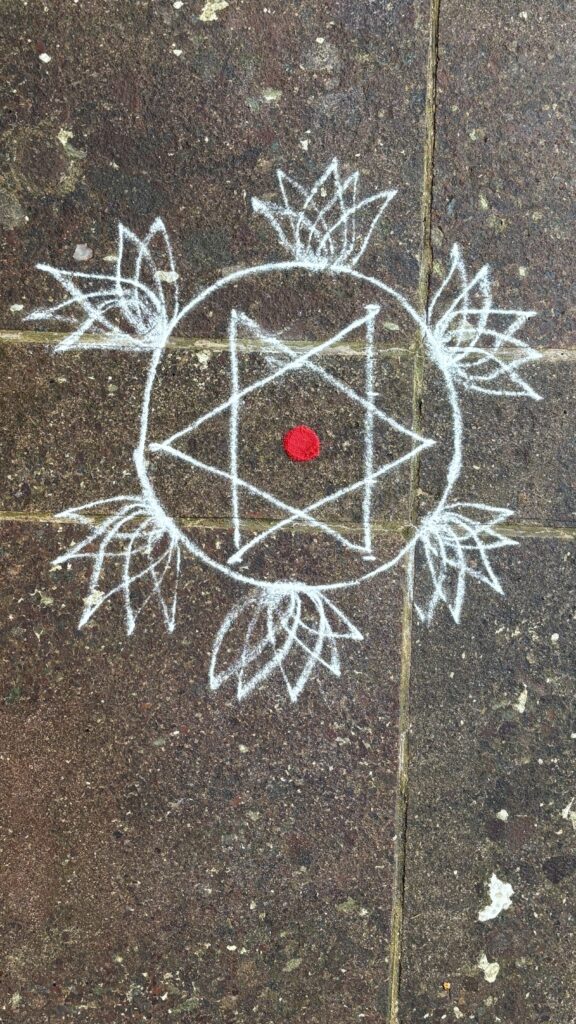
Shadkonam, the Siva/Shakti symbol
A lotus blossom
Another form of lotus design
The main image in three colors
Divya Ramanathan and Family Return to Kauai to Offer Her Designs to Siva Nataraja
Months back Divya received Bodhinatha’s blessings to fly to Kauai, as she has done for the past two years, and create a kolam design for Siva. They arrived December 28, and she went right to work after a brief darshan in Kadavul Temple. Such designs are common in India, ephemeral signs of auspiciousness and meaning meant to bless the morning threshold of a home or compound, an offering that has impermanence built into it, for a rain or hungry birds and insects will disappear it before noon.
Meanings
Meaning, you ask? Yes, they are so simple in design, and so rich in symbolism. The Book of Kolams describes the four-armed style:
Here is the core meaning of the Pulli Kolam
1. Continuity and eternity
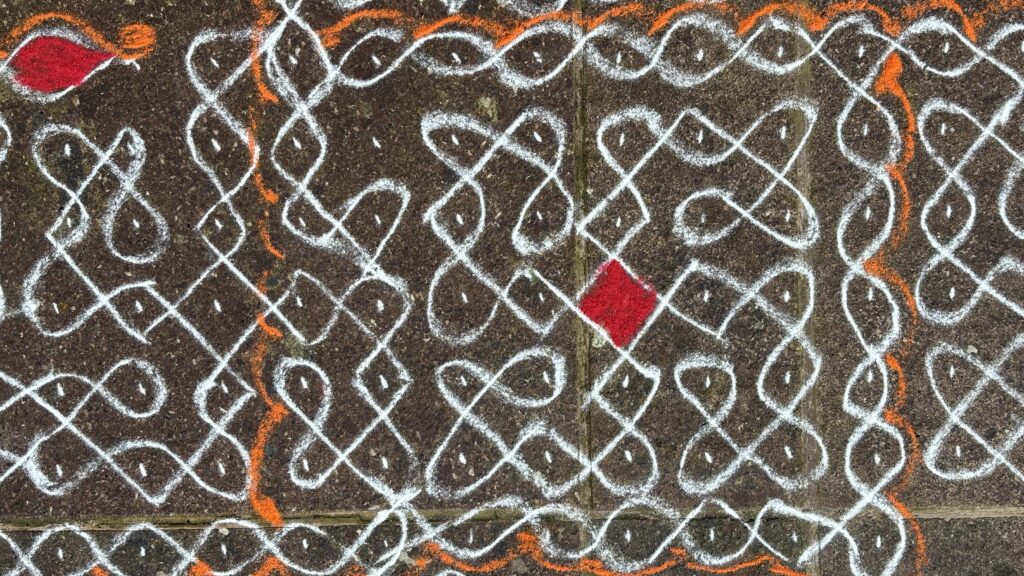
The unbroken white line weaving in and out around the dot grid symbolizes anadi–ananta—that which has no beginning and no end. Life moves through obstacles yet remains whole.
2. Order within complexity
Though it appears intricate, the design follows strict symmetry and rule. This expresses a key Indian insight:
The universe is patterned, not random.
What looks chaotic is actually governed by dharma.
3. Protection and boundary
The orange border acts as a raksha rekha—a protective enclosure. Kolams traditionally mark the threshold, inviting benevolent forces and discouraging disorder.
4. Fivefold expansion (cross form)
The overall cross-like expansion suggests extension in the four directions with a central bindu, a common sacred geometry idea:
Center = source, Self, Brahman
Four arms = space, time, movement, manifestation
It reflects Vedic spatial cosmology.
5. Red accents as life force
The red forms represent shakti, fertility and auspiciousness—the living pulse within the structure. White is purity and order; red is life and energy.
6. Cultural intent
Such kolams are drawn to:
Invite Lakshmi (prosperity and harmony)
Establish spiritual order at the household threshold
Remind the viewer daily of impermanence held within cosmic order
In one sentence:
This kolam expresses the eternal flow of life, protected by order, energized by shakti, and expanding harmoniously in all directions from a sacred center.
Satguru Bodhinatha Veylanswami gives his weekly upadesha in Kadavul Temple at Kauai’s Hindu Monastery in Hawaii. It is part of a series of talks elaborating on the inspired teachings of Satguru Śivaya Subramuniyaswami as found in his book Merging With Śiva.
“Lord Gaṇeśa is the first God a Hindu comes to know. As the Lord of Categories, His first objective is to bring order into the devotee’s life, to settle him into the correct and proper flow of his dharma—the pattern of duties, responsibilities and expectations suited to the maturity of his soul. As the Lord of Obstacles, He deftly wields His noose and mace, dislodging impediments and holding avenues open until the individual is set in a good pattern, one that will fulfill his spiritual needs rather than frustrate them.“
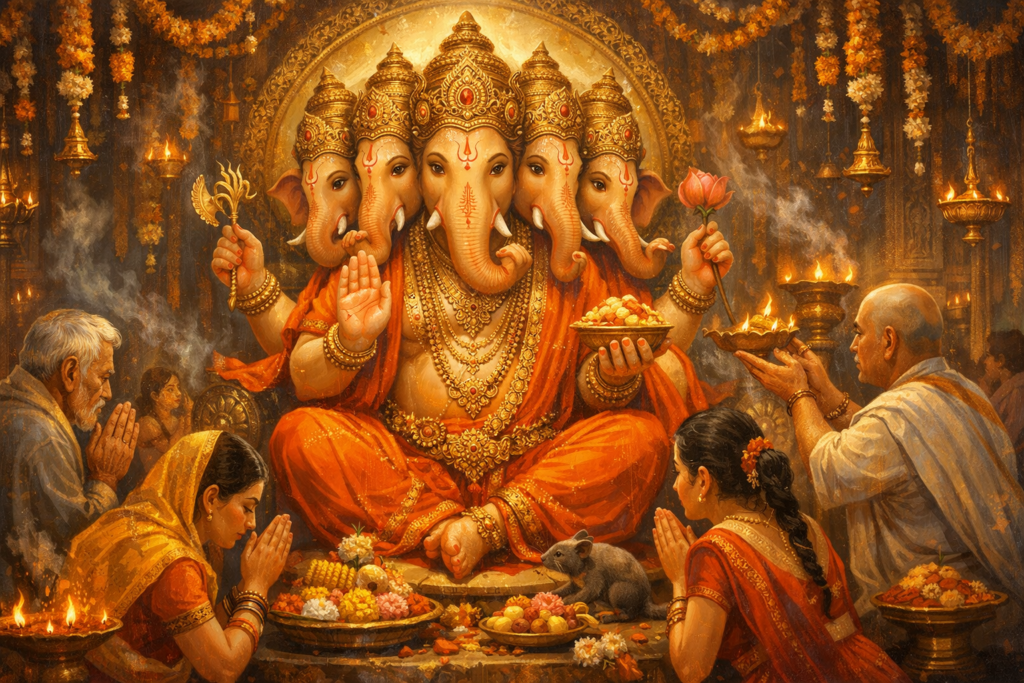
The family sadhana for the final day of Pancha Ganapati is to bring forth love and harmony within all three worlds. Because of sadhanas well performed during the first four days, the family is now more open and aware of Ganesa’s grace, and their love for Him is overflowing. On this day the entire family experiences an outpouring of affection and tranquility from the great God Himself. His blessings fill the home and the hearts of everyone within it, inspiring them anew for the coming year. This exchange of affection between all members of the family and the Lord is invoked and perpetuated through the day by performing five special pujas. These five pujas to Pancha Ganapati (see sidebar below) solicit help from His devas in the home and establish the patterns for improvement in family life. The overflowing love that is felt today will inspire generosity in the year to come, bringing abundance and good fortune in return. All gifts received during the day are placed unopened before Pancha Ganapati.