Hibiscus is the national flower of Malaysia and South Korea, and the state flower of Hawaii. It has great meaning in many cultures. In the Hindu tradition, hibiscus (especially Hibiscus rosa-sinensis, the red hibiscus) is sacred. Its five petals are interpreted as representing the five senses, the five elements, and even the five potencies of God Siva. The flowers are offered to Kali because their deep red color resembles divine power and the life force. They are also offered to Ganesha in many regions. They symbolize Shakti, energy and devotion and, for some, the transience of life, since their blooms, while stunningly beautiful, are brief, reminding us to be present in every moment.
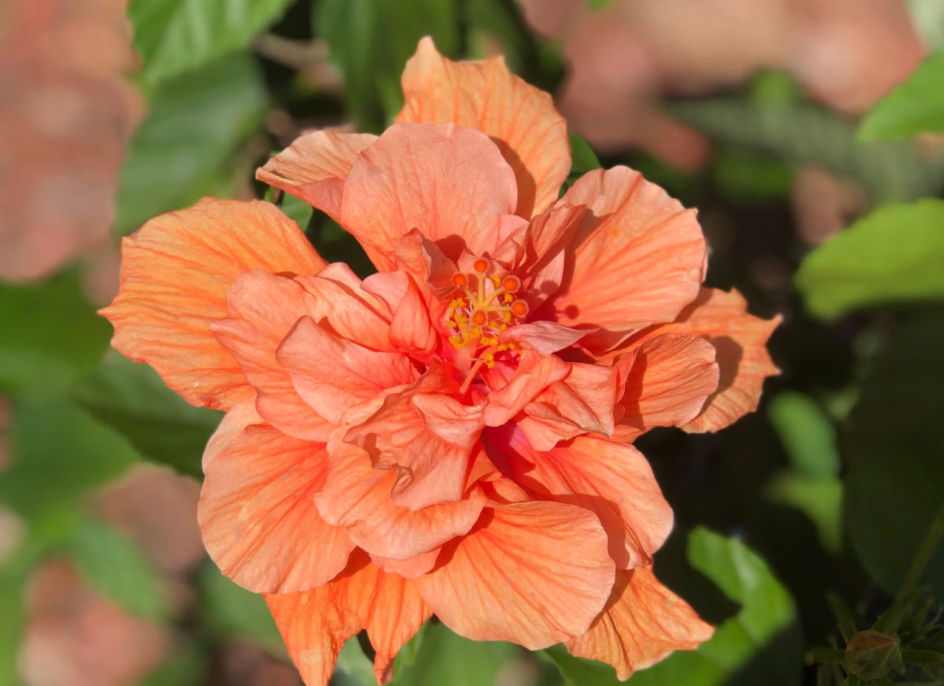
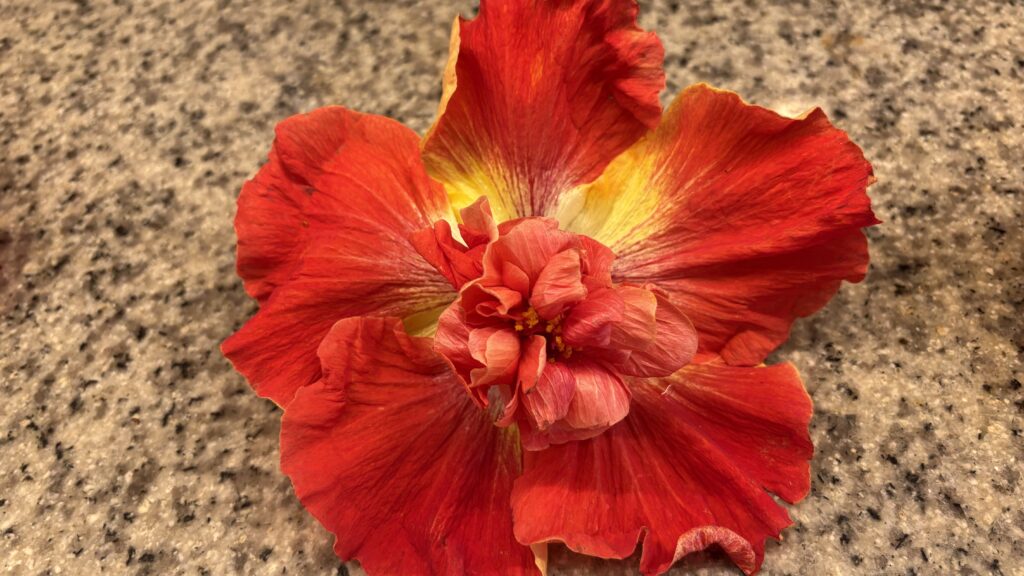
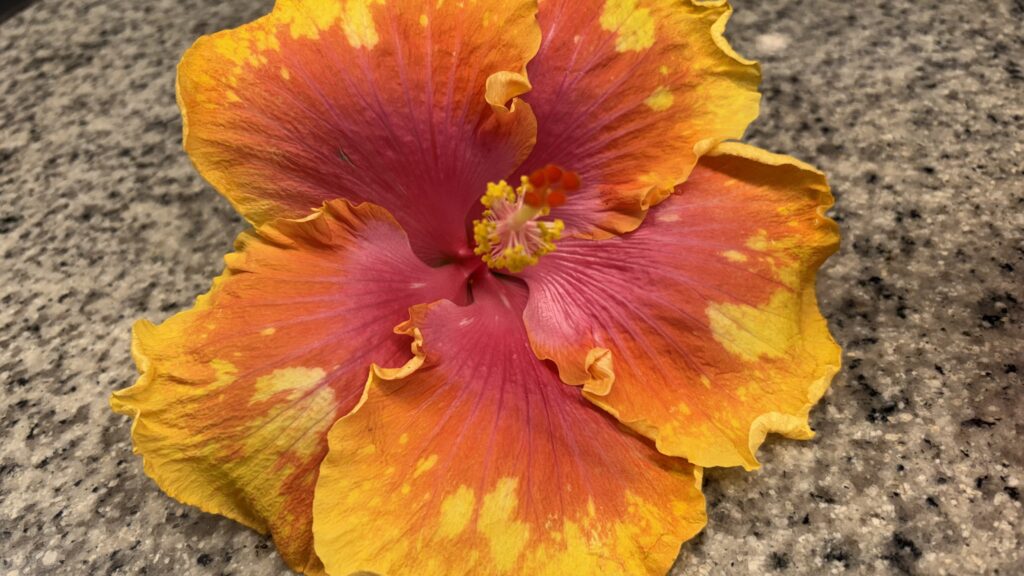
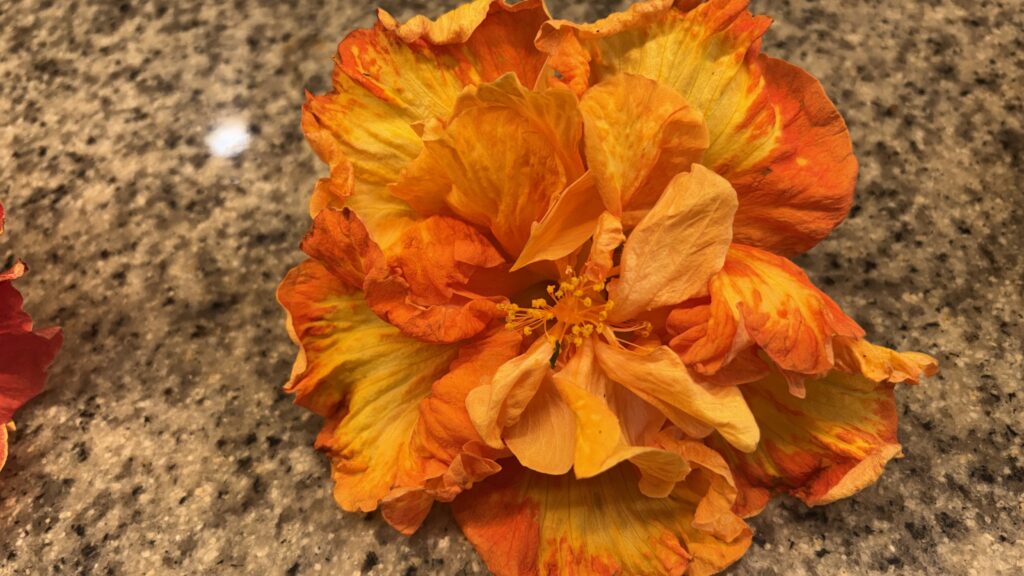
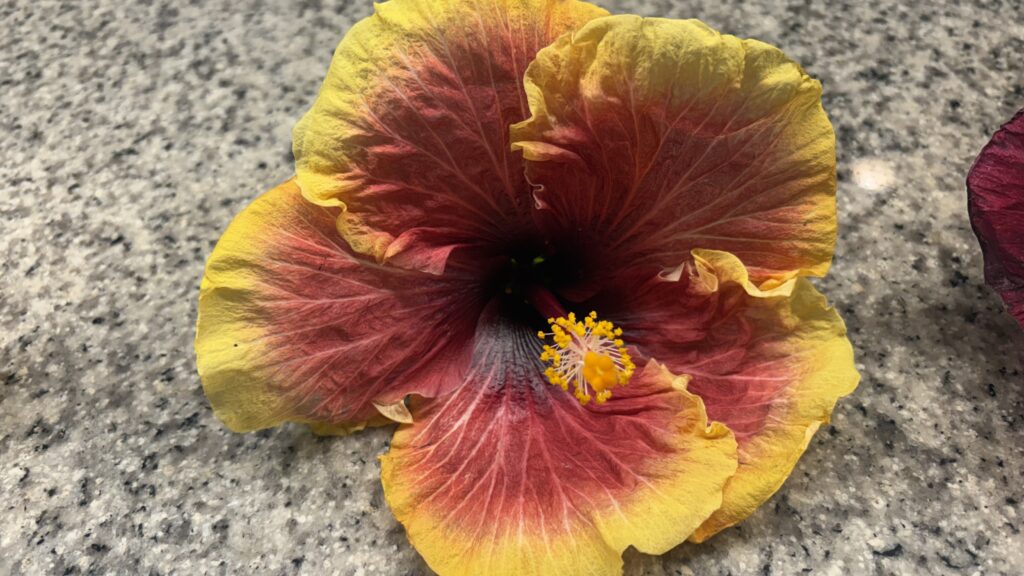
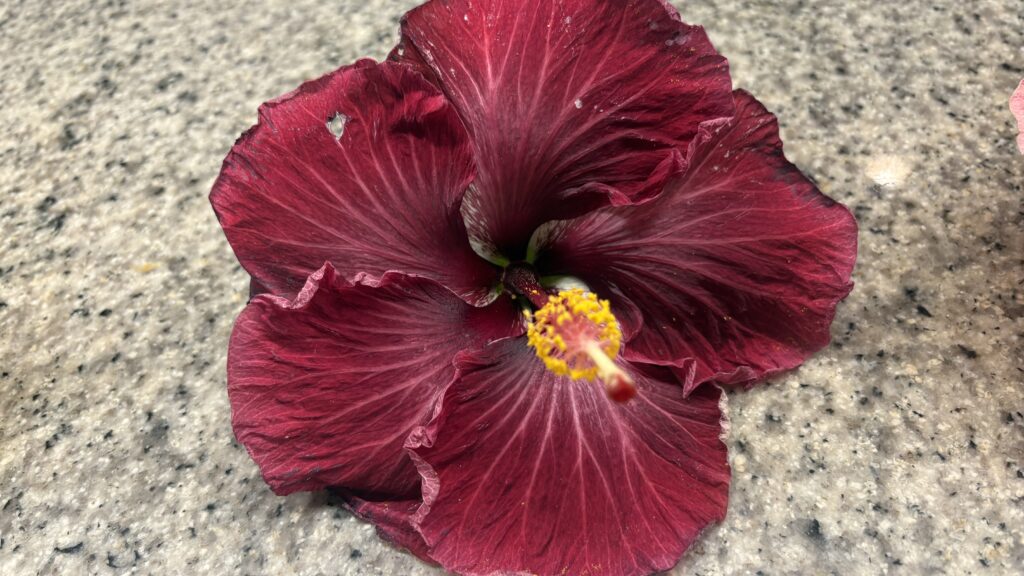
The fancy hybrids are not as productive as the workhorse flowers that we collect daily by the bushel. They are far more spectacular, as though the plant puts all of its effort into the extra attention given to color, shape and form of the blossom. We show a few of the hybrids and a few of the more productive flowers that are the monks’ daily offerings to the deities in our two temples. Enjoy this short slideshow.
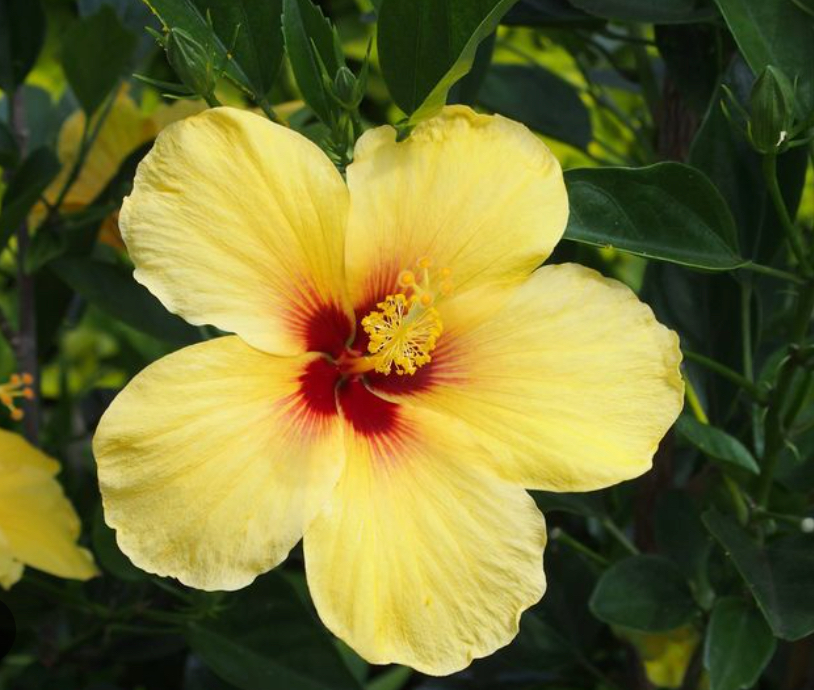
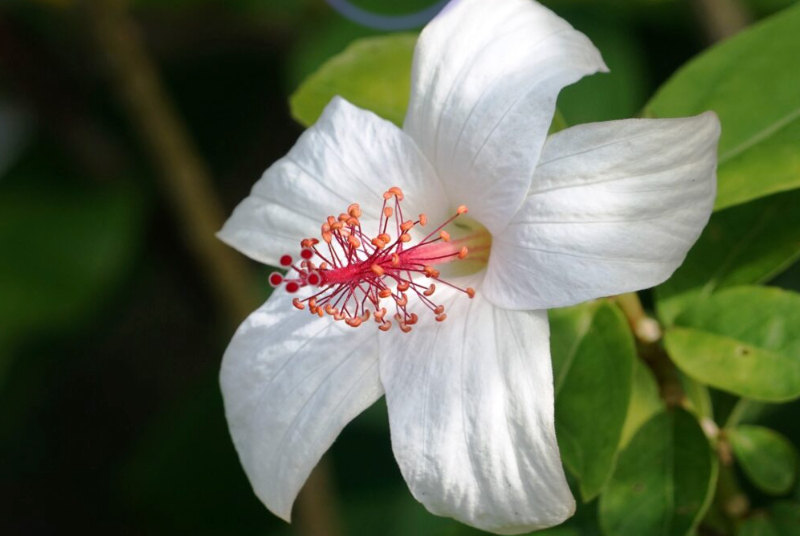
This is the state flower of Hawaii
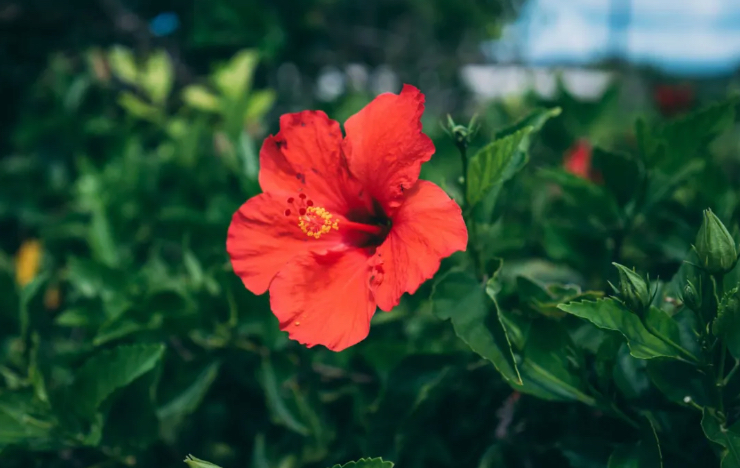
One of the best producers we have
The famed and sacred Hibiscus rosa-sinensis
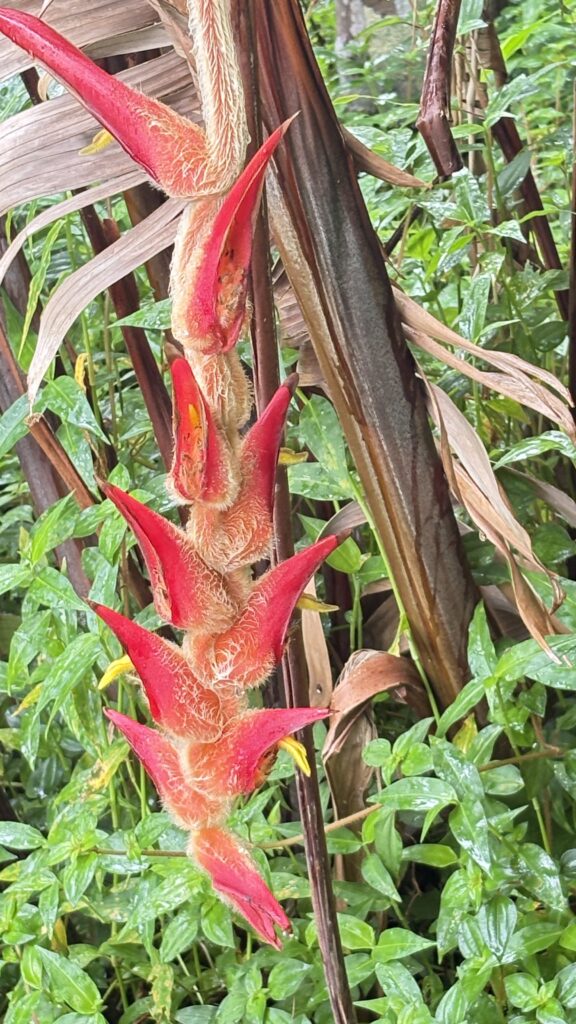
This is a heliconia called by the playful name Barnum & Bailey. In bloom today. It’s fuzzy, feels like a soft stuffed animal.
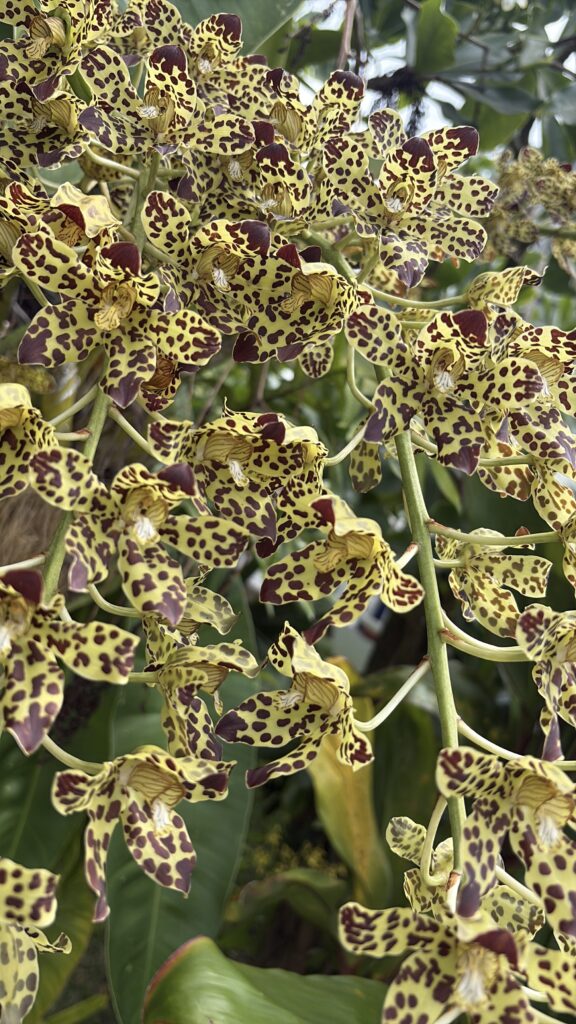
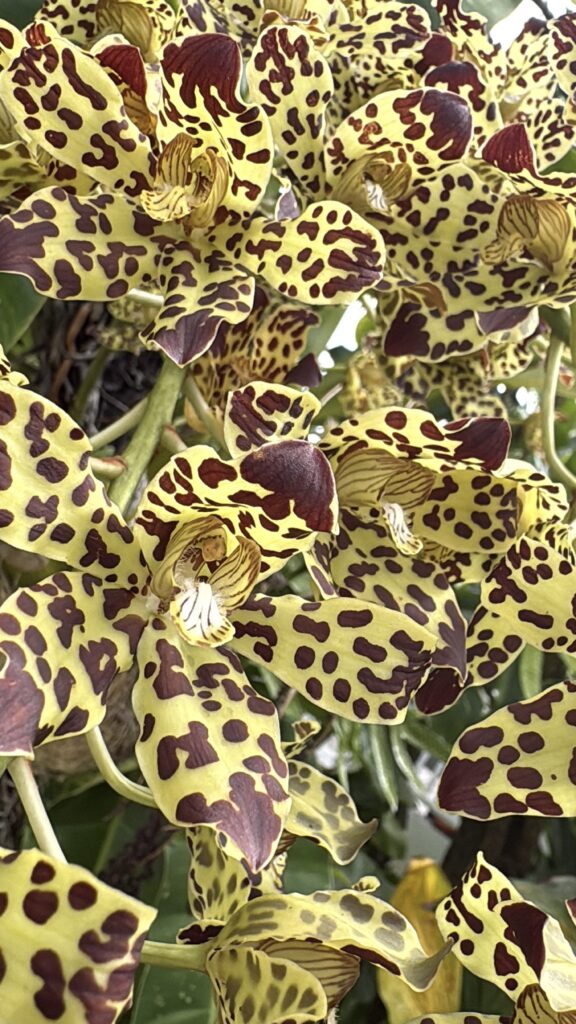
And a Gramatophyllum orchid. There are hundreds blooming on the trees.
B ack to the hybrids.
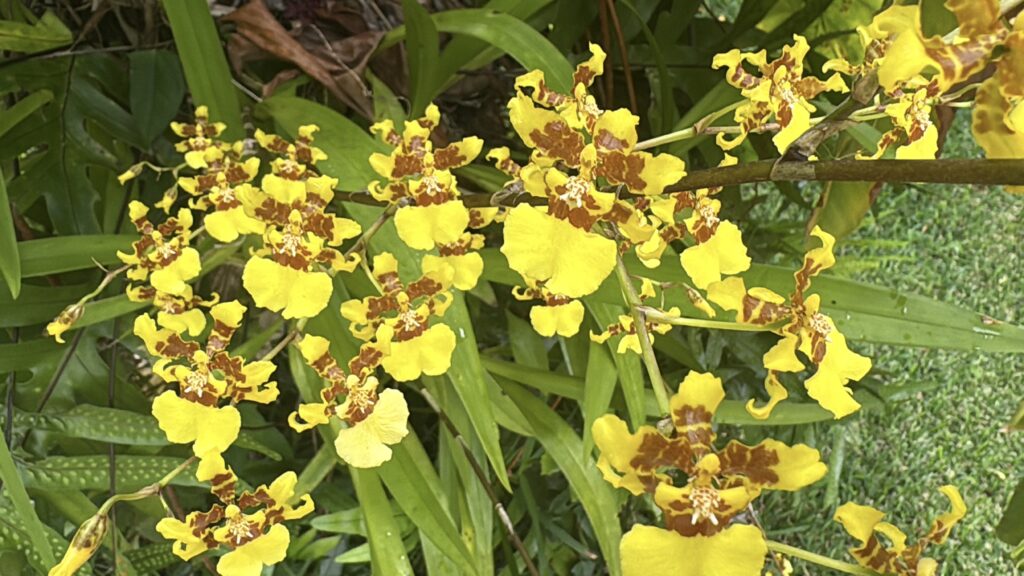
It’s called Popcorn Orchid.
Grammatophyllum measuresianum from the Philippines
How do we know Siva created a special sweetness on Kauai? Because He made the world’s only fragrant hibiscus here, named after the Waimea Canyon. It is one of a kind. The Hawaiians call it Kokiʻo keʻokeʻo. Botanically, it is Hibiscus waimeae subsp. hannerae
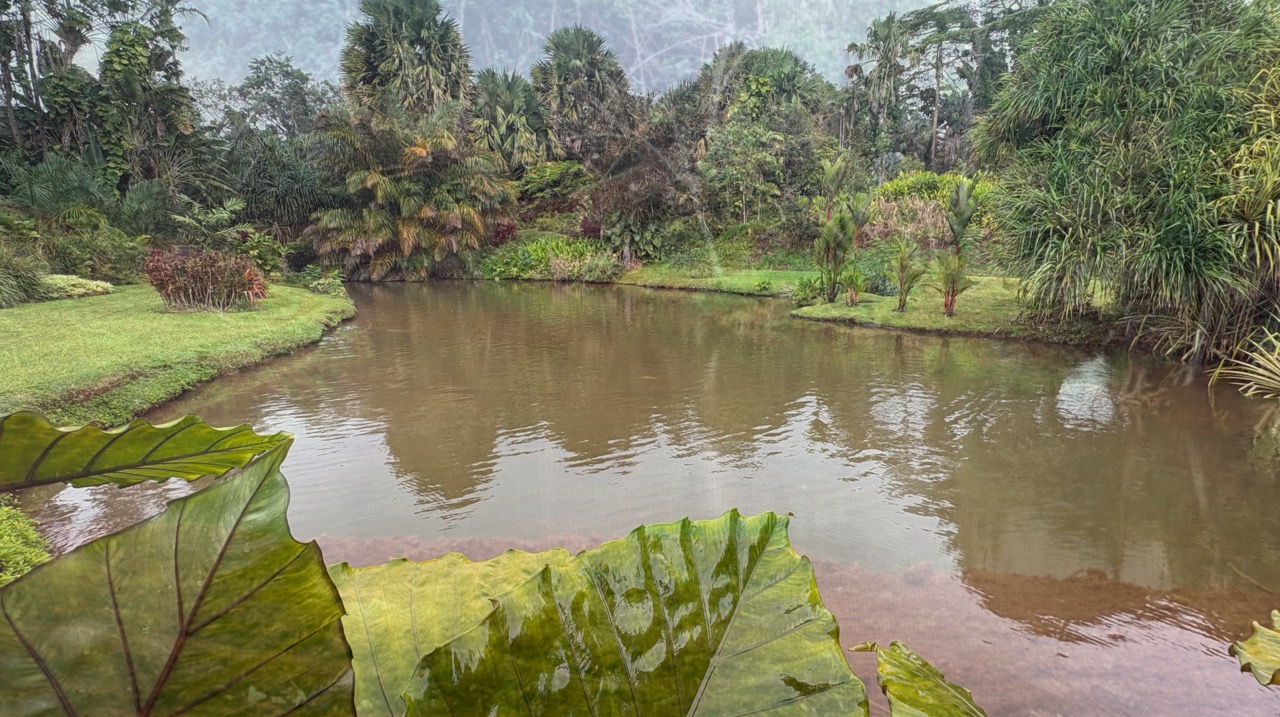
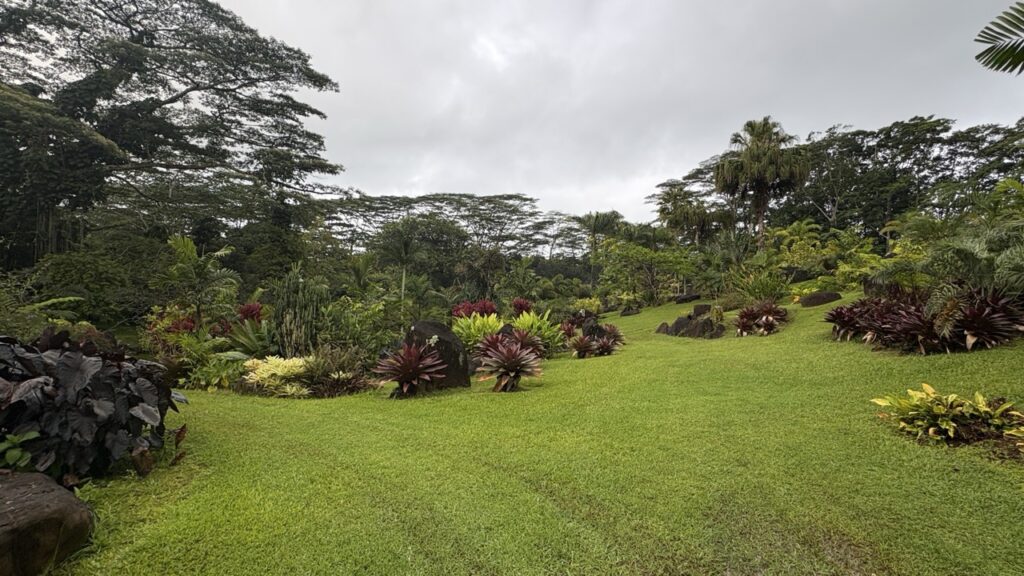
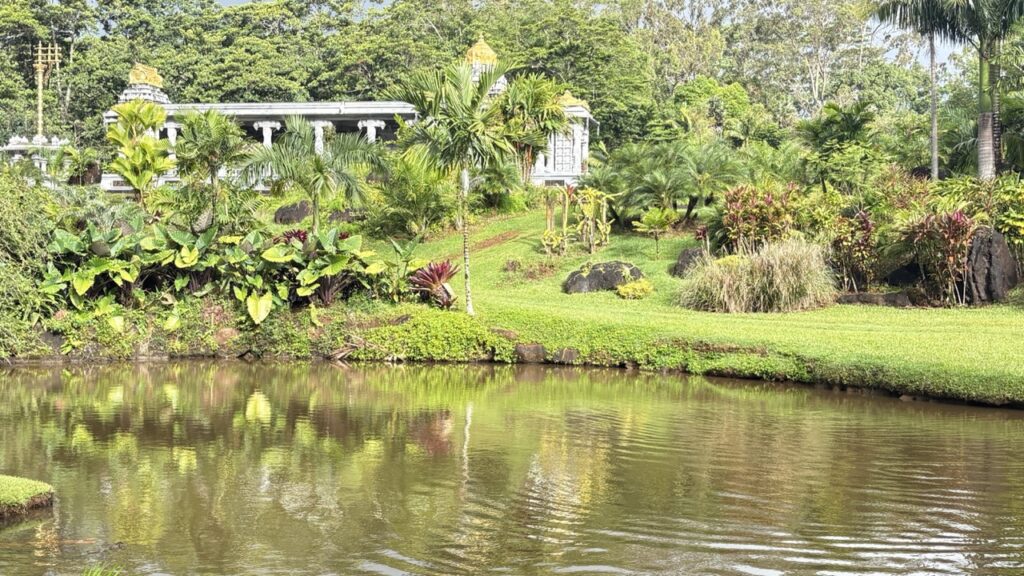
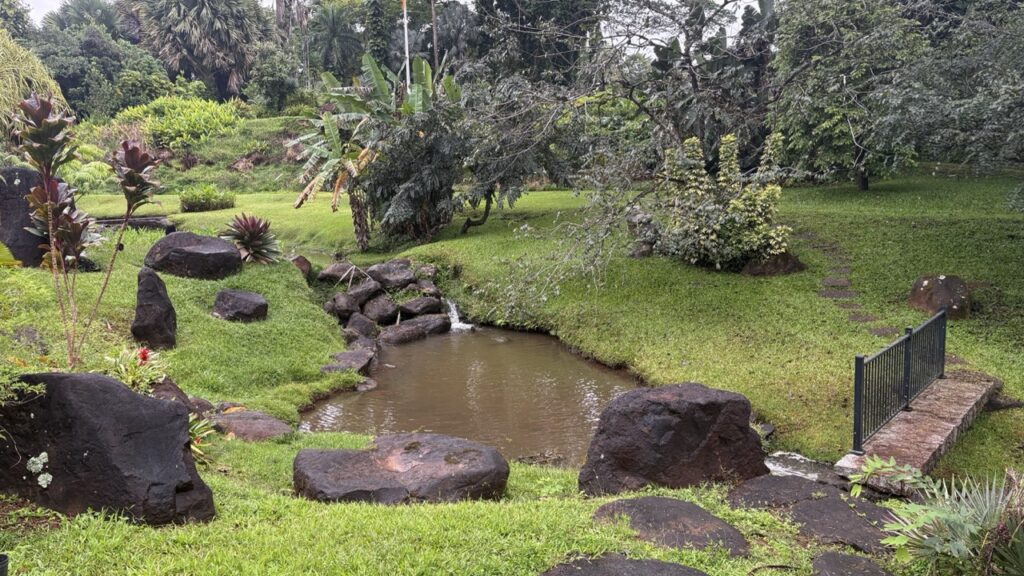
This morning, while in Rishi Valley (just 100 feet East of Iraivan Temple for those unfamiliar) inspecting some minor pig damage from their nighttime foraging, we were struck by the beauty of the pond and the surrounding landscape. You know the experience: we see something day after day and then, suddenly, it reveals itself in a fresh and completely different way.
That happened today, and our minds drifted back through the many years of clearing land, making paths, creating waterfalls and ponds, reshaping the terrain, planting, planting and planting some more. We have come a long way.
Back at our computers, we found an old photograph taken during the valley’s early development. It looked so raw and rugged. We thought it would be fun to share a glimpse of what the valley looked like then and how it appears today.
Use the slider to move back and forth between past and present.
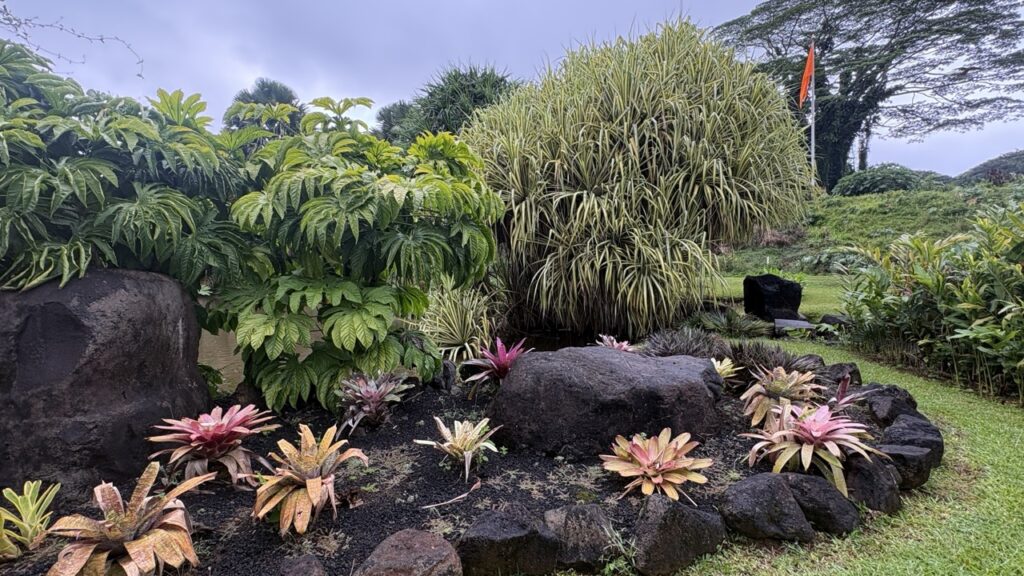
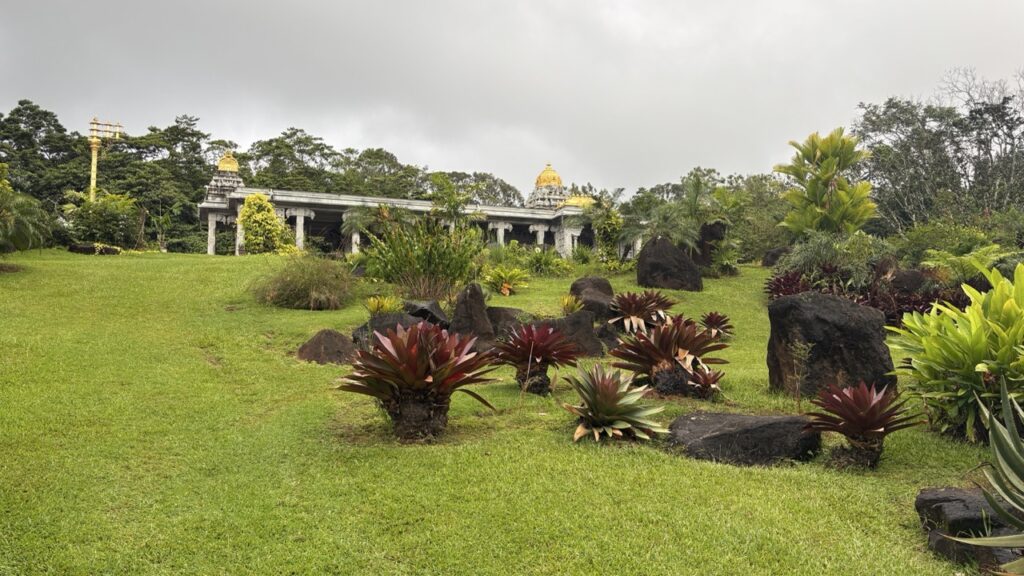
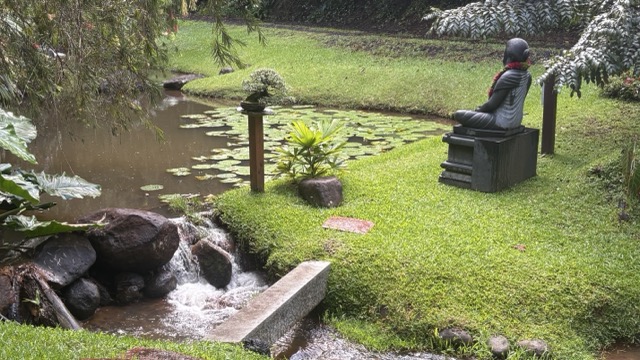
Photos from today’s walk through the monastery sacred garden on Kauai
Today’s amble through the monastery’s sacred gardens became a meditation on water — among the most common substances on Earth, yet also one of its rarest treasures. Without it, no garden could flourish, no forest could endure and no human life could continue. On our island of Kauai, water appears in many forms at once: rushing rivers, quiet pools, misting rain, waterfalls tumbling over volcanic stone and delicate droplets resting silently on lotus leaves. It is an essential offering to Siva in the temple sanctum during abhishekam. Clear water appears empty, but contains 5-6 million forms of life in a single drop. Patiently, persistently, unceasingly, water moves toward its source, the sea, just as the soul moves toward God.
Water is endlessly adaptable. It accepts every shape without losing its own essence. It yields to obstacles and moves around them effortlessly. It can appear gentle enough to cradle a lotus leaf, yet powerful enough to carve valleys through stone over thousands of years.
Scientifically, water is astonishing. A simple molecule made from two hydrogen atoms and one oxygen atom forms the basis of nearly all life on Earth. Its unusual properties allow plants to draw moisture upward against gravity, help living cells regulate temperature and enable oceans to store immense amounts of heat that stabilize the planet’s climate.
In Hindu thought, water has always carried sacred meaning. It purifies, renews and restores. Temples are traditionally built beside rivers, tanks or oceans, recognizing water as both a physical necessity and a spiritual symbol. Watching the streams move through the monastery gardens today, one is reminded that water teaches by example. It yields, adapts, nourishes and continues moving forward without resistance.
We have much to learn from water’s ways.
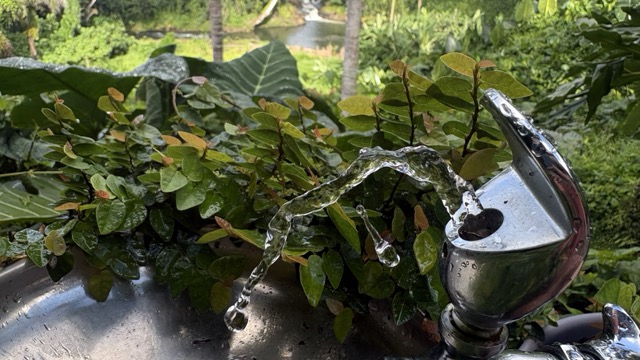
A drinking fountain stream arcs gracefully through the air, suspended for an instant before returning to earth. The river waterfall observes from the distance.
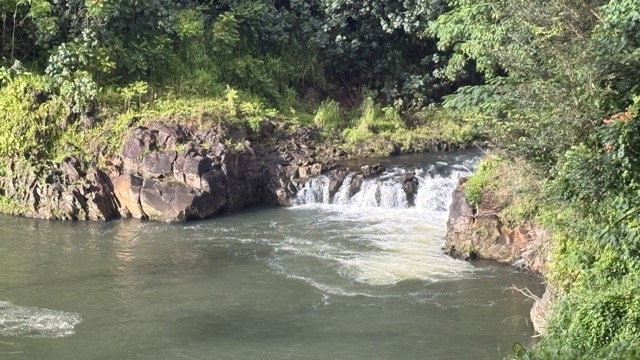
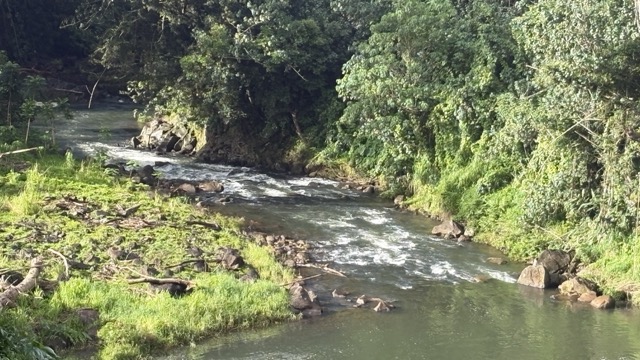
The Wailua River winds through dense greenery, carrying fresh mountain waters to the ocean.
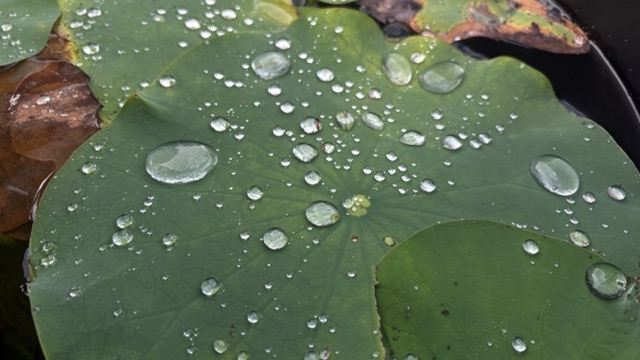
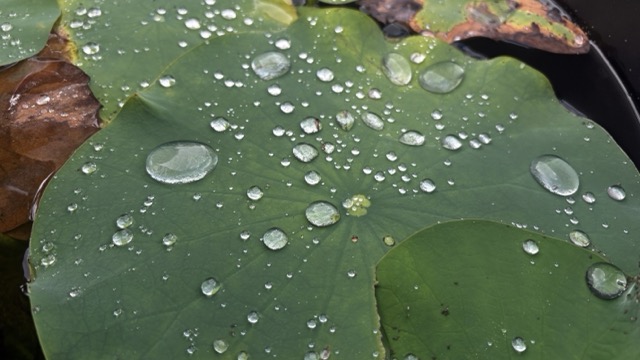
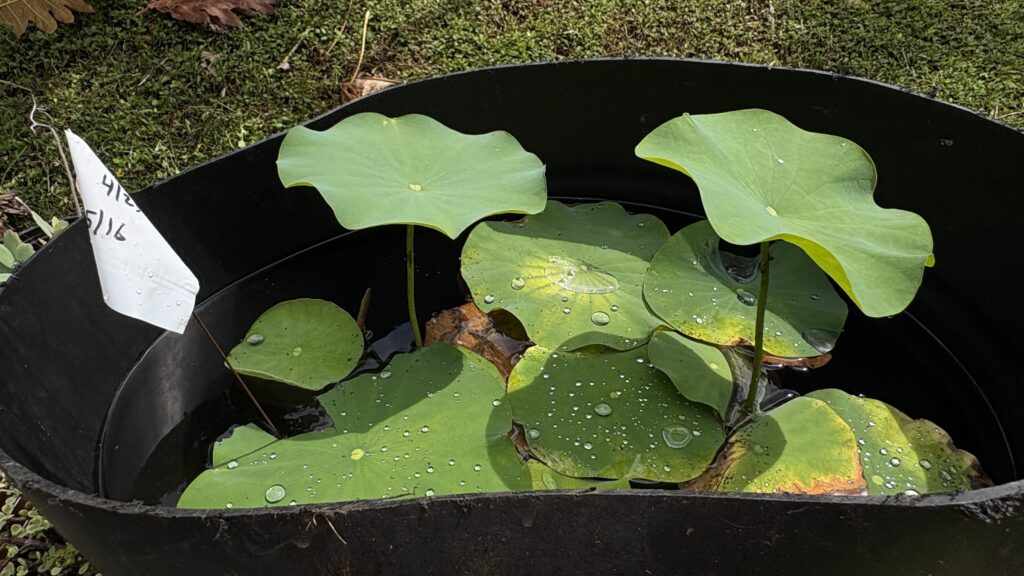
Lotus leaves float peacefully atop a small pond, collecting drops of fresh Kauai rain.
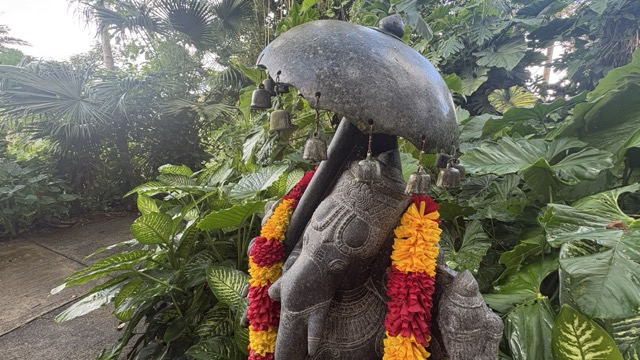
Knowing He would be outdoors in the tropical rains, we provided Ganesha with an umbrella.
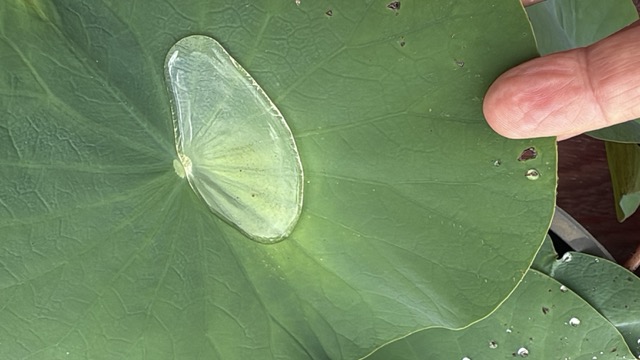
A tiny pond of water rests perfectly upon a lotus leaf, unattached, as we should be.
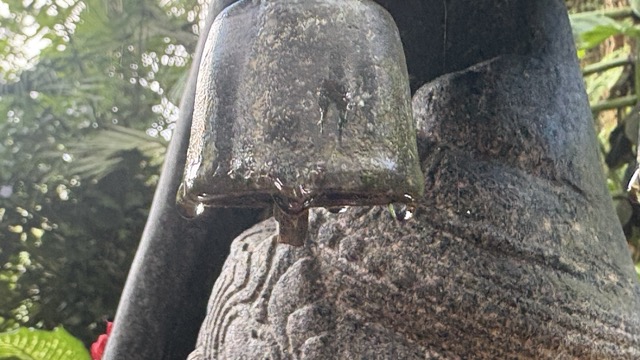
Four drops of water gather on the small bell attached to the umbrella.
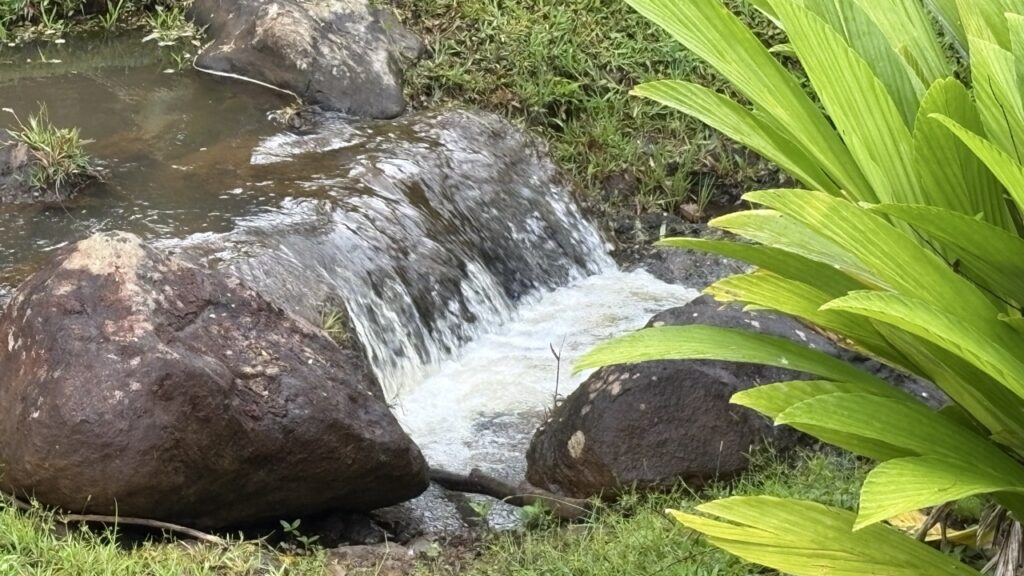
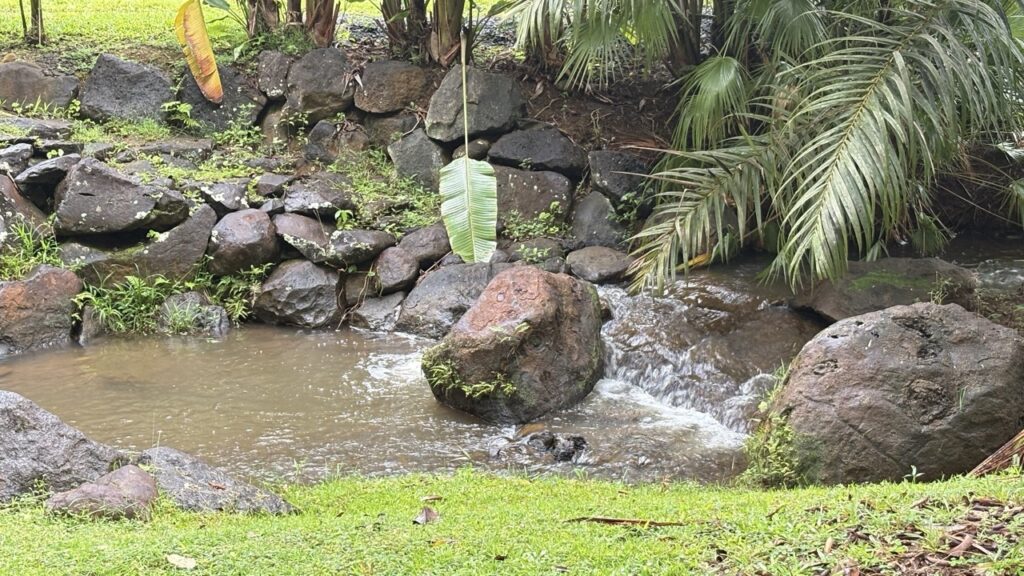
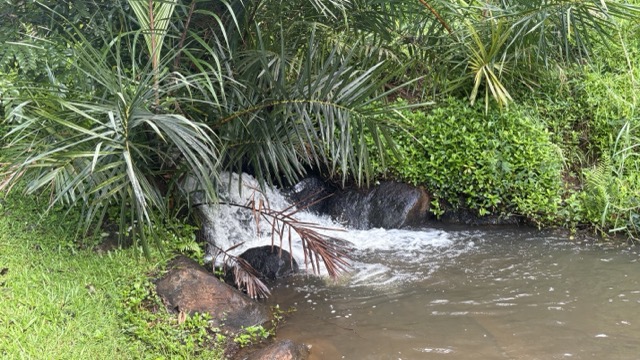
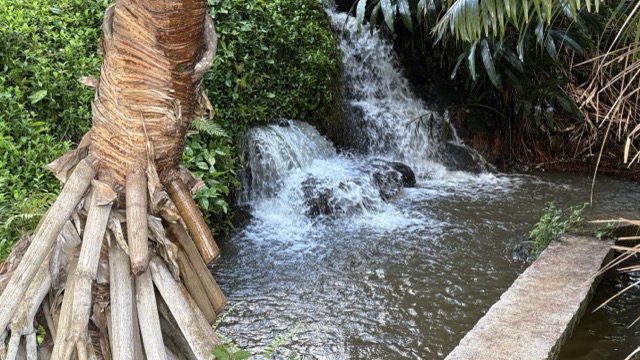
One of many falls, this one emptying into Rishi Valley Pond.
Getting the water under the paths and roads. Not pretty, but oh-so-necessary.
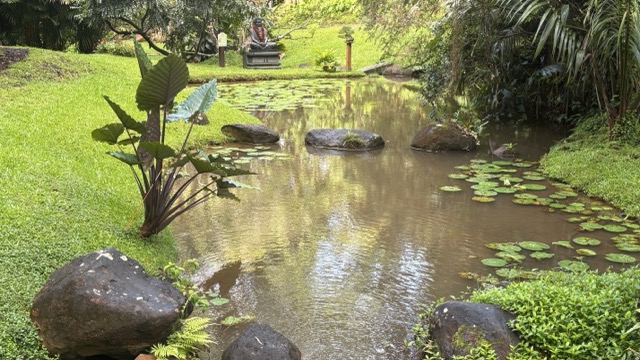
Water lilies looked after by Yogaswami in the distance.
Raindrops on the lotus leaf.
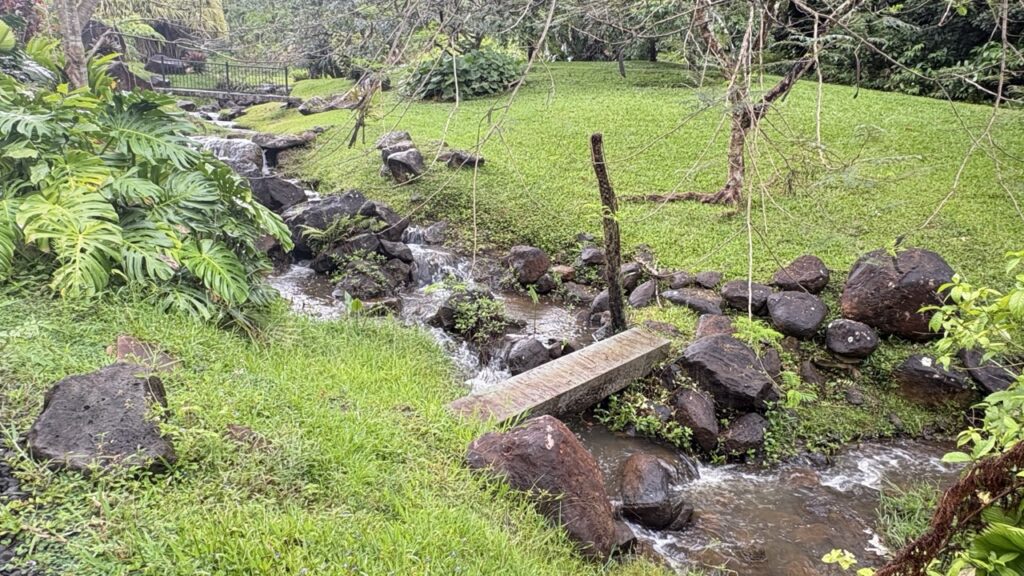
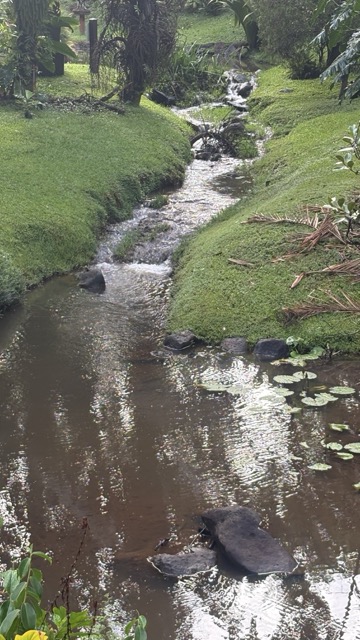
Narmada Stream connects two ponds.
Wailua River moves toward the sea, 3 miles away.
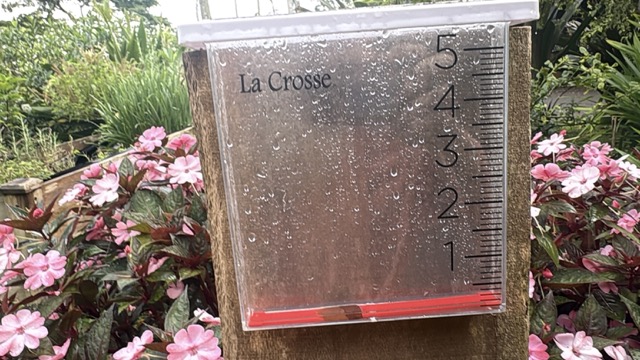
The monks log any rainfall over .5 inche. We get about 100 inches a year!
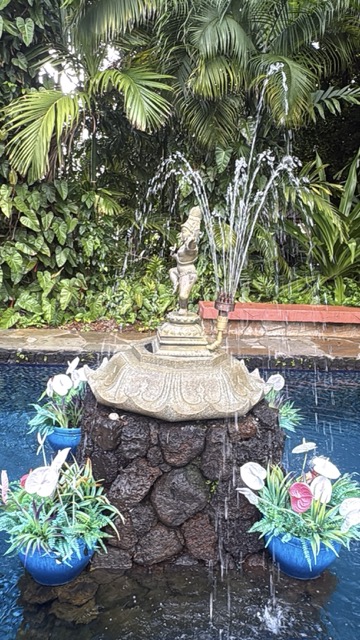
Saint Sambandar dances in his fountain.
A seldom traveled path in the garden.
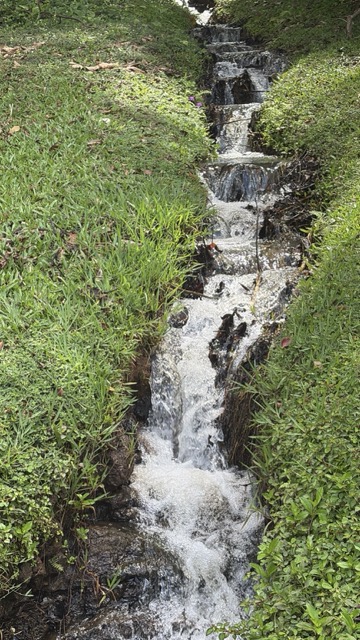
Cascading down a steep slope.
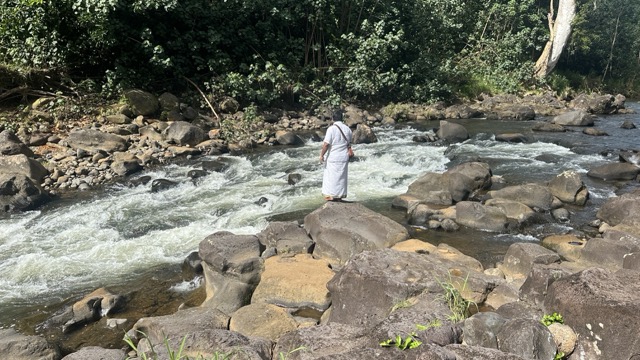
Pilgrims love the solitude of the river rocks.
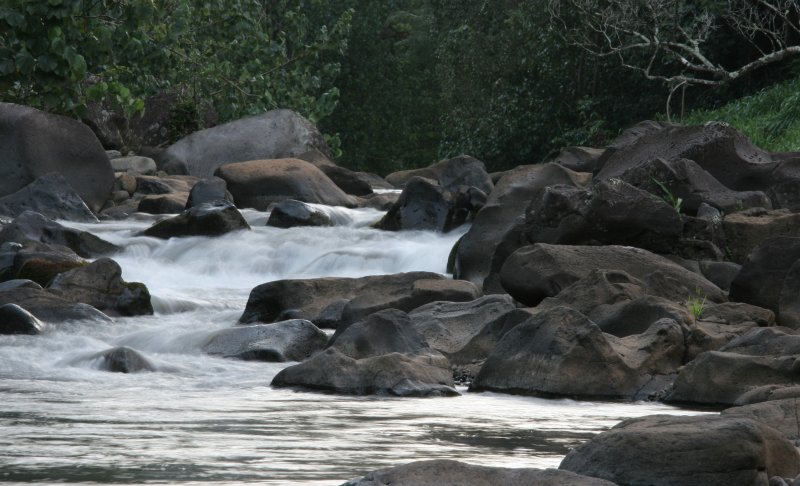
Black rock and water, what a combination.
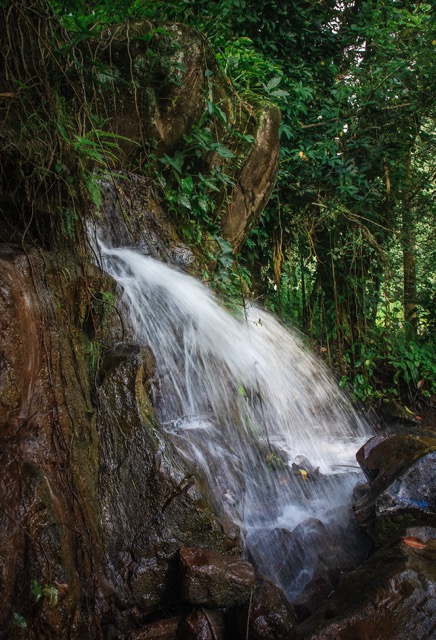
Bali Hai waterfall, just 15 feet away from falling into the river.
A carefully set exposure.
Small fall near Yogaswami’s murti.
Looking straight down as water enters the Narmada pond.
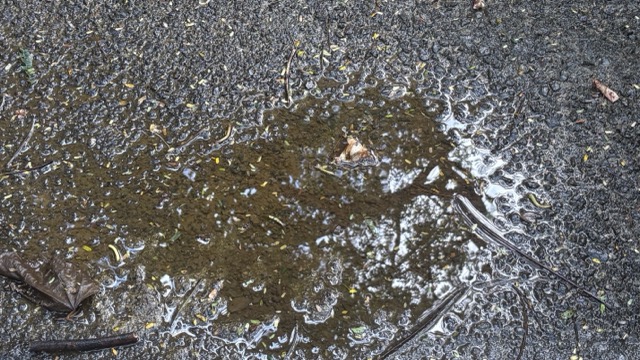
A shallow rain puddle captures fleeting reflections of sky, leaves and passing clouds.
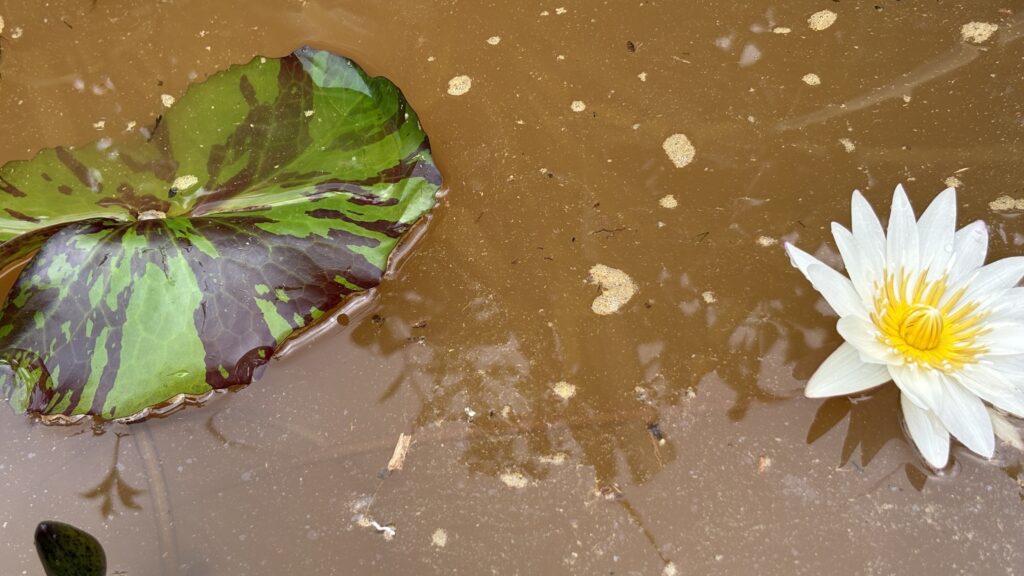
Lotus can be distinguished from water lilies by the fact that they hold their leaves above the water when mature.
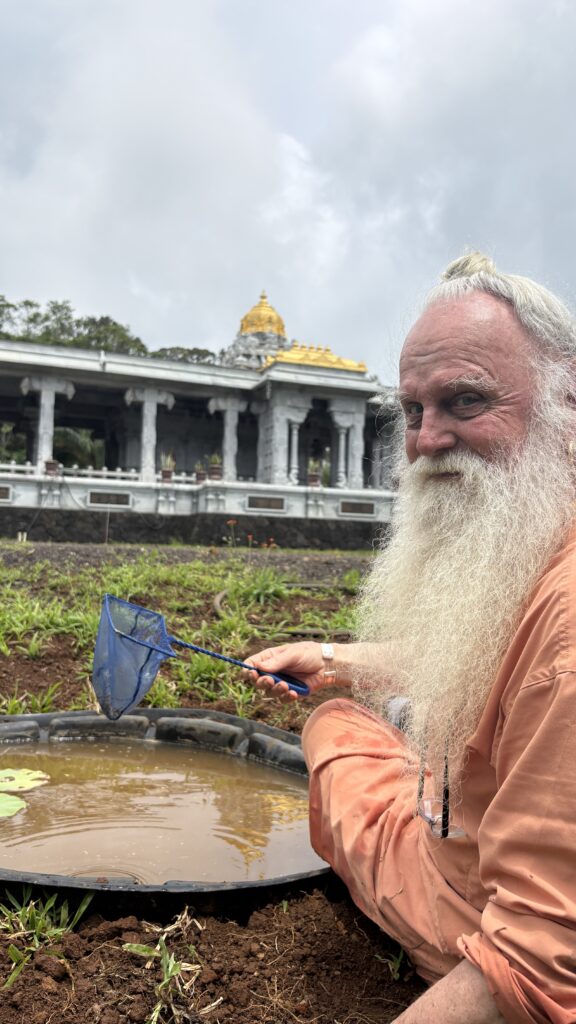
Swami adds the small fish.
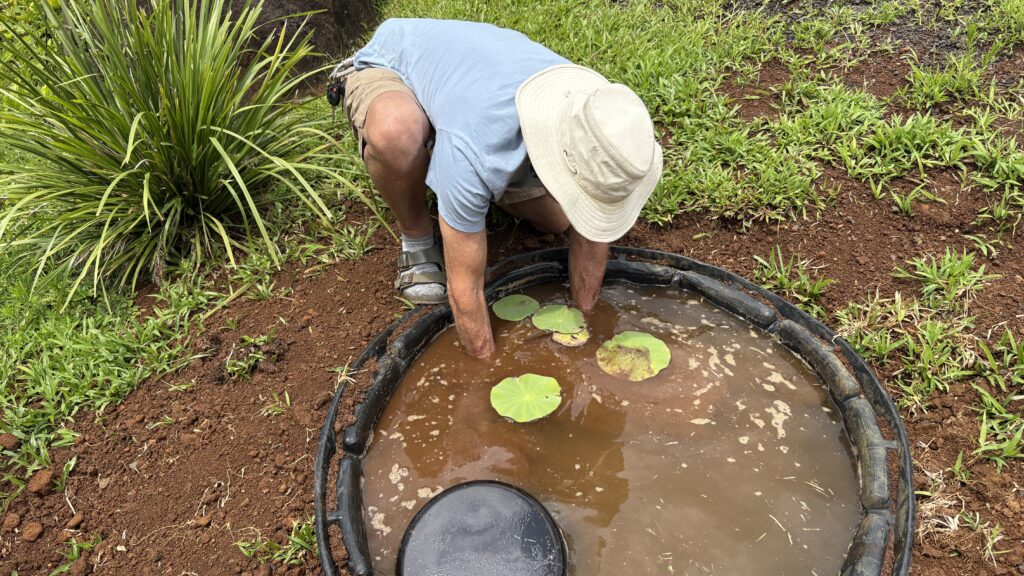
Ken places the first lotus, the American Yellow, into its pot
One of the water lilies is already blooming
The lotus propagation area
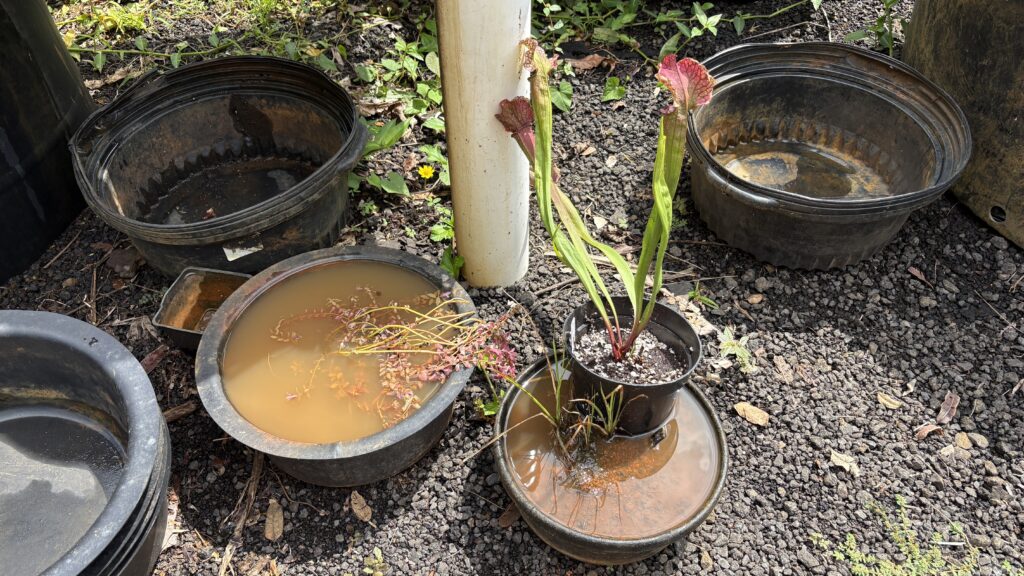
That tall pink plant is an aquatic carnivorous plant Ken brought.
More to come…..
The Saga Continues
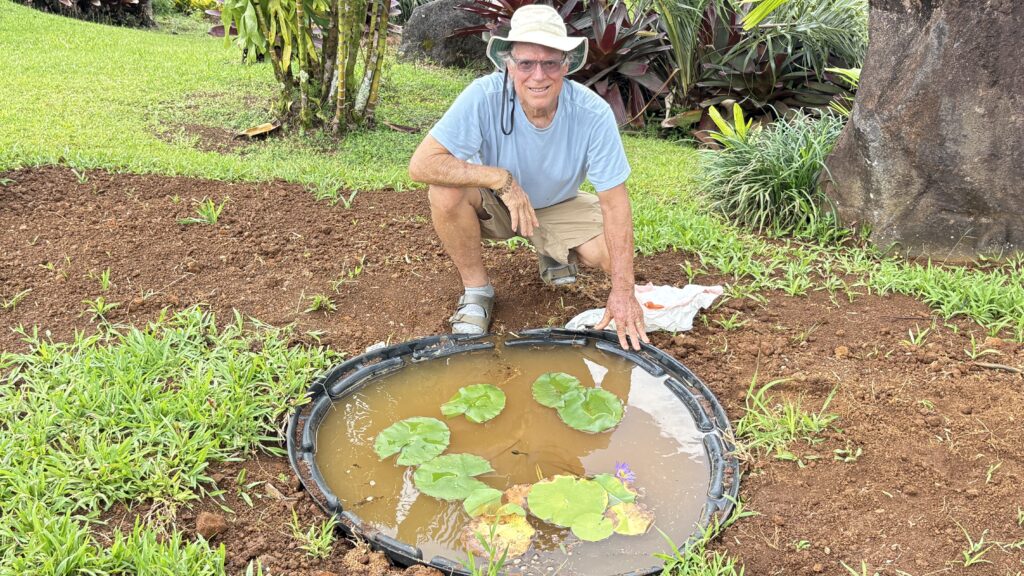
We have shared recently how lotuses that were once super abundant in our ponds were totally eaten by the ravenous tilapia fish some years back. Inspired by two pilgrims, we have successfully (with the help of Kauai’s lotus whisperer, Ken Bernard) established just yesterday seven lotuses in seven 130-gallon pots buried in the ground. Ken also brought water lilies and five fast-growing aquatic plants. These will provide interest in the pots when the lotuses naturally die back and hibernate. He also introduced some small red platies fish and a few small snails who, as they multiply, are to become the maintenance crew.
Ken brought an abundance and with the additional plants he and Sadasivanathaswami set up a small Water Garden Propagation Area with the idea that when these lotuses and water lilies in smaller pots bloom they can be displayed at the Iraivan Temple entrance for all pilgrims to enjoy for a few days or weeks.
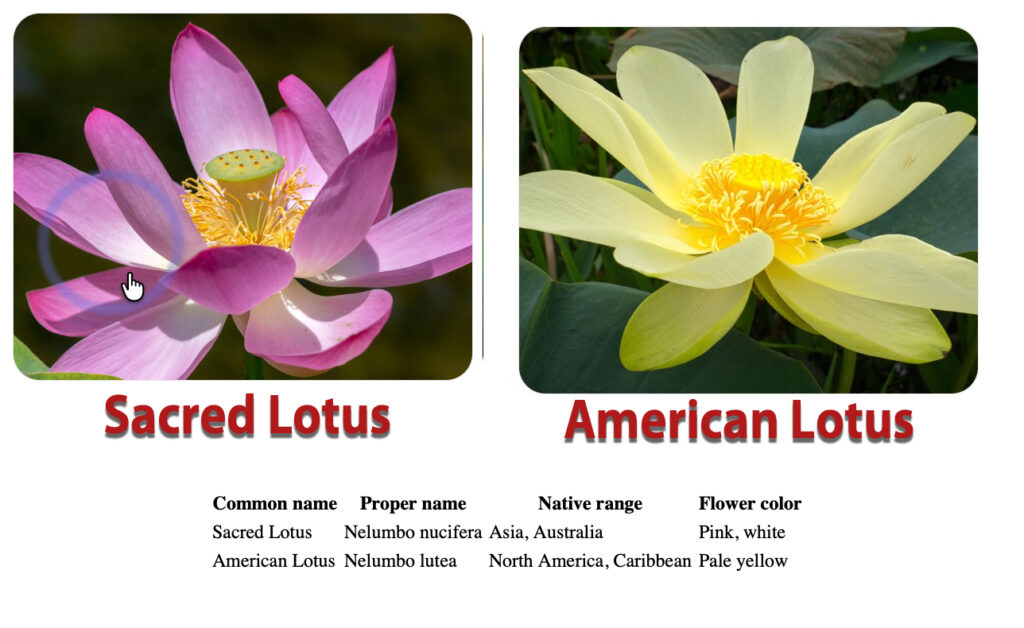
We learned from Ken that there are only two true species of lotus on the planet, the Asian Sacred Lotus and the American Yellow Lotus. Ken remarked that their new home, being half Indian and half American is an apt place for these two. And, he added, lotuses have been on the Earth for 130 million years, and are among the earliest flowering plants.
Factoids
Lotus has several unusual features that fascinate botanists:
Thermal flowers
Some lotus flowers can regulate temperature slightly, which is rare among plants.
Extremely durable seeds
Sacred lotus seeds have germinated after more than 1,000 years. One famous Chinese lotus seed was dated to around 1,300 years old and successfully sprouted.
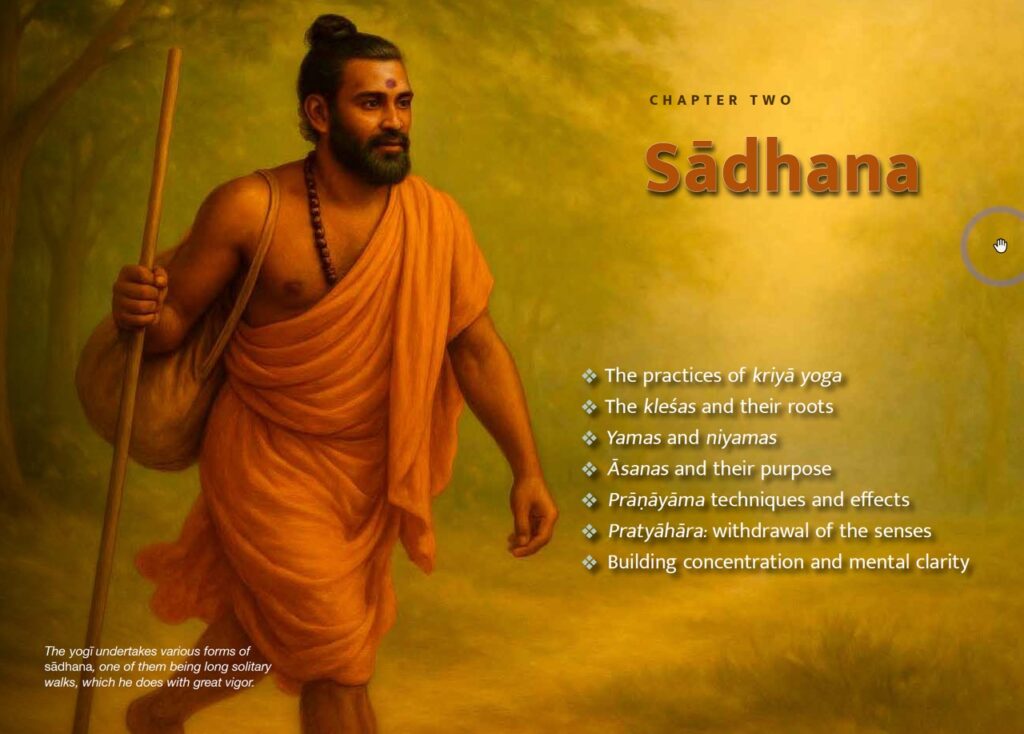
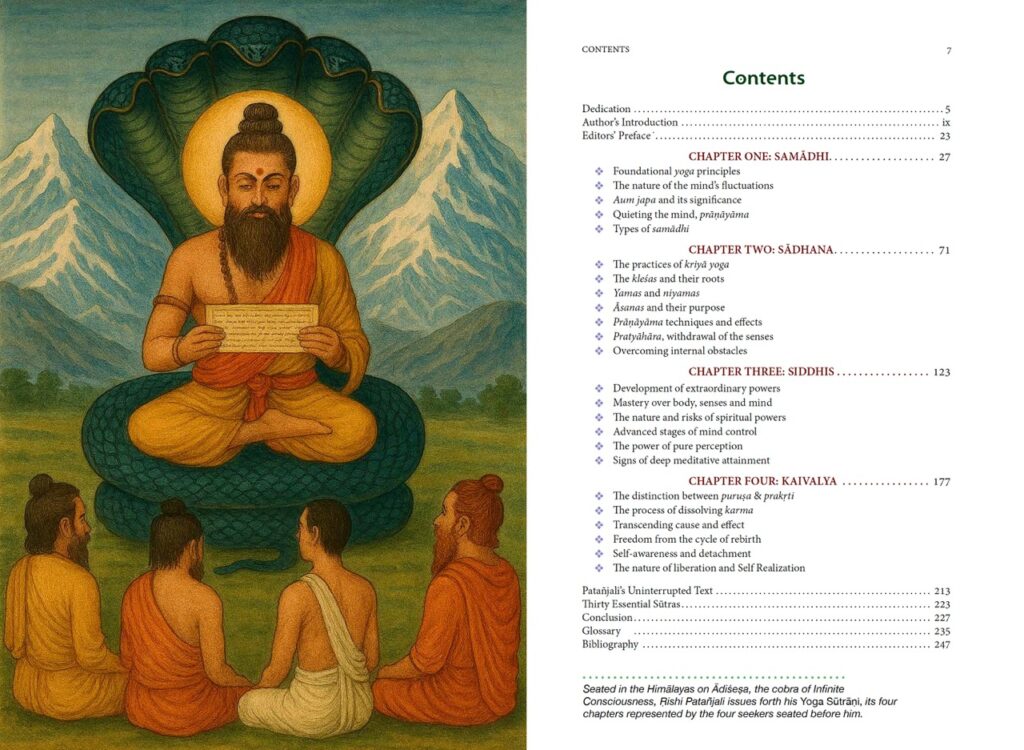
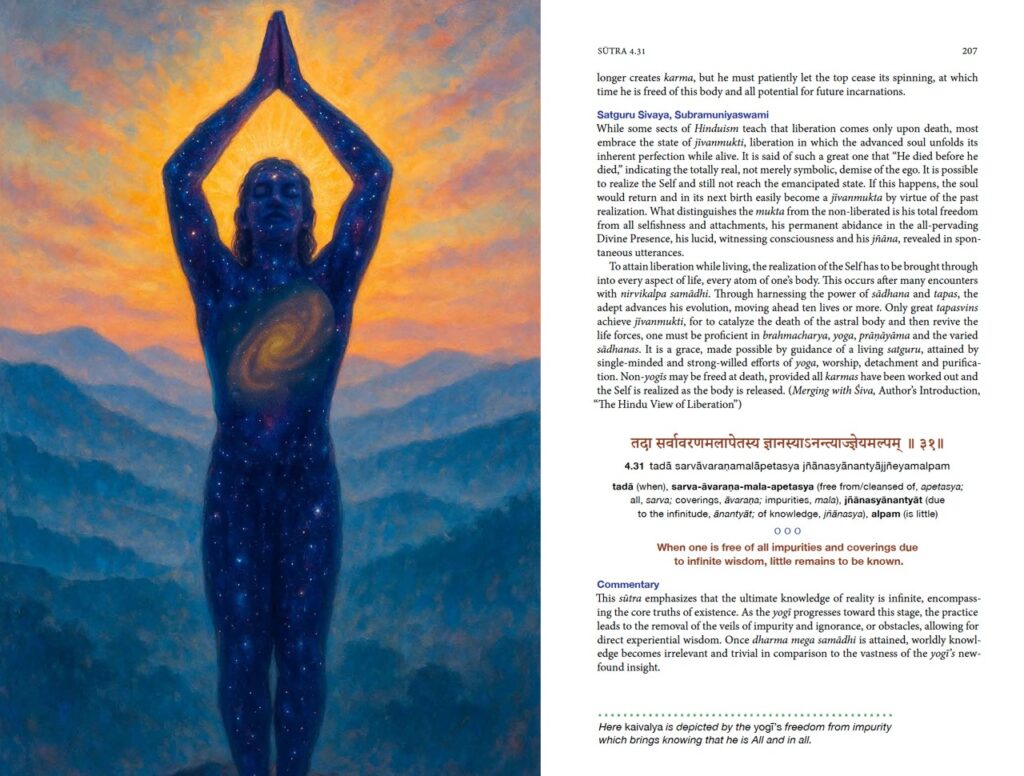
Image depicting kaivalya, when the yogi sees he is in Siva and Siva is in him.
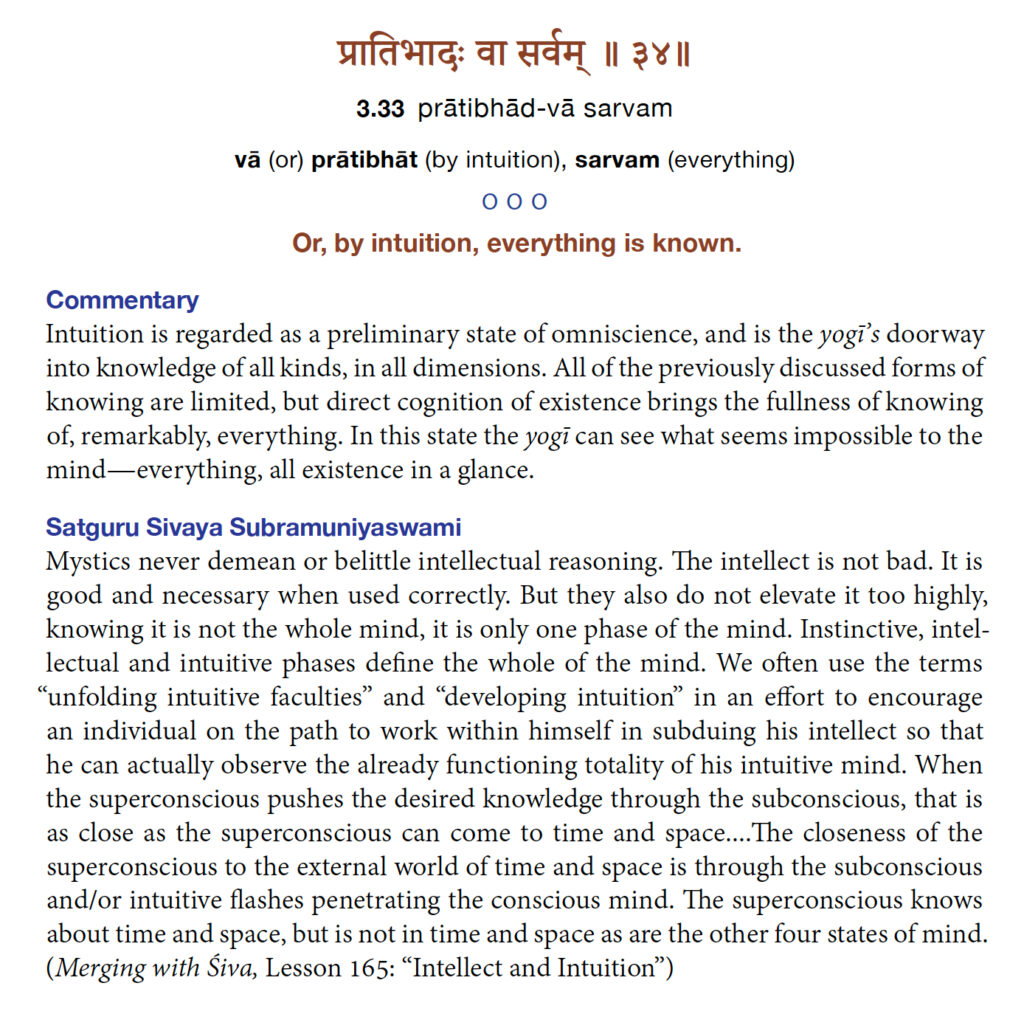
A typical sutra, one of 196 in the text
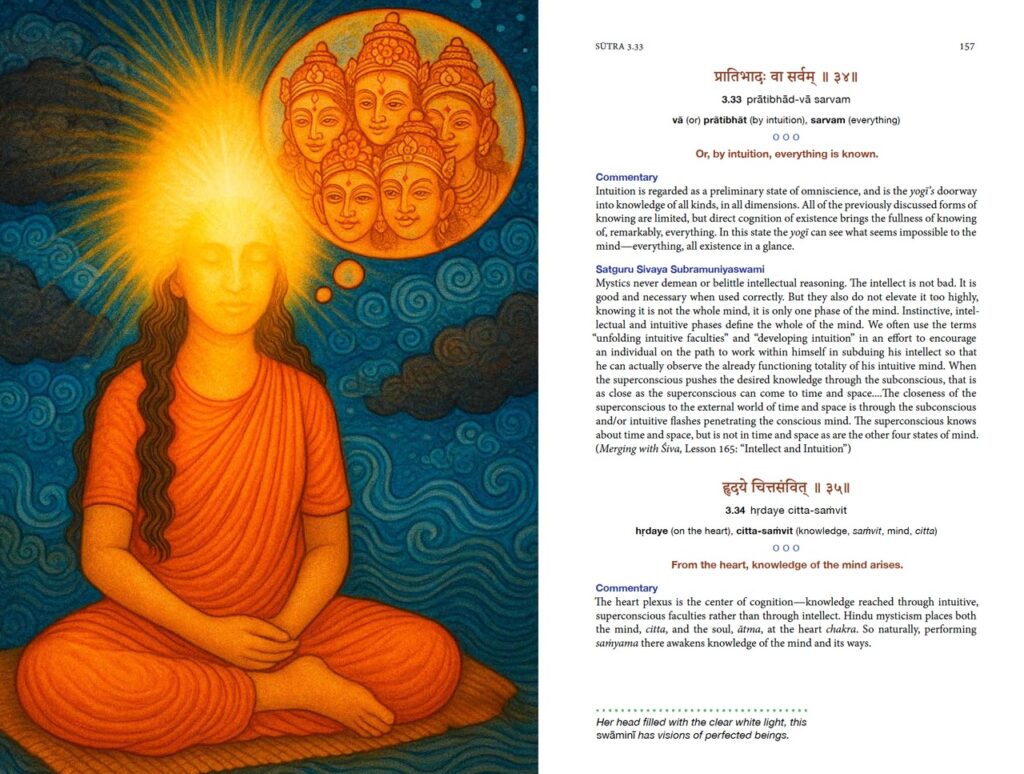
Her head filled with light, the swamini has visions of perfected beings.
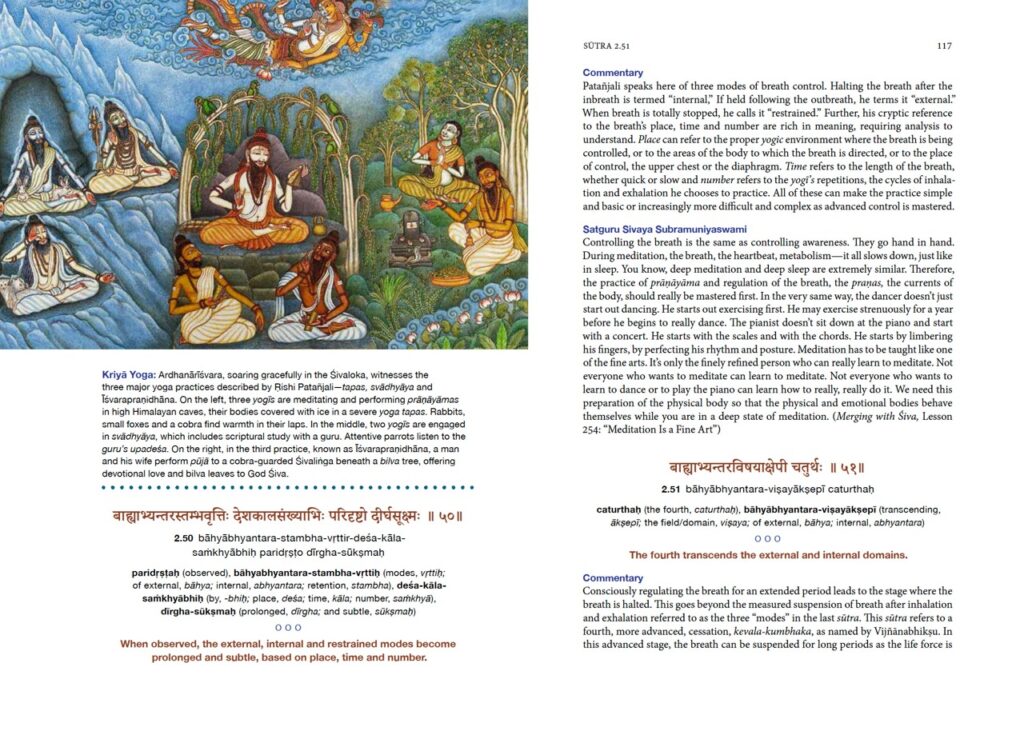
Ten of the art pieces are the work of Suresh Muthukulam, a Kerala muralist. Here he is depicting austerity, self-study and worship of God: tapas, svadhyaya and Ishvara pranidhana.
Bengaluru’s Jayendrapuri Swami Extols the Book
Last month we asked Jayenderapuri Swami to comment of Satguru Bodhinatha Veylanswami’s amazing Yoga Sutras book. Yesterday he responded with such a full-hearted assessment we wanted all CyberCadets to have it. Swami is uniquely positioned to comment on the book, having spent his life in its study and practice. You will enjoy his nuanced take on what makes Bodhinatha’s book unique.
Book Review of Patanjali’s Yoga Sutras
Swami writes: The perennial quest of mankind, as has been profoundly echoed through the sacred traditions of
Sanatana Dharma, is not merely to live, but to know—to realize, to awaken to that eternal, unchanging
Reality which shines as the very substratum of existence, the silent witness of all modifications, and the
immutable essence behind the ever-changing panorama of life. In this exalted pursuit, the timeless work
Patanjali’s Yoga Sutras stands as a radiant beacon, guiding earnest seekers toward the direct realization
of their own true nature.
At the very outset, one is struck not merely by the intellectual precision of the sutras, but by their deeply
experiential orientation. Unlike many philosophical treatises that dwell extensively in abstraction, the
aphorisms of Patanjali offer a direct and methodical pathway—an inner science—through which the
aspirant may transcend the limitations of the mind and abide in the supreme stillness of pure
consciousness. The celebrated declaration, yōgaś-citta-vr̥tti-nirōdhaḥ, encapsulates the entire
essence of this path. Yoga is not merely physical discipline, nor philosophical speculation; it is the
cessation of the fluctuations of the mind. If the restless modifications of the mind are the cause of
bondage, their mastery alone opens the gateway to liberation.
The rendering of these sutras by the Himalayan Academy, through the translation of Satguru Bodhinatha
Veylanswami, extracted from the treasury of works of Gurudeva Sri Sivaya Subramuniya Swami,
resonates deeply with the timeless wisdom of the Upanishads, wherein the mind is both the cause of
bondage and liberation. The text does not stand in isolation but is presented as part of the grand
continuum of Vedic and Agamic thought. The division into four padas—Samadhi, Sadhana, Vibhuti, and
Kaivalya—is not merely structural, but symbolic of the aspirant’s inner evolution: from the initial glimpse
of stillness, through disciplined practice, past the temptations of extraordinary attainments, and finally
into the consummation of absolute freedom.
Within this illuminating framework, the exposition of Ashtanga Yoga—the eightfold path—restores Yoga
to its original sanctity and completeness. Yama and Niyama are not external moral impositions but
essential purifications of the inner instrument. Asana becomes a means to steadiness rather than an
end in itself; Pranayama unfolds as mastery over the vital force; Pratyahara reveals the art of inward
withdrawal—not suppression, but transcendence. Dharana matures into Dhyana, and Dhyana
culminates in Samadhi, where the triad of knower, knowing, and known dissolves into non-dual
awareness.
Yet, what elevates this edition of Patanjali’s Yoga Sutras into a rare and luminous category is the
profound spiritual authority and experiential authenticity brought forth by Sivaya Subramuniyaswami,
reverentially addressed as Gurudeva Sri Sivaya Subramuniya Swami, and the deft, disciplined, andcompassionate exposition of Bodhinatha Veylanswami, revered as Satguru Sri Bodhinatha
Veylanswami.
It must be stated without reservation that the depth of knowledge embodied by Gurudeva Sri Sivaya
Subramuniya Swami is not merely intellectual. It is born of direct realization, refined through intense
tapas, and sanctified through decades of guiding seekers along the inner path. His insights are not
speculative commentaries but living truths—arising from the stillness of meditation and the clarity of
Self-experience. In his hands, each sutra becomes vibrant, pulsating with spiritual force, revealing
layers of meaning that remain hidden to superficial reading.
His grasp of the subtle workings of the mind is particularly extraordinary. When elucidating the
foundational principle of Yoga, he does not merely define mental restraint but leads the aspirant into a
direct encounter with the restless nature of consciousness itself. His words carry the authority of
realization, possessing the rare capacity to instruct, inspire, and transform simultaneously.
Equally remarkable is Gurudeva Sri Sivaya Subramuniya Swami’s integrative vision. He harmonizes the
rigorous discipline of Yoga with the devotional richness of temple-centered Hinduism, dissolving
artificial divisions between bhakti, karma, jnana, and raja yoga. For him, these are not separate paths
but complementary streams converging toward the same महासागरः of realization. This synthesis reflects
not only scholarship but an all-encompassing spiritual vision rooted in lived experience.
If Gurudeva represents the vast ocean of spiritual wisdom, then Satguru Sri Bodhinatha Veylanswami
stands as the master navigator who guides seekers across its depth with precision and grace. His
handling of the text is truly deft in the highest sense. He neither dilutes the profundity of the teachings
nor burdens the reader with unnecessary complexity. Instead, he unfolds the insights with clarity,
balance, and accessibility, ensuring that the essence remains intact while becoming approachable for
the modern aspirant.
Where Gurudeva’s voice resounds with the authority of realization, Satguru Sri Bodhinatha
Veylanswami’s exposition reflects the clarity of a teacher who has deeply internalized that wisdom. His
interpretations bridge the distance between ancient aphorism and contemporary understanding,
making the teachings immediately relevant without compromising their sanctity.
His treatment of the Vibhuti Pada is particularly commendable. In an age where fascination with siddhis
can easily distract the aspirant, he maintains unwavering focus on the ultimate goal. While
acknowledging these powers, he gently but firmly redirects attention toward the higher उद्दे श्यः—the
realization of the Self. Similarly, in the Kaivalya Pada, his exposition reveals philosophical clarity and
experiential depth, guiding the reader toward the recognition that liberation is not an attainment in time,
but the unveiling of one’s eternal nature.
A feature of exceptional significance in this work is its presentation of the Yoga Sutras through the
illuminating lens of Saiva Siddhanta—a perspective that is indeed rare and perhaps one of its kind in the
vast landscape of yogic literature. Traditionally, the sutras have been interpreted through various
philosophical frameworks; however, under the realized vision of Gurudeva Sri Sivaya Subramuniya
Swami and the refined articulation of Satguru Sri Bodhinatha Veylanswami, they are revealed through
the profound metaphysical and devotional framework of Saiva Siddhanta.
This approach is not merely interpretative but deeply revelatory. It brings into harmonious alignment the
disciplined psychology of Yoga with the rich theology of Saiva Siddhanta—where the relationship of Pati
(the Lord), Pasu (the soul), and Pasa (the bonds) provides a comprehensive understanding of spiritual
evolution. Here, the restraint of the mind is not an isolated practice but part of a larger journey toward
union with Lord Siva—not as an abstract principle, but as a living, experiential Reality.In this synthesis lies the true uniqueness of the work. It serves as a profound unifying force between two
of the most ancient streams of thought in Bharat—the analytical, introspective discipline of Yoga and
the devotional, metaphysical richness of Saiva Siddhanta. What may appear as divergent paths are
revealed here as complementary dimensions of the same eternal truth.
This unification carries immense significance for the modern aspirant. It affirms that spiritual life need
not be fragmented—that one may pursue deep meditation while remaining anchored in devotion, that
inner stillness and divine worship are not contradictory but mutually enriching. The ultimate goal
described by Patanjali as Kaivalya is shown to be in consonance with the Saiva Siddhanta realization of
union with Siva, dissolving conceptual boundaries and inviting a more holistic spiritual vision.
Throughout the text, one perceives a harmonious integration of dualistic and non-dualistic insights.
While distinctions are acknowledged for the sake of clarity, the culmination transcends all duality. This
delicate balance reflects the wisdom of the great masters who have celebrated the diversity of
expression while affirming the unity of essence.
The language of the work deserves special appreciation. It is at once elevated and accessible, imbued
with reverence yet free from unnecessary complexity. More importantly, it carries a subtle spiritual force.
This is not merely a text to be read, but a scripture to be lived. Each sutra is a seed; each reflection, a
call to introspection; each page, an invitation to transformation.
In the context of the modern world—marked by unprecedented external advancement and inner
unrest—the relevance of such a work cannot be overstated. The mastery of the outer world has not
yielded mastery of the inner. The Yoga Sutras address this imbalance at its very root, offering a timeless
pathway to inner harmony and ultimate freedom.
The role of the Guru, though subtle, pervades the entire work. The journey inward, while deeply personal,
is illumined by the guidance of those who have realized the Truth. In this regard, the combined presence
of Gurudeva Sri Sivaya Subramuniya Swami and Satguru Sri Bodhinatha Veylanswami transforms this
edition into a living transmission rather than a mere intellectual exercise.
Thus, what emerges is not simply a commentary, but a confluence—a sacred संगमः of realization,
discipline, devotion, and wisdom. It stands as a testament to the अखण्डता of Sanatana Dharma, where
diverse streams merge into the ocean of Truth.
In conclusion, Patanjali’s Yoga Sutras is not merely a philosophical treatise nor only a manual of
practice. It is a mirror wherein the aspirant beholds the Self, a मागगदर्गकः leading from ignorance to
knowledge, from restlessness to peace, from bondage to freedom.
May all who approach this sacred work, which has been worked on by Satguru Bodhinatha Veylanswami
and the senior swamis here for several years, with a goal of providing a translation and commentary in
the context of Saiva Siddhanta. with humility, श्रद्धा, and sincerity be blessed with the clarity to
understand, the strength to practice, and the grace to realize the supreme Truth.
With these reflections, we place this humble offering at the lotus feet of Patanjali, and bow in reverence
to Gurudeva Sri Sivaya Subramuniya Swami and convey our Om Namo Naarayanaaya and Om namah
Shivaaya to Satguru Sri Bodhinatha Veylanswami, whose wisdom continues to illumine the path of
The concrete team is forming up the path. The narrow white lines are the 2 x 4s they are installing.
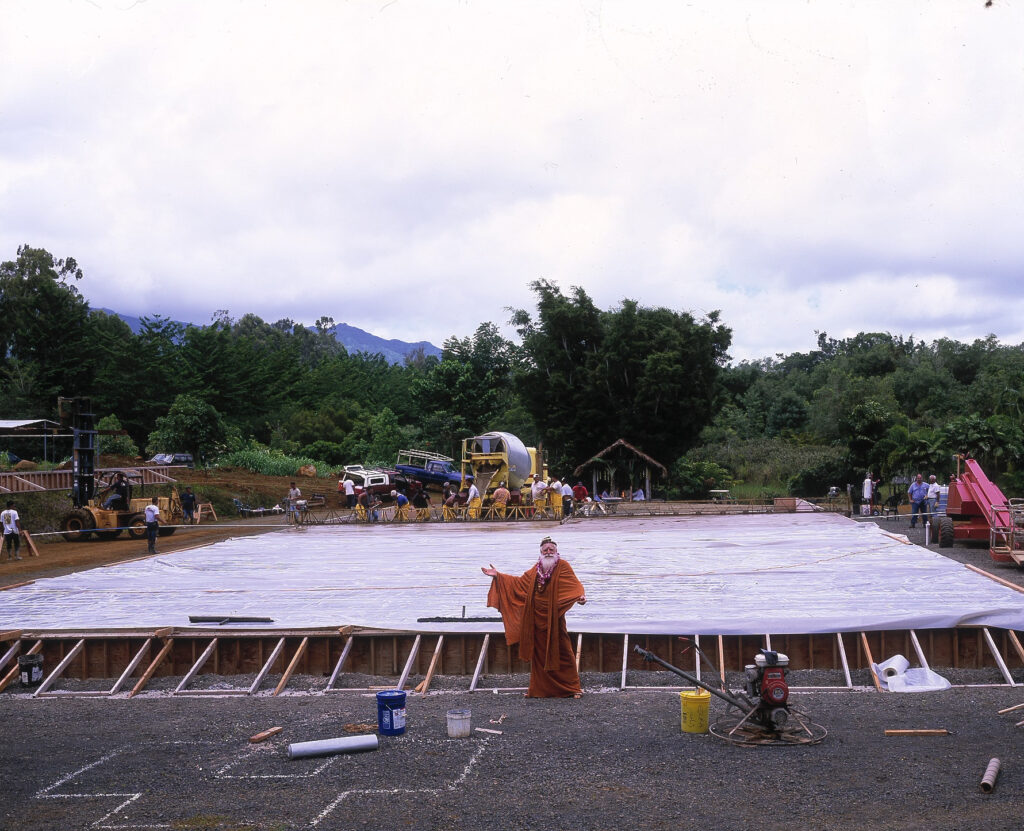
A happy Gurudeva celebrates the concrete pour of the foundataion, which took 108 cement trucks!
The temple is marked on top of the engineered fill (which is four feet deep in the ground) to guide the forming of the above ground concrete foundation
For form takes shape on three sides following the careful markings.
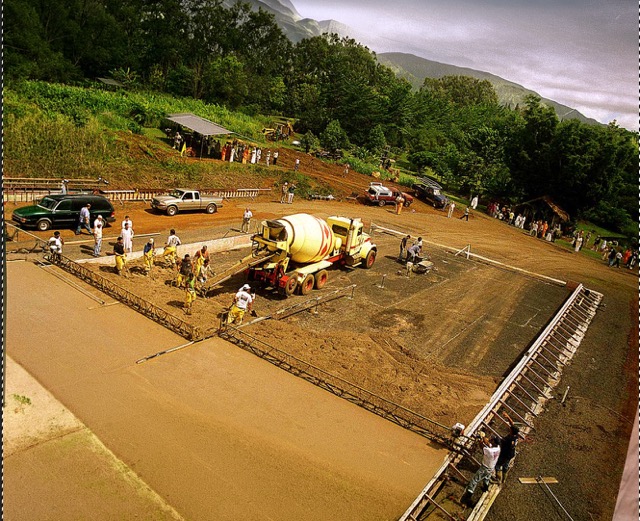
Concrete trucks line up all day long delivering the special fly-ash concrete mix.
It’s hard work but the crew is strong and skilled.
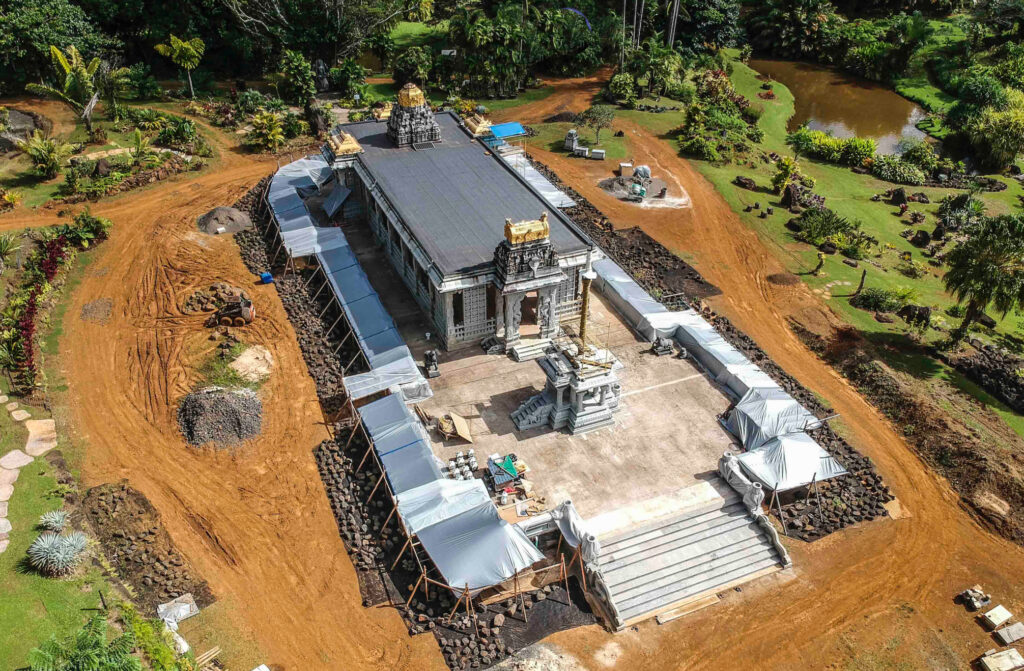
Showing the installation of the lava rock plinth, which took years to complete.
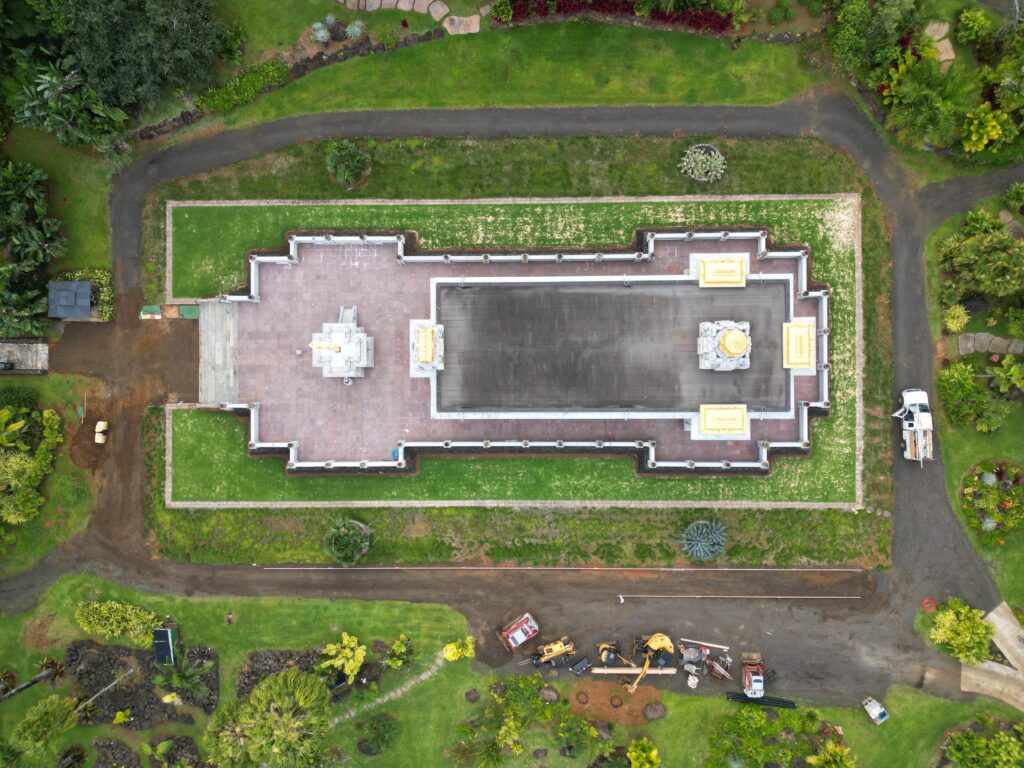
As the Garden Path surrounding Iraivan Temple takes shape (the first concrete trucks arrive tomorrow), we reflect on how far it has come in recent years. Building such an architectural gem on a remote island presents special challenges, and those challenges have been overcome one by one with Gurudeva’s inner guidance and blessings and Bodhinatha’s practical genius.
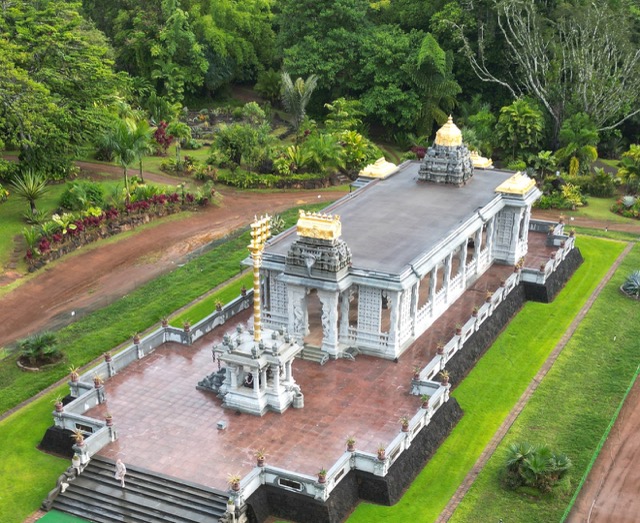
The Garden Path has several purposes. First, it will provide safe, mud-free walking access to Iraivan. Second, it will make maintenance in and around the temple (such as landscaping and stone cleaning) more efficient for our electric vehicles. Third, it will provide an elegant circumambulation path for pilgrims and for the annual chariot parade which carries Satguru around the temple on Guru Purnima. Fourth, it is the last unfinished major component of the temple, tying together the mature and beautiful landscaping that took decades to create and the completed-three-years-ago granite Siva temple.
Before & After Slider
Below is a shot of the foundation pour in 1999 and almost the same angle photo of the completed temple. Slide back and forth to see the changes.

 This is the state flower of Hawaii