Bodhinatha’s Yoga Sutras Acclaimed
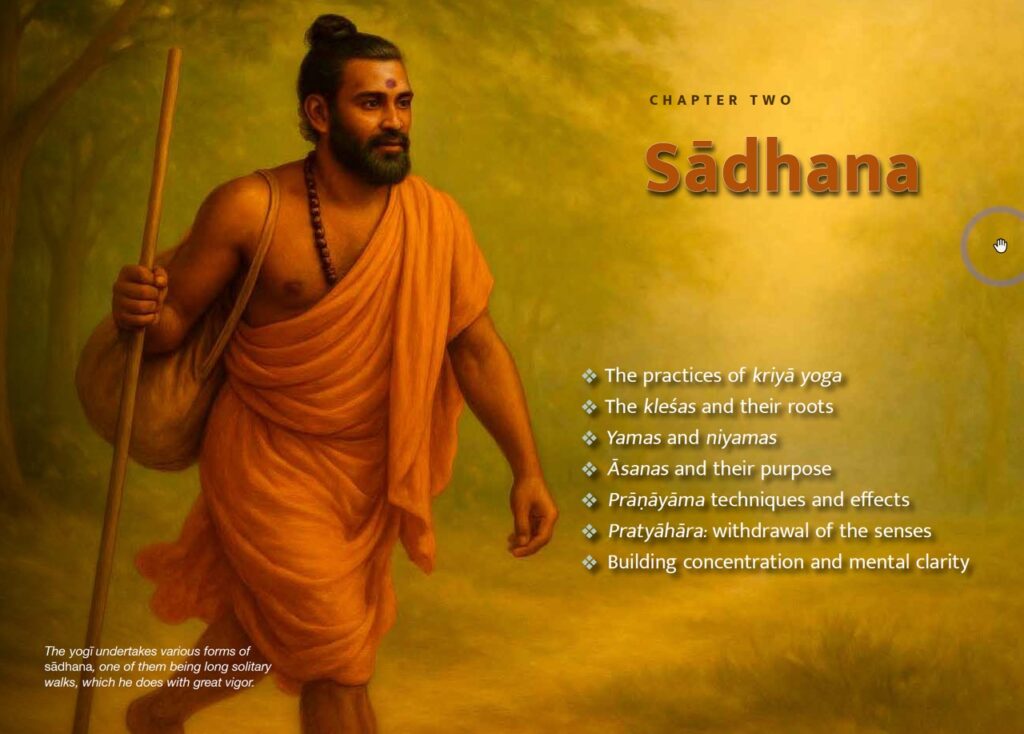
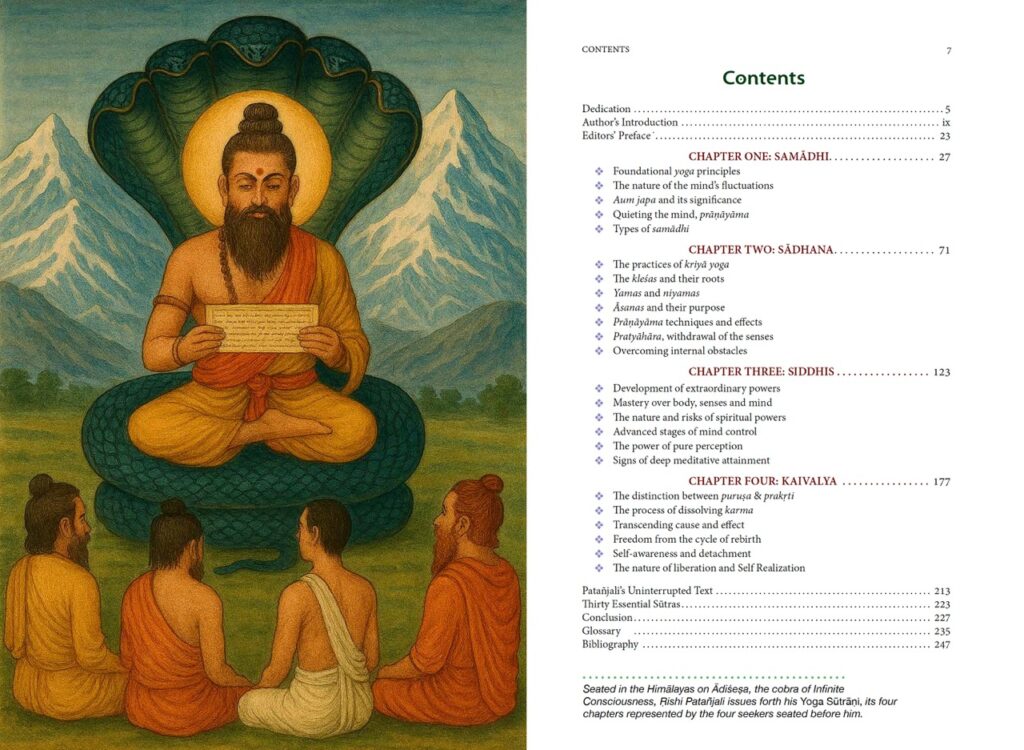
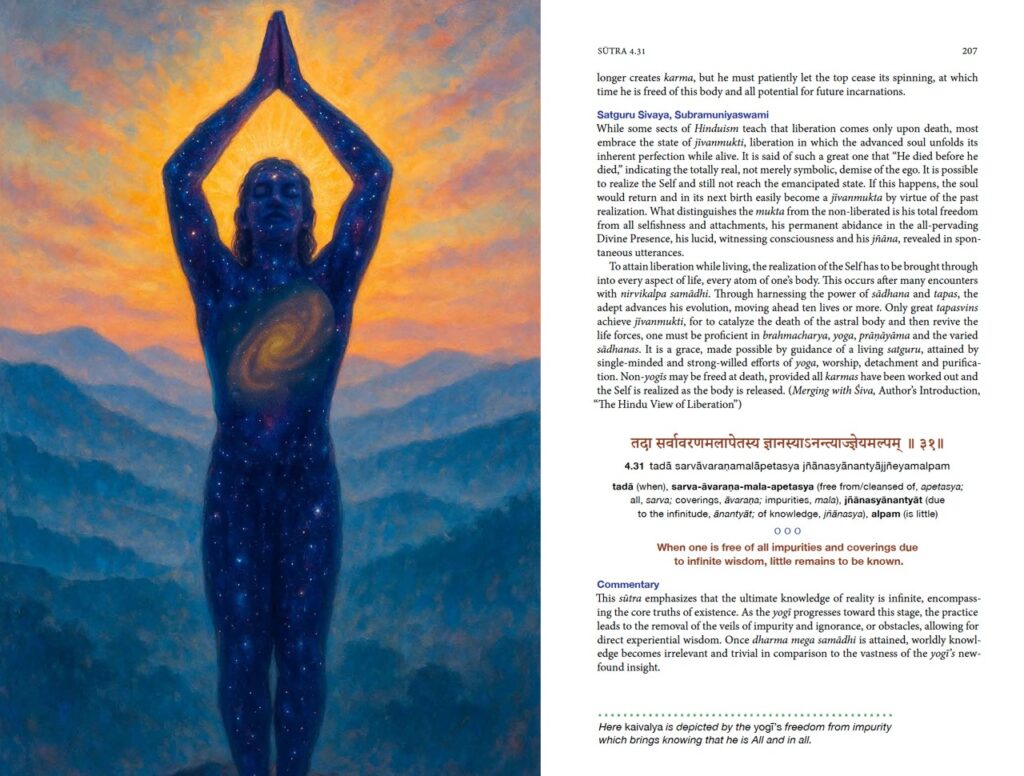
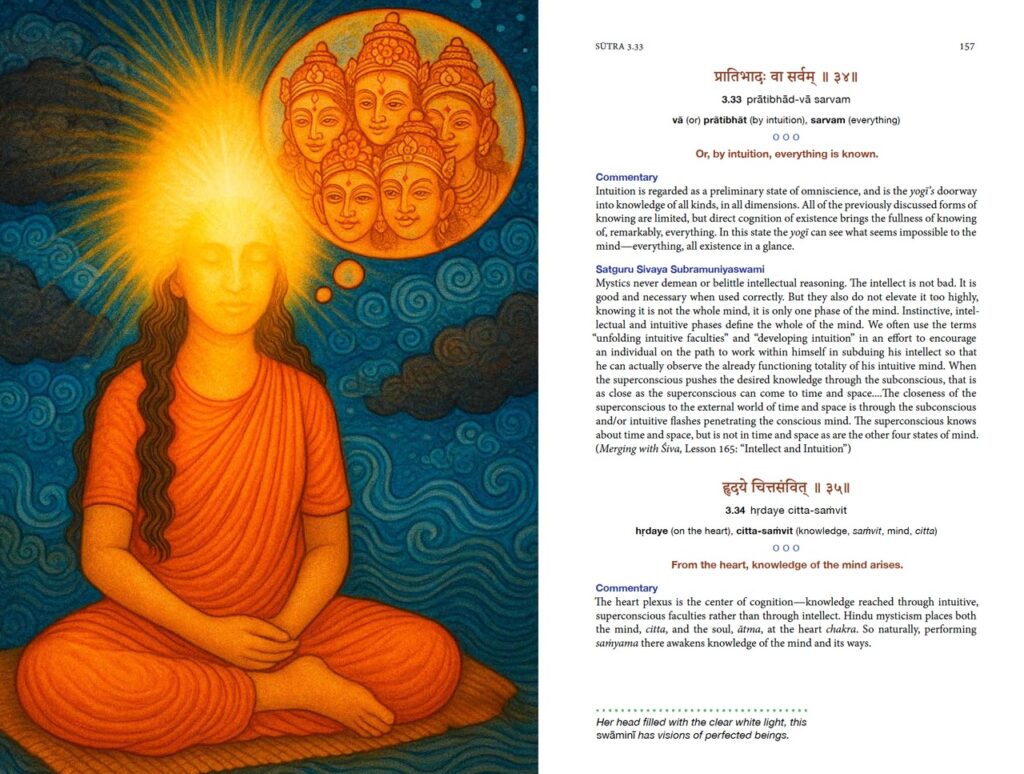
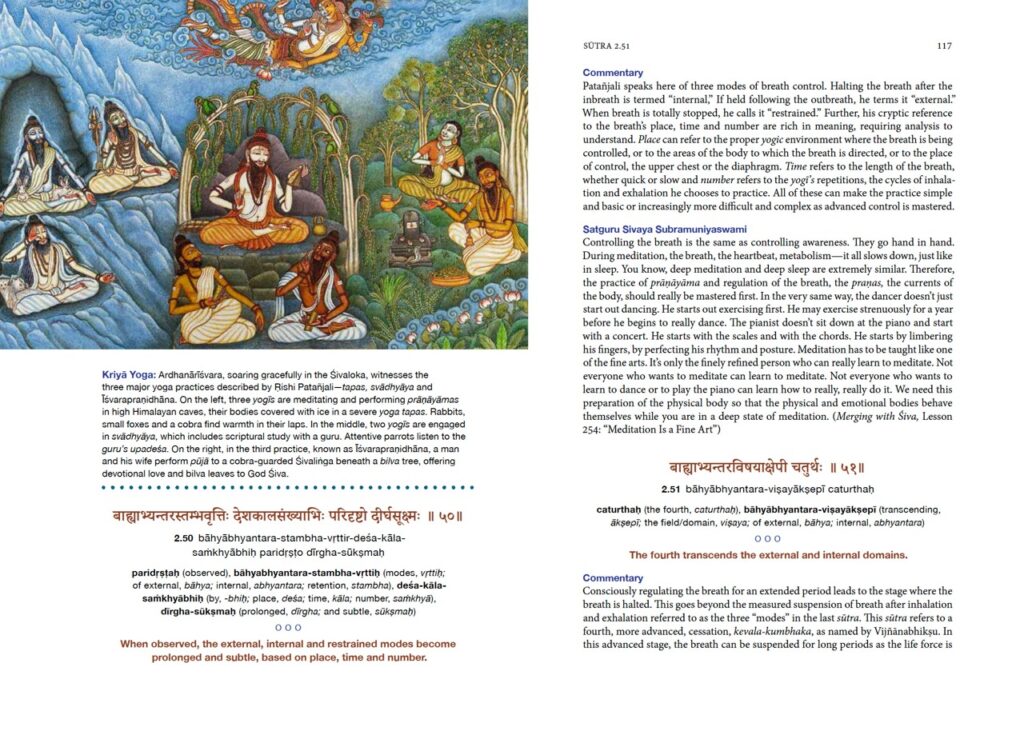
 One of the four spreads introducing the chapters.
- During Jeyendrapuri’s latest Kauai Visit
- Table of Contents
- Image depicting kaivalya, when the yogi sees he is in Siva and Siva is in him.
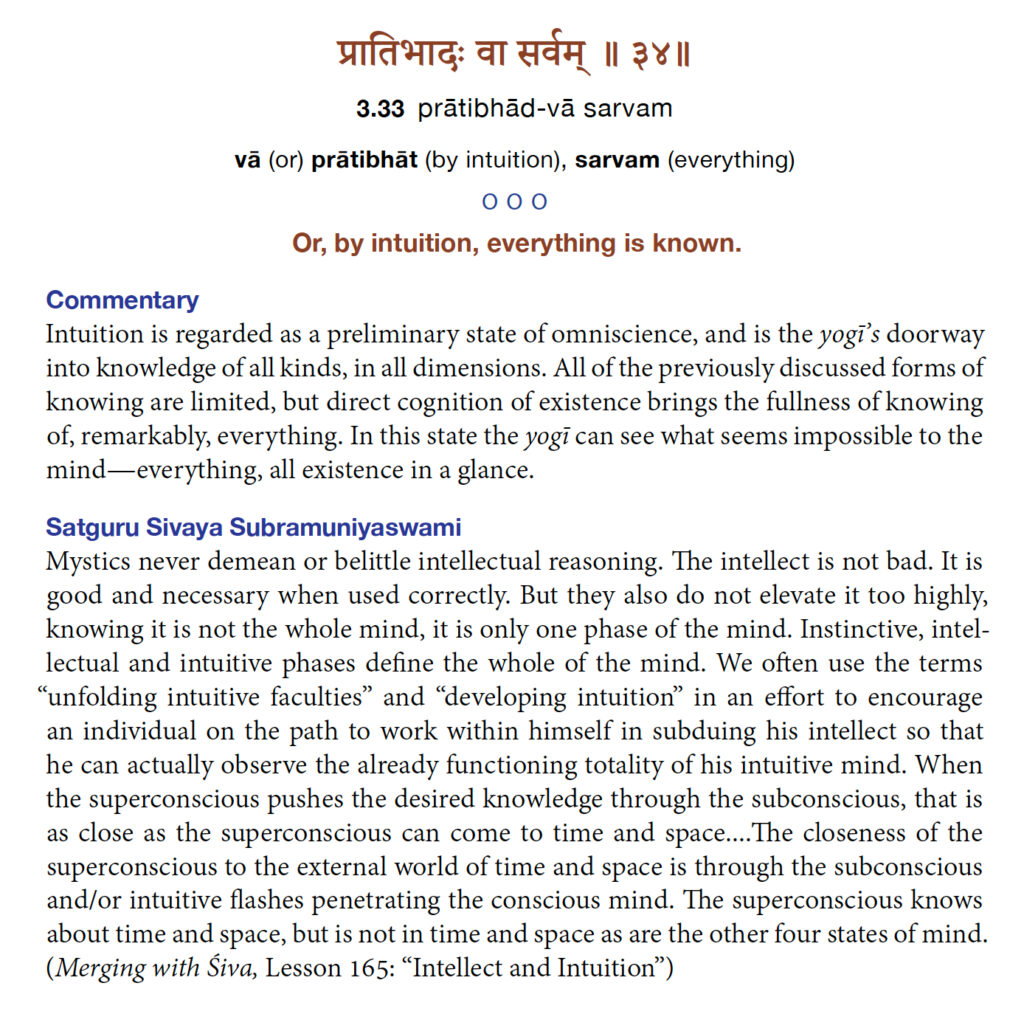
- A typical sutra, one of 196 in the text
- Her head filled with light, the swamini has visions of perfected beings.
- Ten of the art pieces are the work of Suresh Muthukulam, a Kerala muralist. Here he is depicting austerity, self-study and worship of God: tapas, svadhyaya and Ishvara pranidhana.
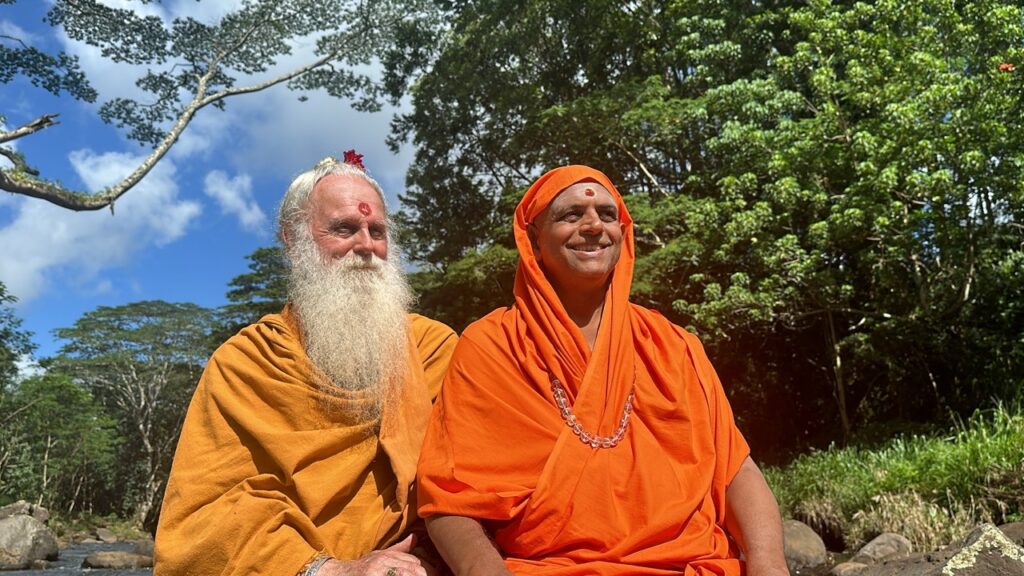
Bengaluru’s Jayendrapuri Swami Extols the Book
Last month we asked Jayenderapuri Swami to comment of Satguru Bodhinatha Veylanswami’s amazing Yoga Sutras book. Yesterday he responded with such a full-hearted assessment we wanted all CyberCadets to have it. Swami is uniquely positioned to comment on the book, having spent his life in its study and practice. You will enjoy his nuanced take on what makes Bodhinatha’s book unique.
Book Review of Patanjali’s Yoga Sutras
Swami writes: The perennial quest of mankind, as has been profoundly echoed through the sacred traditions of
Sanatana Dharma, is not merely to live, but to know—to realize, to awaken to that eternal, unchanging
Reality which shines as the very substratum of existence, the silent witness of all modifications, and the
immutable essence behind the ever-changing panorama of life. In this exalted pursuit, the timeless work
Patanjali’s Yoga Sutras stands as a radiant beacon, guiding earnest seekers toward the direct realization
of their own true nature.
At the very outset, one is struck not merely by the intellectual precision of the sutras, but by their deeply
experiential orientation. Unlike many philosophical treatises that dwell extensively in abstraction, the
aphorisms of Patanjali offer a direct and methodical pathway—an inner science—through which the
aspirant may transcend the limitations of the mind and abide in the supreme stillness of pure
consciousness. The celebrated declaration, yōgaś-citta-vr̥tti-nirōdhaḥ, encapsulates the entire
essence of this path. Yoga is not merely physical discipline, nor philosophical speculation; it is the
cessation of the fluctuations of the mind. If the restless modifications of the mind are the cause of
bondage, their mastery alone opens the gateway to liberation.
The rendering of these sutras by the Himalayan Academy, through the translation of Satguru Bodhinatha
Veylanswami, extracted from the treasury of works of Gurudeva Sri Sivaya Subramuniya Swami,
resonates deeply with the timeless wisdom of the Upanishads, wherein the mind is both the cause of
bondage and liberation. The text does not stand in isolation but is presented as part of the grand
continuum of Vedic and Agamic thought. The division into four padas—Samadhi, Sadhana, Vibhuti, and
Kaivalya—is not merely structural, but symbolic of the aspirant’s inner evolution: from the initial glimpse
of stillness, through disciplined practice, past the temptations of extraordinary attainments, and finally
into the consummation of absolute freedom.
Within this illuminating framework, the exposition of Ashtanga Yoga—the eightfold path—restores Yoga
to its original sanctity and completeness. Yama and Niyama are not external moral impositions but
essential purifications of the inner instrument. Asana becomes a means to steadiness rather than an
end in itself; Pranayama unfolds as mastery over the vital force; Pratyahara reveals the art of inward
withdrawal—not suppression, but transcendence. Dharana matures into Dhyana, and Dhyana
culminates in Samadhi, where the triad of knower, knowing, and known dissolves into non-dual
awareness.
Yet, what elevates this edition of Patanjali’s Yoga Sutras into a rare and luminous category is the
profound spiritual authority and experiential authenticity brought forth by Sivaya Subramuniyaswami,
reverentially addressed as Gurudeva Sri Sivaya Subramuniya Swami, and the deft, disciplined, andcompassionate exposition of Bodhinatha Veylanswami, revered as Satguru Sri Bodhinatha
Veylanswami.
It must be stated without reservation that the depth of knowledge embodied by Gurudeva Sri Sivaya
Subramuniya Swami is not merely intellectual. It is born of direct realization, refined through intense
tapas, and sanctified through decades of guiding seekers along the inner path. His insights are not
speculative commentaries but living truths—arising from the stillness of meditation and the clarity of
Self-experience. In his hands, each sutra becomes vibrant, pulsating with spiritual force, revealing
layers of meaning that remain hidden to superficial reading.
His grasp of the subtle workings of the mind is particularly extraordinary. When elucidating the
foundational principle of Yoga, he does not merely define mental restraint but leads the aspirant into a
direct encounter with the restless nature of consciousness itself. His words carry the authority of
realization, possessing the rare capacity to instruct, inspire, and transform simultaneously.
Equally remarkable is Gurudeva Sri Sivaya Subramuniya Swami’s integrative vision. He harmonizes the
rigorous discipline of Yoga with the devotional richness of temple-centered Hinduism, dissolving
artificial divisions between bhakti, karma, jnana, and raja yoga. For him, these are not separate paths
but complementary streams converging toward the same महासागरः of realization. This synthesis reflects
not only scholarship but an all-encompassing spiritual vision rooted in lived experience.
If Gurudeva represents the vast ocean of spiritual wisdom, then Satguru Sri Bodhinatha Veylanswami
stands as the master navigator who guides seekers across its depth with precision and grace. His
handling of the text is truly deft in the highest sense. He neither dilutes the profundity of the teachings
nor burdens the reader with unnecessary complexity. Instead, he unfolds the insights with clarity,
balance, and accessibility, ensuring that the essence remains intact while becoming approachable for
the modern aspirant.
Where Gurudeva’s voice resounds with the authority of realization, Satguru Sri Bodhinatha
Veylanswami’s exposition reflects the clarity of a teacher who has deeply internalized that wisdom. His
interpretations bridge the distance between ancient aphorism and contemporary understanding,
making the teachings immediately relevant without compromising their sanctity.
His treatment of the Vibhuti Pada is particularly commendable. In an age where fascination with siddhis
can easily distract the aspirant, he maintains unwavering focus on the ultimate goal. While
acknowledging these powers, he gently but firmly redirects attention toward the higher उद्दे श्यः—the
realization of the Self. Similarly, in the Kaivalya Pada, his exposition reveals philosophical clarity and
experiential depth, guiding the reader toward the recognition that liberation is not an attainment in time,
but the unveiling of one’s eternal nature.
A feature of exceptional significance in this work is its presentation of the Yoga Sutras through the
illuminating lens of Saiva Siddhanta—a perspective that is indeed rare and perhaps one of its kind in the
vast landscape of yogic literature. Traditionally, the sutras have been interpreted through various
philosophical frameworks; however, under the realized vision of Gurudeva Sri Sivaya Subramuniya
Swami and the refined articulation of Satguru Sri Bodhinatha Veylanswami, they are revealed through
the profound metaphysical and devotional framework of Saiva Siddhanta.
This approach is not merely interpretative but deeply revelatory. It brings into harmonious alignment the
disciplined psychology of Yoga with the rich theology of Saiva Siddhanta—where the relationship of Pati
(the Lord), Pasu (the soul), and Pasa (the bonds) provides a comprehensive understanding of spiritual
evolution. Here, the restraint of the mind is not an isolated practice but part of a larger journey toward
union with Lord Siva—not as an abstract principle, but as a living, experiential Reality.In this synthesis lies the true uniqueness of the work. It serves as a profound unifying force between two
of the most ancient streams of thought in Bharat—the analytical, introspective discipline of Yoga and
the devotional, metaphysical richness of Saiva Siddhanta. What may appear as divergent paths are
revealed here as complementary dimensions of the same eternal truth.
This unification carries immense significance for the modern aspirant. It affirms that spiritual life need
not be fragmented—that one may pursue deep meditation while remaining anchored in devotion, that
inner stillness and divine worship are not contradictory but mutually enriching. The ultimate goal
described by Patanjali as Kaivalya is shown to be in consonance with the Saiva Siddhanta realization of
union with Siva, dissolving conceptual boundaries and inviting a more holistic spiritual vision.
Throughout the text, one perceives a harmonious integration of dualistic and non-dualistic insights.
While distinctions are acknowledged for the sake of clarity, the culmination transcends all duality. This
delicate balance reflects the wisdom of the great masters who have celebrated the diversity of
expression while affirming the unity of essence.
The language of the work deserves special appreciation. It is at once elevated and accessible, imbued
with reverence yet free from unnecessary complexity. More importantly, it carries a subtle spiritual force.
This is not merely a text to be read, but a scripture to be lived. Each sutra is a seed; each reflection, a
call to introspection; each page, an invitation to transformation.
In the context of the modern world—marked by unprecedented external advancement and inner
unrest—the relevance of such a work cannot be overstated. The mastery of the outer world has not
yielded mastery of the inner. The Yoga Sutras address this imbalance at its very root, offering a timeless
pathway to inner harmony and ultimate freedom.
The role of the Guru, though subtle, pervades the entire work. The journey inward, while deeply personal,
is illumined by the guidance of those who have realized the Truth. In this regard, the combined presence
of Gurudeva Sri Sivaya Subramuniya Swami and Satguru Sri Bodhinatha Veylanswami transforms this
edition into a living transmission rather than a mere intellectual exercise.
Thus, what emerges is not simply a commentary, but a confluence—a sacred संगमः of realization,
discipline, devotion, and wisdom. It stands as a testament to the अखण्डता of Sanatana Dharma, where
diverse streams merge into the ocean of Truth.
In conclusion, Patanjali’s Yoga Sutras is not merely a philosophical treatise nor only a manual of
practice. It is a mirror wherein the aspirant beholds the Self, a मागगदर्गकः leading from ignorance to
knowledge, from restlessness to peace, from bondage to freedom.
May all who approach this sacred work, which has been worked on by Satguru Bodhinatha Veylanswami
and the senior swamis here for several years, with a goal of providing a translation and commentary in
the context of Saiva Siddhanta. with humility, श्रद्धा, and sincerity be blessed with the clarity to
understand, the strength to practice, and the grace to realize the supreme Truth.
With these reflections, we place this humble offering at the lotus feet of Patanjali, and bow in reverence
to Gurudeva Sri Sivaya Subramuniya Swami and convey our Om Namo Naarayanaaya and Om namah
Shivaaya to Satguru Sri Bodhinatha Veylanswami, whose wisdom continues to illumine the path of
countless seekers.
Om Shantih Shantih Shantih॥
Bodhinatha’s Yoga Sutras Acclaimed Read More »