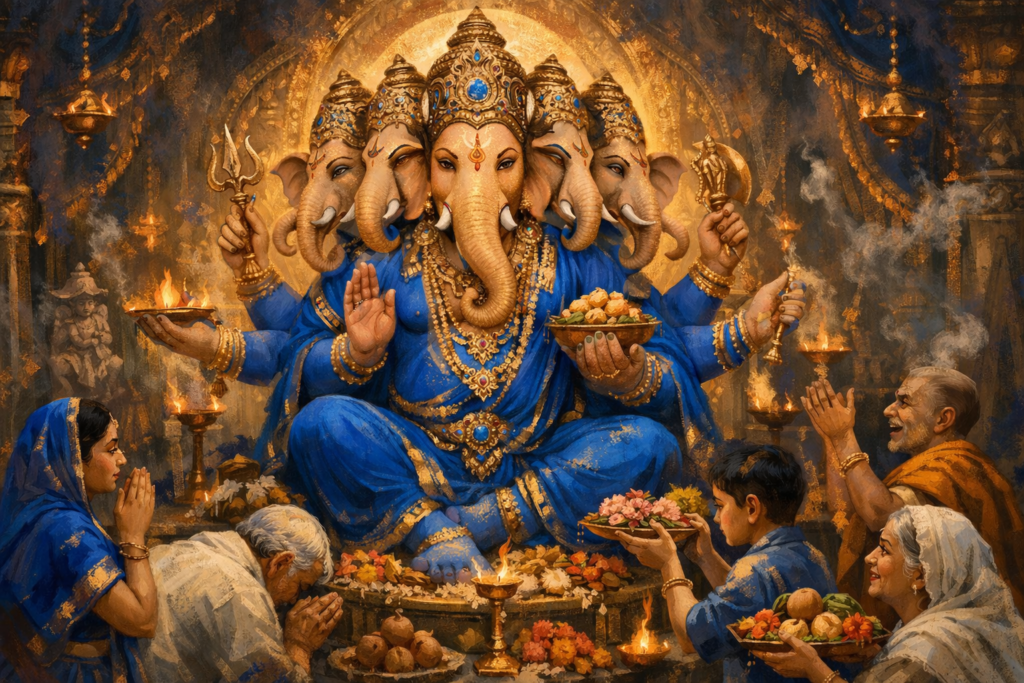
The family sadhana for the second day of Pancha Ganapati is to create a vibration of love and harmony among neighbors, relatives and close friends and present them with heartfelt gifts. Members of the family offer apologies and clear up any misunderstandings that exist beyond the home, among friends and neighbors. Relatives and friends in far-off places are written to or called, forgiveness is sought, amends made and tensions released. Gifts received are placed unopened before Pancha Ganapati.
For the full history and details of how families celebrate this Hindu holiday, you can follow the QR code or go to: panchaganapati.com
It’s day one and we begin with nurturing harmony among family members, those closest to us. The family sadhana for the first day of Pancha Ganapati is to create a vibration of love and harmony among immediate family members. The day begins early, with the entire family working together to design and decorate the shrine with traditional symbols, rangoli, lamps and more. The color of the day is yellow. A grand puja is performed invoking the spirit of Pancha Ganapati in the home. The sadhana of the day begins with the family sitting together for the purpose of easing any strained relationships that have arisen during the year. They make amends one with another for misdeeds performed, insults given, mental pain and injuries caused and suffered. Once forgiveness is offered to all by one and all, they speak of one another’s good qualities and resolve that in the days ahead they will remember the futility of trying to change others and the practicality of changing oneself to be the silent example for all to witness. Gifts are then exchanged and placed unopened before Pancha Ganapati.
The Five Śaktis of Lord Gaṇeśa
A Reverent Doxology by a Śaiva Paramāchārya
Loving Ganesha! Dear to Siva’s men,
Within whose form the world of form resides,
Who earned the mango by a pond’rous ken
And made the moon to wax and wane in tides.
Aum Ganesha! Loved by saints and sages,
Whose skillful arms five potent shaktis wield
To guide men now as in forgotten ages—
The seeker’s shield, the farmer’s fertile field.
Aum! Ganesha’s first shakti is home life,
Protection, harmony, fertility—
Respect becomes the man, as love the wife,
Obedience their cherished offspring’s glee.
Aum! Ganesha’s second shakti’s family—
By blood, by marriage and proximity.
Word and thought controlled, like minds agree,
While faithful friends preserve community.
Aum! Ganesha’s third shakti’s the market,
Where commerce earns the earth stability,
Where forthright, selfless merchants, free from debt,
Conceive, produce, exchange prosperity.
Aum! Ganesha’s fourth shakti brings culture—
Refined expression, graceful artistry
In music, dance, in poetry and sculpture
Or common conduct performed consciously.
Aum! Ganesha’s fifth shakti is dharma—
Fair merit found in virtue’s charity—
Where love of God conquers ancient karma
And Siva’s slaves earn grace’s rarity.
Jaya Ganesha! Come, our hearts protect
From discord in the home, from strife with friend,
Satguru Bodhinatha Veylanswami gives his weekly upadesha in Kadavul Temple at Kauai’s Hindu Monastery in Hawaii. It is part of a series of talks elaborating on the inspired teachings of Satguru Śivaya Subramuniyaswami as found in his book Merging With Śiva.
“The Hindu looks to the Gods for very practical assistance. He devoutly believes that the Gods from their dwelling in the Third World are capable of consciously working with the forces of evolution in the universe and they could then certainly manage a few simpler problems. He devoutly believes that the Gods are given to care for man on the planet and see him through his tenure on Earth, and that their decisions are vast in their implications. Their overview spans time itself, and yet their detailed focus upon the complicated fabric of human affairs is just as awesome.“
We continue to take each of the books that Gurudeva authored (or channeled, as is the case here) and create a audio version using his professionally cloned voice. Lemurian Scrolls is now complete and available here. The Editors’ Introduction for each chapter is rendered in a different voice.
“Every belief creates certain attitudes. Attitudes govern our actions. Our actions can thus be traced to our inmost beliefs about ourself and the world around us.“
“erforming daily sādhana, keeping good company, pilgrimaging to holy places, seeing to others’ needs——these evoke the higher energies, direct the mind to useful thoughts and avoid the creation of troublesome new karmas.“
“It is the interplay between our experience and how we respond to it that makes karma devastating or helpfully invigorating.“
“The only good decisions come to us when we hold the consciousness of the eternity of the moment and go within ourself for the answer.“
Jai Gurudeva!
Several days ago, during the Chitra nakshatra, we observed our monthly pada puja to Gurudeva. Monks and devotees gathered before sunrise in Kadavul Temple and enjoyed a padapuja performed by Sadhaka Shankaranatha and Yogi Haranandinatha.
“The guru helps the devotee to hold his mind in focus, to become pointedly conscious of thought, word and deed, and to cognize the lessons of each experience.” – Gurudeva
With the monastery’s observance of Sadhu Paksha having come to a close, we enter our next season today. We began the day with a homa and a parade out to change the flag. Here are reminders from Gurudeva, from his Saiva Dharma Shastras, detailing the significance and sadhanas of this inner season.
112 Introduction Beginning with Hindu New Year in mid-April, three seasons of the year divide our activities into three great needs of humankind–the learning of scripture in the first season, Nartana Ritau; the living of culture in the second season, Jivana Ritau; and the meditating on Siva in the third season, Moksha Ritau. Thus we are constantly reminded that our life is Siva’s life and our path to Him is through study, sadhana and realization. In ritau one, we teach the philosophy; in ritau two, we teach the culture; and in ritau three, we teach meditation.
120 The Third Season: Moksha Ritau The third period of the year, Moksha Ritau, the cool season, is from mid-December to mid-April. It is the season of dissolution. The key word is resolution. Merging with Siva: Hinduism’s Contemporary Metaphysics is the focus of study and intense investigation. The colors of this season are coral-pink, silver and all shades of blue and purple–coral for the Self within, silver and blue for illumination, and purple for enlightened wisdom. High above flies the coral flag, signaling Parasiva, Absolute Reality, beyond time, form and space. Moksha Ritau is a time of appreciation, of gratitude for all that life has given, and a time of honoring elders, those in the sannyasa stage of life. Moksha Ritau is excellent for philosophical discussions, voicing one’s understanding of the path through an enlightened intellect. In finance, it is the time for yearly accounting and reconciliation. On a mundane level it is a time of clearing attics, basements, garages, sheds, warehouses, workshops and desks, getting rid of unneeded things, of pruning trees, of streamlining life on the physical plane–of reengineering.